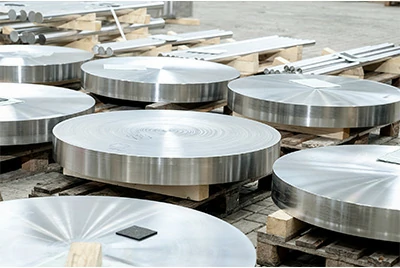
Titanium Forged Discs
Titanium forged discs are round forgings produced by forging titanium or titanium alloy billets under high temperature and pressure. Unlike titanium discs cut directly from plate, forging can refine the grain structure and internal microstructure, making the material more suitable for critical components such as aircraft engine discs and impellers where strength, fatigue performance and internal quality are important.
Chalco Titanium can supply large titanium forged discs with diameters of Φ400–2800 mm and thicknesses of 80–500 mm. Φ2300 mm titanium discs have already been delivered as finished machined products. Depending on the grade, part dimensions and service requirements, we can provide forged blanks, rough machining and subsequent machining services.
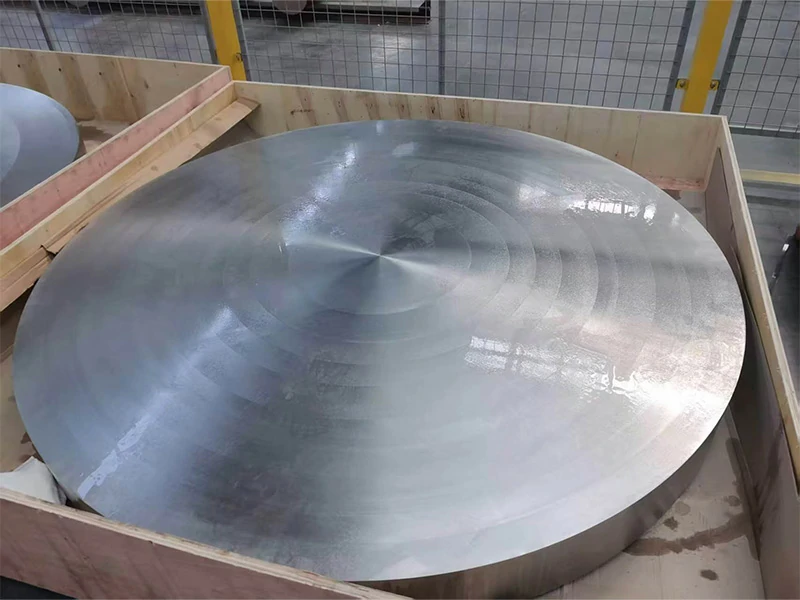
If your project has special requirements for titanium forged disc dimensions, grades, properties or inspection, send us your drawings or technical specifications. Chalco Titanium can recommend a suitable product solution based on the actual service conditions.
Titanium forged disc standards and certifications
- ASTM B381: Standard specification for titanium and titanium alloy forgings
- AS9100D / EN 9100:2018: Aerospace quality management system certification
- ISO 9001:2015: Quality management system certification
- AMS 2750: Titanium alloy heating furnaces meet the requirements of this standard
Titanium forged disc specifications and supply range
Chalco Titanium can provide titanium forged discs in multiple sizes and grades, supporting procurement needs from forged blanks through subsequent machining.
| Product form | Titanium forged disc / disc forging / forged disc blank |
| Diameter | Φ400–2800 mm |
| Thickness | 80–500 mm |
| Common grades | Grade 2, Grade 5, TA2, TC4; other grades available to order |
| Forging method | Open-die forging / rapid forging |
| Delivery condition | As-forged, rough-machined, machined |
| Machining support | Saw cutting, turning, vertical turning, milling |
| Inspection support | Chemical composition, mechanical properties, metallography, UT/PT, dimensional inspection |
Common titanium forged disc grades
Different titanium grades vary significantly in strength and corrosion resistance. Chalco Titanium commonly supplies Grade 2, Grade 5 and Grade 12, with material selection based on part loading, service environment and applicable standards.
-
Grade 2 titanium forged disc
Diameter: Φ400–2800 mm
Tensile strength: approx. 485 MPa
Yield strength: approx. 345 MPa
-
Grade 5 titanium forged disc
Diameter: Φ400–2800 mm
Tensile strength: approx. 985 MPa
Yield strength: approx. 885 MPa
-
Grade 12 titanium forged disc
Diameter: Φ400–2800 mm
Tensile strength: approx. 600 MPa
Yield strength: approx. 460 MPa
Titanium forged disc applications
Titanium forged discs are typically used as forged blanks for high-load, thick-section or corrosion-service components and are machined into final parts. Applications include aircraft engines, chemical equipment, energy equipment and large machinery.
Aircraft engine discs
Used as machining blanks for engine disc components and related high-load parts. Suitable for aerospace applications with higher requirements for strength, fatigue performance and cross-sectional microstructural uniformity.

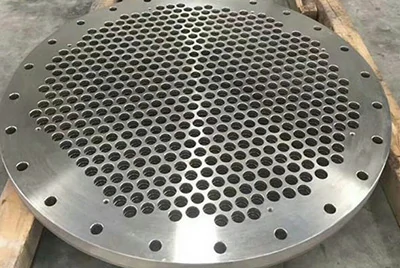
Flanges and tube sheets
Large-diameter titanium forged discs can be further machined into flanges, tube sheets and other disc-shaped parts for chemical equipment, heat exchangers and corrosion-service pressure systems.
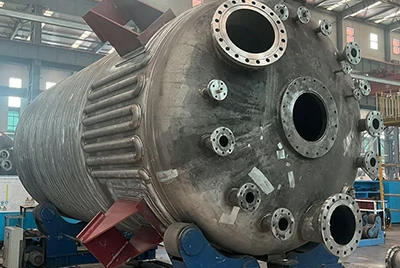
Pressure equipment and reactor components
Suitable for covers, pressure components and reactor-related parts where thick sections, corrosion resistance and high reliability are required.
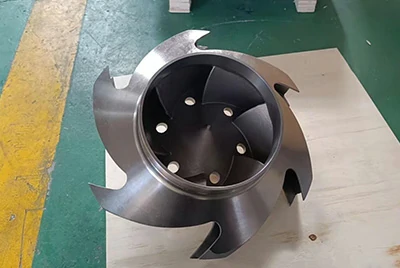
Pumps, valves and impellers
Can be used as forged blanks for impellers, valves and pump components in fluid-handling equipment requiring both mechanical load capacity and corrosion resistance.
If your project requires titanium forged discs for disc components, flanges, tube sheets, impellers or other large parts, contact Chalco Titanium for a solution suited to your project.
Large titanium forged disc manufacturing capabilities
Large titanium forged discs place higher demands on forging pressure, billet deformation capability and process stability. With large open-die forging equipment and experience in large forgings, Chalco Titanium can support the production of thick-section, high-unit-weight titanium alloy forgings.
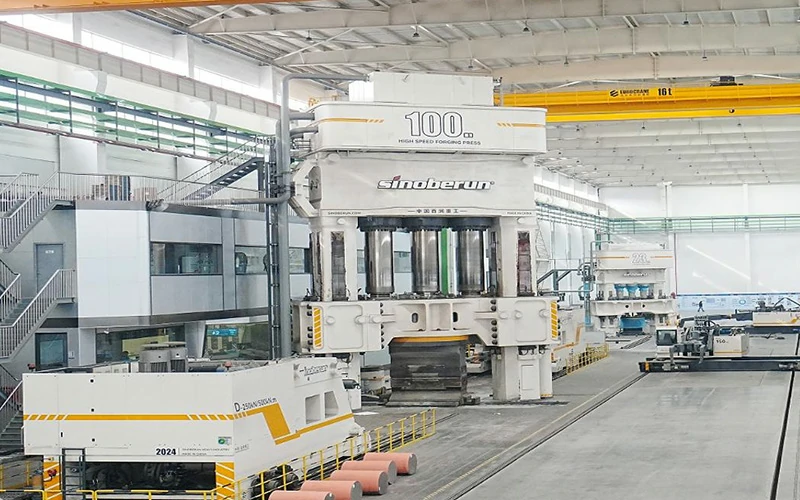
100MN forging capacity for deep-section deformation
The high-tonnage force of the 100MN open-die forging press, combined with high-frequency and high-speed forging, can be used for ultra-large titanium alloy billets with high deformation resistance. For thick-section titanium forged discs, more effective pressure transmission helps improve deformation in the center and overall microstructural uniformity.
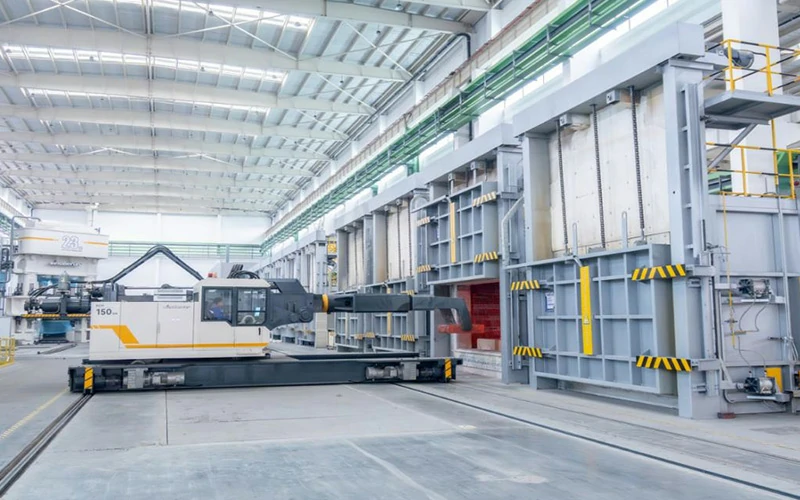
High-precision temperature control supports stable deformation of large billets
Large titanium billets require tighter temperature uniformity control during multiple forging heats. Heating furnaces can reach up to 1250℃; natural-gas furnace TUS can reach ±7℃, and electric-heating furnaces can reach ±5℃. Precise temperature control combined with high-tonnage forging provides more stable deformation conditions for thick-section billets.
Multidirectional forging improves microstructural uniformity in large forgings
Through upsetting, drawing, directional changes during upsetting and drawing, and repeated recrystallization forging, large billets undergo continued plastic deformation in multiple directions, reducing local dead zones with insufficient deformation. This process is more suitable for large-diameter, thick titanium alloy forgings with higher requirements for internal microstructural uniformity.
Large-size product experience
Experience with large titanium forgings includes TC4 Φ1050 mm titanium discs, GR5 Φ1500 mm and GR5 Φ2200 mm large titanium alloy forgings, providing a manufacturing basis for ultra-large-diameter and high-unit-weight titanium forged disc projects.
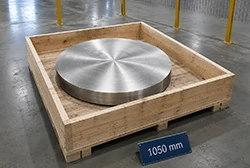
TC4 Φ1050 mm titanium forged disc
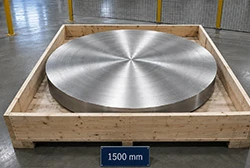
GR5 Φ1500 mm titanium forged disc
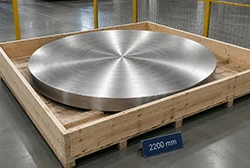
GR5 Φ2200 mm titanium forged disc
If your project requires large-diameter titanium forged discs, contact Chalco Titanium for product and project support.
Why are large titanium forged discs more difficult to manufacture?
As diameter, thickness and unit weight increase, the manufacturing challenge shifts from dimensional forming to internal quality control. Thick-section billets require a suitable balance of temperature, pressure and deformation path to achieve sufficient center deformation, microstructural uniformity and stable subsequent performance.
The center section requires sufficient forging deformation
The center of a large-diameter, thick-section billet is more difficult to deform sufficiently. Adequate forging pressure combined with appropriate upsetting, drawing and multidirectional forging can reduce localized under-deformation and transfer deformation more effectively into the center of the section.
Temperature uniformity directly affects deformation
Titanium alloys are sensitive to forging temperature, while large billets are more prone to temperature differences between the surface and center. Uniform heating helps maintain stable plastic deformation conditions. Heating furnaces on the forging line can reach up to 1250℃, with natural-gas furnace TUS of ±7℃ and electric-furnace TUS of ±5℃.
The forging path determines microstructural uniformity
Increasing forging pressure alone does not solve every problem. Multidirectional forging, directional changes during upsetting and drawing, and recrystallization control help distribute deformation more appropriately across different directions and locations, improving microstructural uniformity and property consistency in large forgings.
Titanium forged disc manufacturing process
Manufacturing large titanium forged discs requires continuous control of ingot quality, heating temperature, forging deformation and subsequent machining to maintain dimensional forming and internal microstructural stability.
- Raw material and melting: Prepare the charge by grade, make electrodes and carry out vacuum consumable-electrode melting to produce titanium and titanium alloy ingots with uniform composition and stable quality for large forgings.
- Billet heating: Heat uniformly according to the alloy process requirements and control the temperature difference between the surface and center of large billets to create stable conditions for subsequent plastic deformation.
- Breakdown forging: Use open-die forging for initial working of the ingot, breaking down the as-cast structure and producing the billet shape required for subsequent upsetting and drawing.
- Multidirectional upsetting and drawing: Apply upsetting, drawing and directional changes to provide more complete plastic deformation through thick sections and improve center deformation and microstructural uniformity.
- Disc forming: After multiple forging heats, progressively upset and size the billet while controlling final diameter, thickness and machining allowance to form the titanium forged disc blank.
- Heat treatment: Apply the required heat treatment according to the grade, property requirements and applicable standard to further stabilize the microstructure and mechanical properties.
- Rough machining: Remove surface stock by turning or vertical turning and prepare a suitable surface and dimensional condition for subsequent inspection and finish machining.
Titanium forged disc customization and machining
For large titanium forged discs that require further CNC machining, selecting an appropriate blank size and machining allowance can reduce material waste while leaving sufficient stock for dimensional control and inspection. Chalco Titanium can match the forged blank and machining plan to the final part drawing.
- Drawing-based customization: Determine the titanium forged disc blank size from the final part outside diameter, thickness, hole locations and structural requirements.
- Machining allowance: Reserve an appropriate allowance based on forging dimensions, surface condition and final machining requirements to avoid insufficient stock or excessive material removal.
- Rough machining: Pre-machine the outside diameter, end faces and other areas to remove the forged surface and prepare for finish machining.
- Machining support: Saw cutting, turning, vertical turning and milling are available, with the process selected according to product size and delivery requirements.
- Delivery condition: Supply is available as forged blanks, rough-machined parts or further-machined products to suit different downstream manufacturing needs.
If you already have the final part drawing, send it to Chalco Titanium and we can assist in determining a suitable forging blank size and machining allowance.
发送图纸
Titanium forged disc vs. plate-cut titanium disc
Titanium forged discs and discs cut directly from titanium plate differ significantly in manufacturing method and suitable applications. Forged blanks are generally more suitable for thick sections, large diameters or components with higher requirements for internal microstructure and load-bearing performance, while plate-cut discs may be more economical for thinner, simpler parts.
| Comparison item | Titanium forged disc | Plate-cut titanium disc |
| Manufacturing method | Titanium billet heated, upset/drawn and forged to shape | Cut directly from titanium plate |
| Thick-section capability | More suitable for thick-section, high-unit-weight blanks | Limited by available plate thickness |
| Internal microstructure | Microstructure can be controlled through forging deformation and heat treatment | Retains the original rolled-plate microstructure |
| Large load-bearing parts | More suitable as blanks for high-load components | More suitable for general discs and simple machined parts |
| Blank shape | Forging dimensions can be optimized for the final part | Mainly limited by original plate thickness and disc dimensions |
| Subsequent machining | Machining allowance can be reserved to part requirements | Typically machined from a constant-thickness disc |
| Typical uses | Engine discs, flanges, tube sheets, impellers and large machinery parts | Gaskets, general disc parts and thinner machined components |
If the final part has a large thickness, high load or higher internal-quality requirements, titanium forged discs should be evaluated first. For simpler, thinner parts, forging and plate cutting can be compared based on cost and performance requirements.
How does Chalco Titanium control titanium forged disc quality?
Chalco Titanium verifies titanium forged disc quality through multiple inspection dimensions, including composition, properties, internal quality, microstructure and dimensions. Specific inspection items can be determined according to the applicable standard, product specification and customer purchasing requirements.
Chemical composition testing
Spectrometric and elemental analysis is used to test major alloying and impurity elements, confirm the material grade and chemical composition against the applicable standard, and reduce the risk of material mix-ups and composition deviations.
Mechanical property testing
Tensile, hardness and other tests are used to verify the mechanical properties of titanium forged discs, including tensile strength, yield strength and other properties required by the customer or applicable standard.
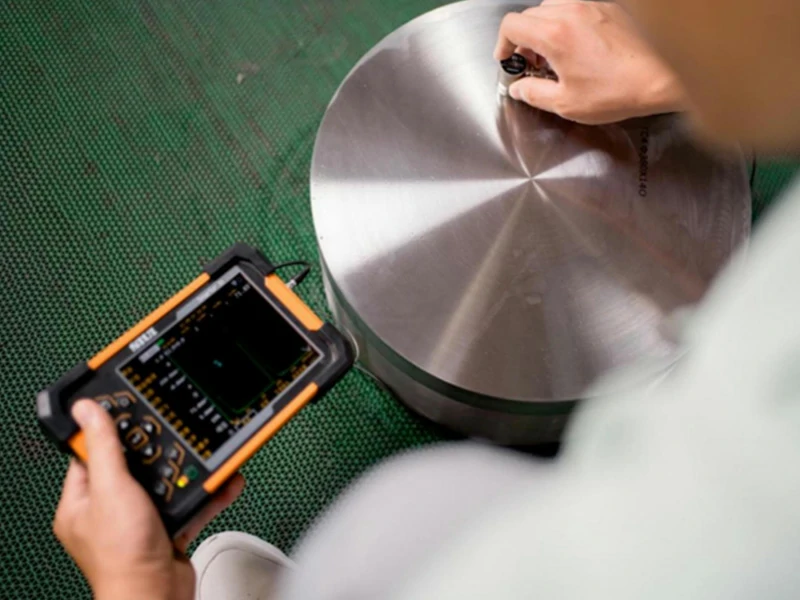
UT ultrasonic testing
Ultrasonic testing is used to inspect the internal quality of titanium forged discs and identify internal discontinuities. For large-diameter, thick-section discs, the inspection scope and acceptance requirements can be determined by the drawing or purchasing specification.
Metallographic examination
Microstructural analysis is used to examine the structure after forging and heat treatment and verify whether it meets the applicable technical and acceptance requirements.
Surface quality inspection
The surface of each titanium forged disc is inspected for cracks, folds and other surface defects that may affect subsequent machining or service.
Dimensional inspection
Diameter, thickness, roundness and critical machined dimensions are inspected to confirm that the delivered dimensions match the drawing, tolerances and order requirements.
Inspection reports and quality documents
Material certificates, inspection reports and other quality documents can be provided according to order requirements, maintaining traceability between the product, material batch and inspection results for customer acceptance and quality tracking.
Related products
In addition to titanium forged discs, Chalco Titanium can provide multiple types of large titanium alloy forgings for structural parts, load-bearing components and subsequent machining.
Titanium forged tube
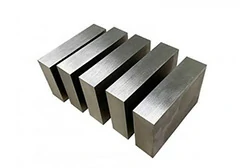
Titanium forged block
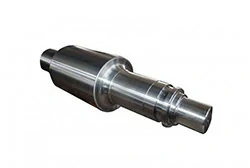
Titanium forged shaft
Titanium forged disc FAQs
How large can a titanium forged disc be?
Chalco Titanium can supply titanium forged discs with diameters of Φ400–2800 mm and thicknesses of 80–500 mm. For ultra-large-diameter, thick-section or high-unit-weight products, actual manufacturing capability depends on the grade and final dimensions.
Which titanium alloys are suitable for titanium forged discs?
Common materials include Grade 2, Grade 5, Grade 12 and other industrial or high-strength titanium grades. Different grades vary in strength, corrosion resistance and service temperature, so material selection should be based on the final part's operating environment.
Can titanium forged discs be manufactured directly to final part drawings?
Yes. For disc components, flanges, tube sheets, impellers and similar parts, the forged blank size and machining allowance can be designed from the final drawing, with delivery in the as-forged, rough-machined or further-machined condition.
How is center quality controlled in large titanium forged discs?
Large-diameter, thick-section titanium forged discs require sufficient forging deformation, appropriate upsetting and drawing paths, and temperature control to improve deformation in the center. Internal quality can then be verified by UT and other specified inspection methods.
What nondestructive testing is available for titanium forged discs?
UT ultrasonic testing and other specified nondestructive testing can be performed according to project technical requirements. The specific method, coverage and acceptance level should be determined by the applicable standard or customer purchasing specification.
How should you choose between an as-forged blank and a rough-machined titanium forged disc?
Customers with large titanium machining capability can select an as-forged blank and complete subsequent machining in-house. If the goal is to reduce surface stock and material removal, a rough-machined condition can be selected with machining allowance reserved for the final part.
Titanium forged disc quotation
If your project requires titanium forged discs, please provide the material grade, outside diameter, thickness, quantity, delivery condition and inspection requirements.
If a final part drawing is available, please send it as well. Chalco Titanium can confirm the blank size, machining allowance and quotation based on the drawing and technical requirements.