

3D Printed Titanium Part
Updated : Nov. 2, 2026Chalcotitanium provides custom 3D printed titanium alloy parts based on 3D models and engineering drawings, with Ti-6Al-4V as the primary material option. These parts are suitable for complex geometries, lightweight structures, internal flow channels, and custom components that are difficult to produce through conventional machining.
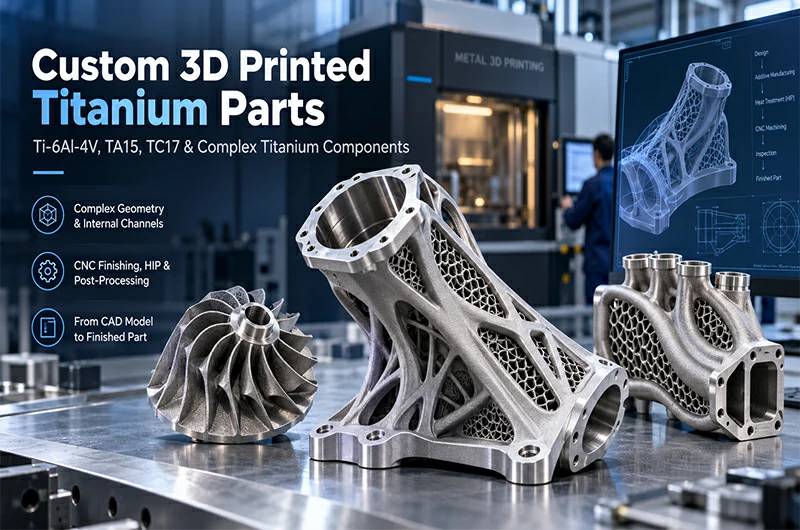
From additive manufacturing through subsequent finishing, a manufacturing plan can be configured based on part geometry, dimensions, tolerances, surface condition, and service requirements to support production from complex designs to finished titanium parts.
Ti-6Al-4V Titanium: Suitable for 3D printed titanium parts with strength, weight, and complex-geometry requirements.
Complex Custom Geometry: Supports additive-manufacturing designs such as complex curved surfaces, internal channels, lightweight structures, and integrated geometries.
Finished Part Solutions: Combines 3D printing with subsequent finishing to provide a more complete part-manufacturing solution for critical dimensions, mating surfaces, and final surface requirements.
Custom 3D Printed Titanium Part Options
Chalcotitanium can customize 3D printed titanium alloy parts with different geometries based on 3D models and engineering drawings. The manufacturing plan is developed around part geometry, critical dimensions, assembly relationships, and final service requirements. For parts with complex surfaces, internal channels, lightweight structures, or numerous conventional machining operations, additive manufacturing can offer a more flexible way to realize the design.
-
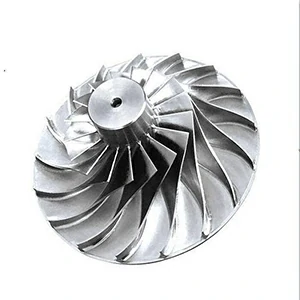 Functional Titanium Alloy Parts
Customized according to the part's actual function, assembly relationships, and engineering drawings. Suitable for functional titanium alloy components with defined geometry, dimensions, and service-performance requirements.
-
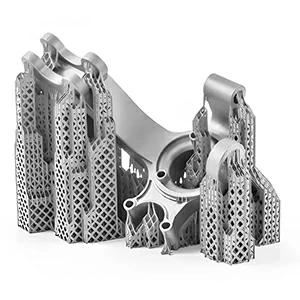 Complex-Geometry Titanium Parts
Suitable for complex curved surfaces, thin walls, irregular connection areas, and integrated multi-feature structures. This can reduce the dependence of some complex parts on repeated setups and multiple cutting operations.
-
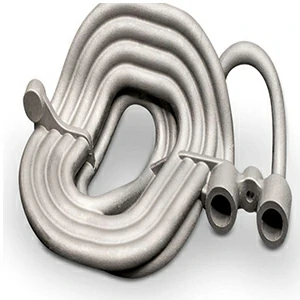 Parts with Internal Channels and Integrated Structures
Can be used for titanium alloy parts with internal passages, flow channels, and integrated structures, providing more design flexibility for fluid transport, thermal management, and multi-part integration.
-
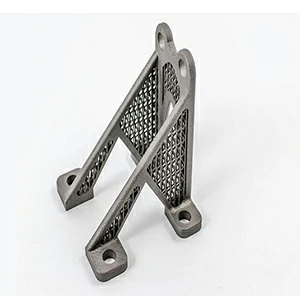 Lightweight and Topology-Optimized Parts
Suitable for titanium alloy components designed for lightweighting or topology optimization. Local weight reduction, hollowed features, and complex support structures can be realized based on part loads and structural requirements.
-
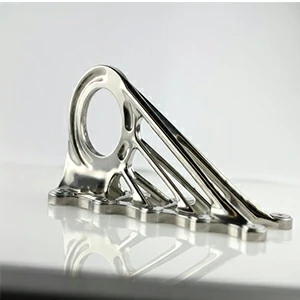 Finished Titanium Parts
For parts with critical dimensions, mating surfaces, holes, threads, or surface requirements, subsequent finishing and surface treatment can bring the 3D printed part to the finished condition required for assembly and service.
Titanium Alloy Material Options
Chalcotitanium can supply multiple titanium alloys suitable for additive manufacturing, including Ti-6Al-4V (TC4), TC17, TA15, TC21, Ti60, Ti65, and Ti2AlNb. The appropriate material can be selected based on part geometry, mechanical-property requirements, operating temperature, and service environment. The available material systems range from commonly used titanium alloys to high-performance and high-temperature grades for different types of complex 3D printed titanium parts.
-
Ti-6Al-4V / TC4
Offers balanced overall properties and is a commonly used material for titanium alloy additive manufacturing. Often used for complex structural parts, lightweight components, brackets, housings, and functional parts.
-
TA15
Suitable for projects with demanding structural-performance and lightweighting requirements. Often used for aerospace structural parts, load-bearing structures, and complex thin-walled components.
-
TC17 / TC21
For titanium alloy parts with relatively high strength and load-bearing requirements. Often used for high-load structural parts and high-performance engineering components.
-
Ti60 / Ti65
Suitable for projects with demanding service-temperature and high-temperature performance requirements. Often used for high-temperature structural parts and aerospace propulsion-related components.
-
Ti2AlNb
For high-temperature, lightweight, and high-performance structural requirements. Often used for lightweight high-temperature structures and advanced aerospace components.
-
Other Titanium Alloys
Matched according to material properties, part geometry, and project requirements. Often used for special grades and custom additively manufactured parts.
For each titanium alloy, material and process matching can consider powder chemical composition, apparent density, tap density, flowability, and powder morphology, as well as the microstructure, porosity, mechanical properties, and heat-treatment schedule after forming. The internal material database covers multiple metal material systems and additive-manufacturing development for multiple grades, supporting a corresponding material and manufacturing plan for each part.
Material selection does not need to be limited to one grade. Projects with specified material requirements can be manufactured according to customer drawings and technical specifications. When the material has not yet been determined, a more suitable titanium alloy can be selected based on load, operating temperature, geometric complexity, and final performance requirements.
3D Printed Titanium Part Production Capabilities
Chalcotitanium has integrated capabilities from metal 3D printing through post-processing, precision machining, and finished-part inspection. A corresponding manufacturing plan can be configured based on part dimensions, geometric complexity, and final service requirements.
3D printing process: SLM / laser powder bed fusion
SLM equipment: More than 70 machines
Build envelope: From small-format systems up to 400 mm to meter-scale systems up to 1500 × 1500 mm
Maximum SLM build size: 1500 × 1500 × 1500 mm
Complex geometries: Thin walls, internal channels, lattice structures, topology optimization, and integrated structures
Post-processing: Powder removal, support removal, heat treatment, hot isostatic pressing, wire cutting, and abrasive flow machining
Finishing: CNC machining, grinding, polishing, shot peening, sandblasting, and surface treatment
Inspection: CMM, blue-light scanning, roughness measurement, mechanical testing, digital X-ray, fluorescent penetrant inspection, and industrial CT
The available equipment covers metal additive-manufacturing requirements across different size ranges, supported by post-processing, machining, and inspection. A 3D printed blank can be further processed into a titanium alloy part that meets drawing requirements for critical dimensions and finished-part inspection.
Post-Processing and Finishing Options
Chalcotitanium can configure post-processing and finishing operations based on the material condition, geometric features, dimensional tolerances, surface requirements, and final service conditions of each 3D printed titanium part. The available production chain covers powder removal, wire cutting, heat treatment, hot isostatic pressing, abrasive flow machining, mechanical machining, precision polishing, and surface treatment.
| Post-Processing Method | Primary Purpose |
| Powder and Support Removal | Removes residual powder and support structures after forming in preparation for subsequent processing and inspection |
| Heat Treatment | Adjusts the material microstructure and property condition, using the appropriate heat treatment for part requirements |
| Hot Isostatic Pressing (HIP) | Used for parts with demanding internal-density, defect-control, and overall performance requirements |
| Wire Cutting | Separates printed parts from the build plate and can be used for some contour or structural processing |
| Precision CNC Machining | Machines critical dimensions, holes, threads, mating surfaces, and other high-precision functional areas |
| Abrasive Flow Machining | Treats the internal surfaces of complex flow channels and areas that conventional tools cannot reach |
| Grinding and Precision Polishing | Improves part surface condition and surface roughness |
3D printed titanium parts do not all use the same post-processing route. The specific processes should be combined according to material grade, part geometry, critical dimensions, tolerances, surface quality, and performance requirements. For example, abrasive flow machining can be used for complex internal channels, while parts with high-precision mating surfaces, holes, or threads can undergo CNC finishing after printing.
Typical 3D Printed Titanium Alloy Parts
3D printed titanium alloy parts can be designed and manufactured for the lightweighting, complex-geometry, functional-integration, and customization needs of different applications. Project experience covers aerospace, low-altitude aircraft, robotics, consumer electronics, medical applications, and other fields. Topology optimization, lattice structures, and integrated design can also be combined to manufacture complex titanium alloy components.
Aerospace Structural Parts
For aerospace brackets, hinges, door mechanisms, and load-bearing structures. Topology optimization reduces weight and part count while maintaining functional performance.
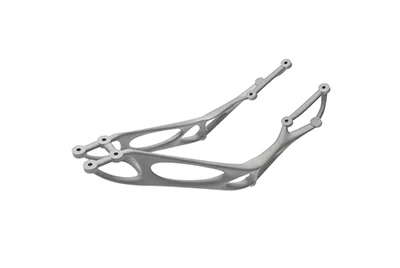
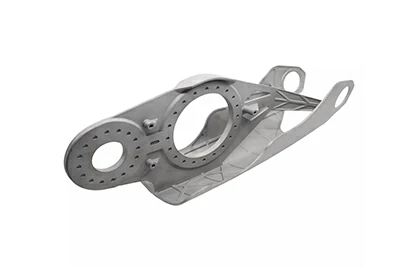
Titanium Robot Components
For robot shells and moving components requiring low weight, high stiffness, and complex geometries. Topology-optimized designs help reduce overall part weight.
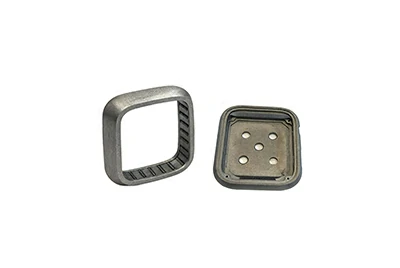
Consumer Electronics Parts
For hinge covers, watch cases, and compact titanium structures. 3D printing supports complex shapes and highly integrated consumer-electronics designs.
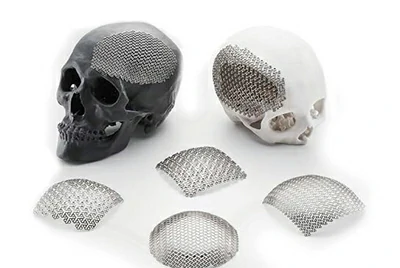
Custom Medical Components
For custom cranial mesh and other patient-specific titanium components. Digital modeling supports personalized structures based on anatomical data.
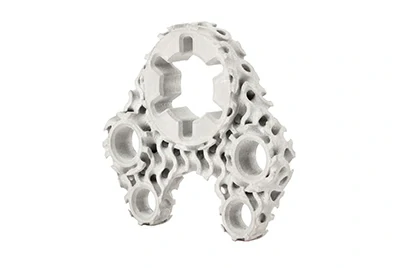
Topology-Optimized Parts
For lightweight parts requiring optimized load paths or specialized functions. Options include lattice, honeycomb, biomimetic, and integrated structures.
Performance Validation and Quality Control
The performance of 3D printed titanium alloy parts is closely related to the material grade, forming process, and heat-treatment condition. Chalcotitanium has established an additive-manufacturing material and process database for validating microstructure, porosity, density, tensile properties, hardness, fatigue, and other characteristics. An inspection plan can be developed around the part's final delivery condition.
Mechanical Properties and Material Validation
| Validation Item | Testing Capability |
| Tensile Properties | Room-temperature and high-temperature tensile testing |
| Hardness | Vickers, Brinell, and Rockwell hardness testing |
| Density and Porosity | Density, porosity, and metallographic analysis |
| Microstructure | Metallography, scanning electron microscopy, and material microstructure analysis |
| Fatigue and Fracture Properties | Evaluation of fatigue, fracture toughness, crack growth, and other properties |
| Chemical Composition | ICP-OES and analysis of O, N, H, and other elements |
The available inspection platform includes room-temperature and high-temperature tensile testing equipment and multiple hardness testing systems. Part performance can be verified according to the material grade and heat-treatment or HIP condition.
Quality and Finished-Part Inspection
| Quality Control Item | Inspection Method |
| Raw Materials and Powder | Chemical composition, particle size, flowability, morphology, and batch consistency |
| Dimensions and Geometry | CMM, blue-light scanning, 2D projection, and height measurement |
| Surface Quality | Roughness, cylindricity, and dimensional inspection |
| Internal Quality | Industrial CT and digital X-ray inspection |
| Surface Defects | Fluorescent penetrant inspection |
| Batch Management | Traceability of raw materials, manufacturing, and quality processes |
Inspection capabilities cover multiple quality stages from raw powder to finished 3D printed parts. A quality traceability system is in place, and dimensional, performance, and nondestructive inspection items can be selected based on drawings, part geometry, and service requirements.
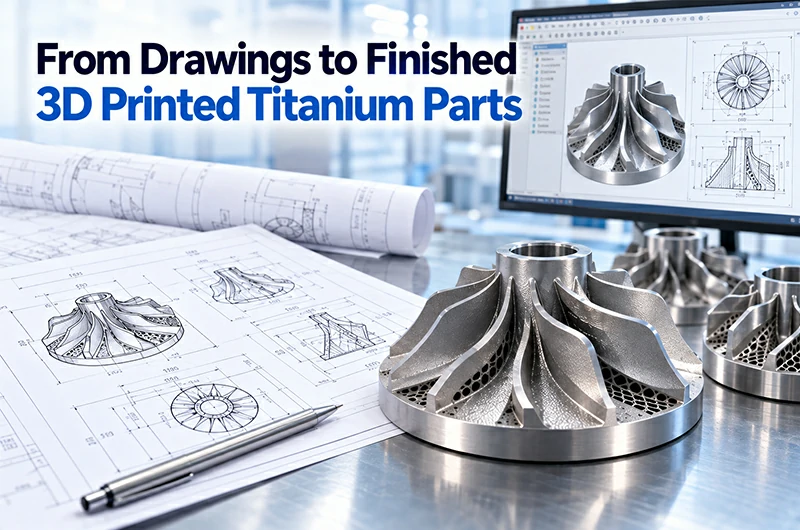
From Drawings to Finished 3D Printed Titanium Parts
Chalcotitanium can develop a manufacturing plan based on customer 3D models, engineering drawings, and part technical requirements, integrating additive manufacturing, post-processing, precision machining, and quality inspection into a complete finished-part delivery process.
Submit 3D model / engineering drawing → Engineering and process review → Material and manufacturing plan confirmation → 3D printing → Heat treatment / HIP / post-processing → CNC finishing and surface treatment → Dimensional, performance, and nondestructive inspection → Finished-part delivery
For projects where the material, post-processing, or inspection plan has not been fully determined, the manufacturing route can be further defined based on part geometry, critical dimensions, service environment, and final performance requirements.
FAQ
Which titanium alloys are available for 3D printed titanium parts?
Available titanium alloy materials include Ti-6Al-4V (TC4), TA15, TC17, TC21, Ti60, Ti65, and Ti2AlNb. The specific grade can be selected based on part strength requirements, operating temperature, geometric features, and service environment.
What tolerances can 3D printed titanium parts achieve?
The dimensional accuracy of 3D printed parts is affected by part size, geometry, build orientation, and post-processing method, so one uniform tolerance value is not recommended for all parts. Machining allowance can be reserved for mating surfaces, holes, threads, and other critical dimensions, which can then be controlled through CNC finishing. Dimensional inspection can be performed with CMMs, blue-light scanning, and other methods.
Can 3D printed titanium parts undergo CNC finishing?
Yes. After 3D printing, CNC machining can be used on critical dimensions, mating surfaces, holes, threads, and other functional areas. Grinding, polishing, sandblasting, or other surface treatments can then be applied according to part requirements. The available manufacturing process covers 3D printing, post-processing, machining, surface treatment, and inspection.
Do all 3D printed titanium parts require HIP?
No. Whether HIP is used should be determined based on the titanium alloy grade, part geometry, internal-quality requirements, mechanical-property requirements, and project specifications. HIP can be included in the post-processing plan for some parts with demanding density, internal-defect, or performance-stability requirements. Other parts can use an appropriate heat-treatment process based on actual requirements.
What files should be provided for a quotation?
A 3D CAD model is recommended, together with a 2D engineering drawing whenever possible, to define critical dimensions, tolerances, hole locations, threads, surface condition, and other technical requirements. If some material, post-processing, or inspection requirements have not yet been determined, the available models and drawings can still be submitted for project evaluation.
Can you manufacture titanium parts with internal channels, lattice structures, and topology optimization?
Yes. The available additive-manufacturing capabilities cover topology optimization, lattice structures, honeycomb and biomimetic structures, conformal flow channels, and structural integration. These capabilities can be used for complex titanium alloy parts that are difficult to produce directly through conventional machining.
3D Printed Titanium Part Quotation
To evaluate the part geometry, manufacturing process, and quotation more accurately, please provide the following project information with your inquiry.
Required Information
- 3D model
- Titanium alloy grade
- Required quantity
- Main part dimensions
Recommended Information
- 2D engineering drawing
- Critical dimensions and tolerances
- Surface roughness requirements
- Heat-treatment requirements
- HIP requirements
- CNC finishing requirements
- Inspection and acceptance requirements
- Service environment or applicable standard
- If some technical requirements have not yet been determined, you can first provide the 3D model and available drawings. We can evaluate the project based on part geometry and service requirements.


