

MMO Titanium Anodes for Cathodic Protection (ICCP)
Updated : Sep. 3, 2026In an impressed current cathodic protection (ICCP) system, MMO titanium anodes serve as the auxiliary anodes that deliver protective current to the steel structure being protected.
Henan Chalco supplies MMO titanium anodes in both Ir-Ta and Ru-Ir coating systems, in formats covering tubular, deep well, ribbon, mesh, wire and disc.
Why titanium is used as the anode substrate
Commercially pure titanium for ICCP anodes is normally Grade 1 or Grade 2 — TA1 and TA2 under the Chinese designation system — with material requirements referenced to ASTM B265, ASTM B338 or ASTM B348.
There are three reasons titanium is selected:
- Low density, with mechanical strength sufficient for groundbed installation and marine service conditions;
- Good corrosion resistance in the acidic interfacial environment created by oxygen- or chlorine-evolution reactions;
- When a local coating defect occurs, the exposed titanium surface forms a protective oxide film that limits propagation of the damage.
One common question is worth clearing up: in an ICCP circuit, the MMO titanium anode connects to the positive terminal of the rectifier and operates as the anode, while the protected steel structure is the cathode. The electrochemical reaction at the anode surface, however, takes place on the coating — titanium's role is to conduct current reliably to the coating interface.
MMO anode formats — at a glance
| Format | Typical environment | Typical application | Selection note |
| Tubular / Multi-Segment | Soil, coke breeze backfill | Deep well and shallow groundbeds | Set quantity by rated current per anode |
| Canister (Deep Well) | Soil | Pre-packaged backfill groundbed | Simplifies site installation work |
| Ribbon / Conductive Bar | Sand, concrete | Tank bottoms, concrete structures | Set spacing by current per unit length |
| Mesh / Expanded Mesh | Concrete, water | Uniform area protection | Select by current per unit area |
| Wire / Flexible Linear | Soil | Close-coupled current distribution over long runs | Low current, evenly distributed applications |
| Rod / Probe / Discrete / Disc | Water, inside equipment | Localized and internal protection | Check the mounting interface type |
Tubular and multi-segment tubular anodes
Built on a titanium tube substrate, tubular anodes are the mainstay format for deep well and shallow groundbeds, and can be configured in multiple segments according to groundbed depth.
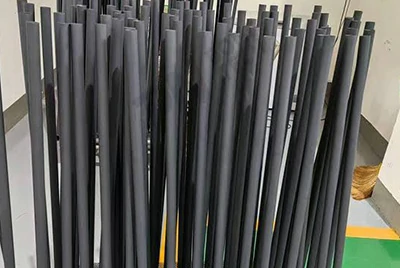
The ends are usually threaded for connection to extension rods or mounting accessories, which also makes segment assembly on site straightforward.
Canister (Deep Well) anodes
The anode and coke breeze backfill are pre-packaged inside a canister and lowered into the hole as a single unit on arrival, reducing site backfilling work and the risk that comes with uneven backfill.
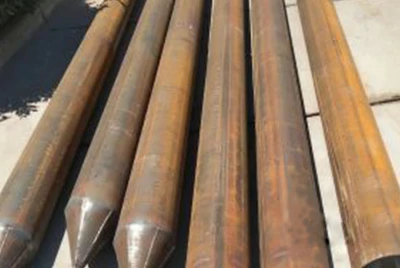
Deep well applications need a vent path for evolved gas.
Ribbon and conductive bar anodes
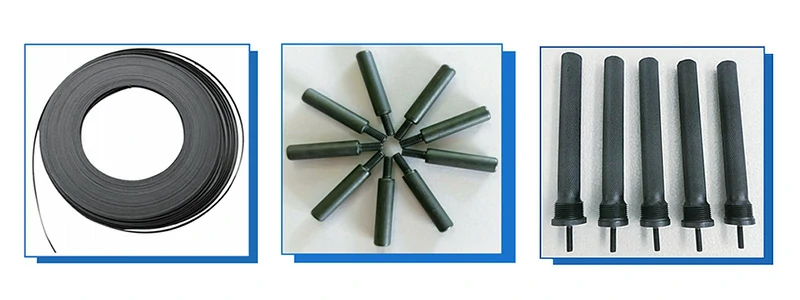
Ribbon anodes are used together with titanium conductive bar, commonly on aboveground storage tank bottoms and reinforced concrete structures.
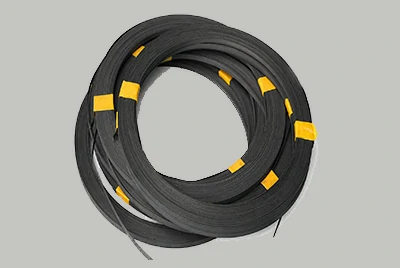
The ribbon format makes distributed current delivery practical in confined spaces; the conductive bar collects current, with intersections normally spot-welded into a grid.
Sizes are selected by thickness, width and coil length, and supply in full coils makes on-site unrolling and laying straightforward.
Mesh and expanded mesh anodes
Mesh and expanded mesh anodes are used where uniform area protection is required — typically embedded ICCP systems in concrete structures.
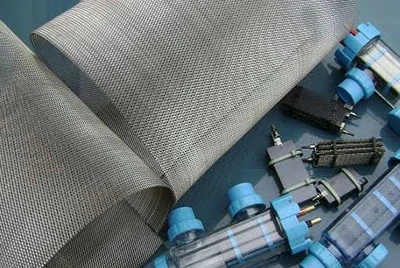
Selection turns on current output per unit area and on whether the mesh pattern is easy to fix in place on site.
Wire and flexible linear anodes
Wire and flexible linear anodes suit low-current applications requiring even distribution over long runs, such as plant piping, tank bottoms and buried structures.
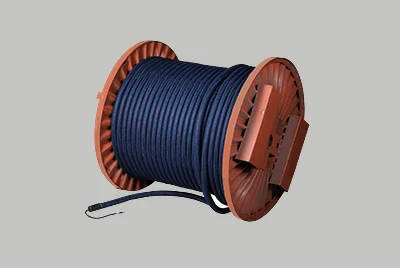
Flexible linear anodes are normally supplied pre-packaged with conductive backfill and a protective sleeve, and can be laid directly from the coil.
Indicative capability: current output of 300–1,000 mA/m, design life of 40 years or more, contact resistance not exceeding 0.0009 Ω, and coil lengths of 500 m and 1,000 m.
Rod, probe, discrete and disc anodes
Rod, probe, discrete and disc anodes are used for localized protection, internal corrosion control in equipment, and placement inside components.
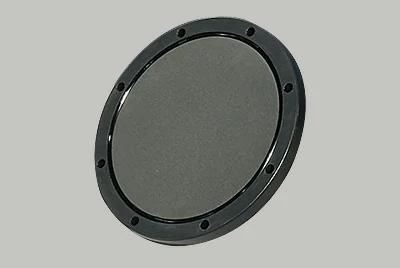
Probe-type anodes generally have a threaded mounting end and a lead wire, so they can be screwed directly into a prepared port — suitable for point installation in vessels, fittings and equipment interiors.
Dimensions and interface types are normally made to drawing.
What is an MMO titanium anode in cathodic protection?
MMO stands for mixed metal oxide.
These anodes use a commercially pure titanium substrate with a sintered precious metal oxide electrocatalytic coating, which is why they are also known as dimensionally stable anodes.
Compared with traditional impressed current anodes such as magnesium, high-silicon cast iron and graphite, MMO anodes work in a fundamentally different way: a traditional anode is itself the reactant and is steadily consumed as it delivers current, so its geometry keeps changing. The MMO coating instead acts as an electrocatalyst — it drives the oxidation reaction at the anode surface without being consumed as the primary reactant.
This difference has two direct consequences for system design. First, the anode keeps essentially the same geometry throughout its service life, so ground resistance is more stable and rectifier output does not need frequent adjustment. Second, the failure mode is not "being eaten away" but gradual wear and passivation of the catalytic layer over time — which means life can be calculated from current loading rather than estimated from volume.
The titanium substrate mainly serves as conductor and valve metal base. The interface where the electrochemical reaction actually occurs is the coating surface.
Cathodic protection solutions by asset type
CP designs differ between assets not in whether protection is needed, but in how current is distributed, where the anodes go, and which criteria govern acceptance.
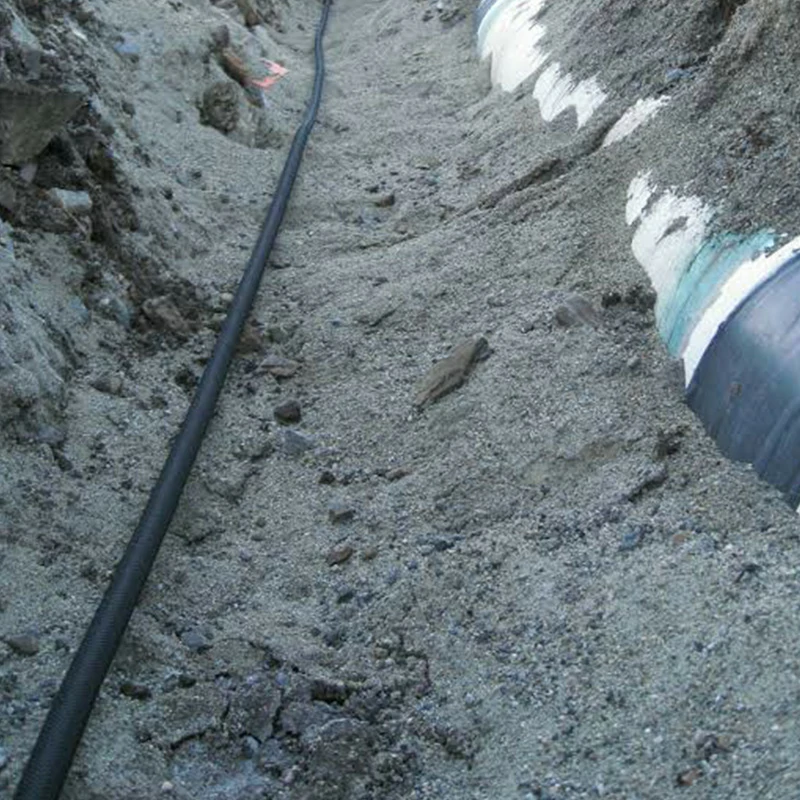
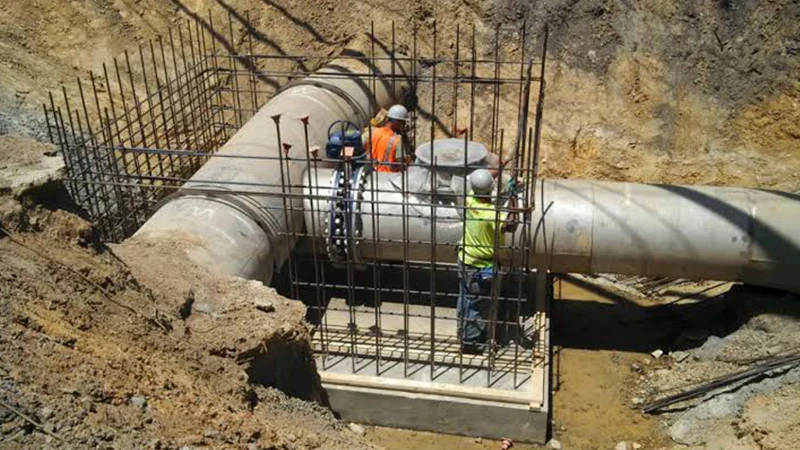
Buried pipelines and groundbeds
Service challenges. Transmission and plant piping present large protected areas over long routes, soil resistivity varies along the line, and stray current interference from adjacent pipelines and rail transit is common. Current has to travel far and spread evenly, while groundbed siting is constrained by land availability.
Coating direction. Soil and coke breeze backfill are predominantly oxygen-evolving, which points to the Ir-Ta system.
Format and layout. Where soil resistivity is high or land is restricted, a deep well groundbed is used, with tubular or canister anodes installed vertically to obtain low ground resistance through depth. Where soil conditions are favorable and space is available, a shallow horizontal groundbed is used. For dense in-plant networks, or where current needs to be topped up evenly along the line, flexible linear anodes can be laid alongside the pipe. Groundbeds are generally combined with coke breeze backfill to improve current distribution.
Available: tubular and multi-segment tubular anodes, deep well canister anodes, flexible linear anodes, and matching cable connection arrangements.
For a quotation, please provide: pipe diameter and protected length, estimated coating condition, soil resistivity along the route, groundbed type and available depth, and target design life.
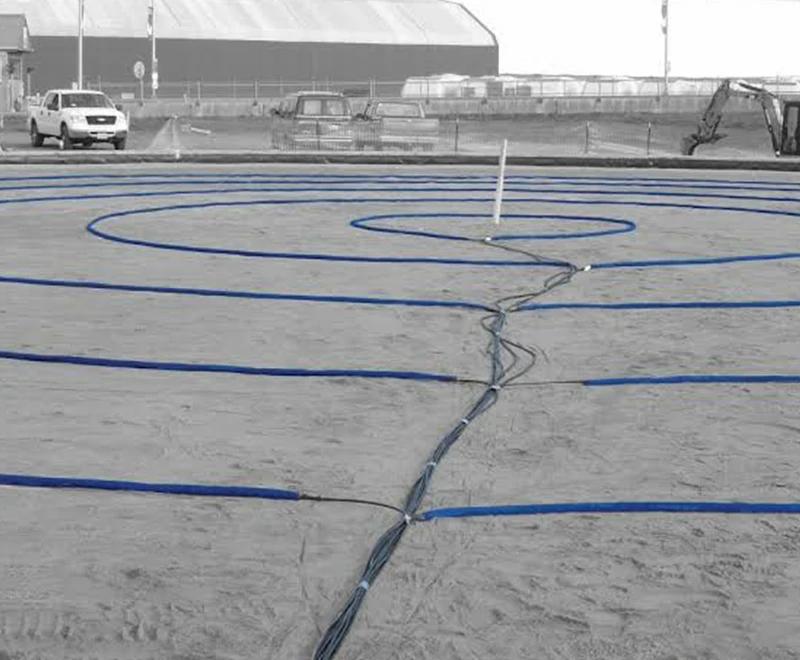
Aboveground storage tank bottoms
Service challenges. The underside of a tank bottom is an enclosed, confined space; the tank itself shields current, and the center of the bottom is the area most likely to be under-protected. The governing metric here is uniformity of current distribution, not total system current. Once the bottom perforates, repair means shutdown and opening the tank — a cost far higher than the anodes themselves.
Coating direction. Tank pads are usually sand or lightly saline media, predominantly oxygen-evolving, which points to the Ir-Ta system.
Format and layout. Ribbon anodes with titanium conductive bar are laid as a distributed network in the tank pad, with spot-welded intersections; current distribution is controlled by spacing rather than by high output at a few points. On new tanks the network is installed in one pass during pad construction; on existing tanks it is usually implemented alongside bottom replacement or an out-of-service inspection. Design and inspection practice can reference API RP 651.
Available: ribbon anodes, titanium conductive bar and connection hardware, with ribbon width and coil length configured to tank diameter.
For a quotation, please provide: tank diameter and bottom area, pad medium, new build or retrofit, target design life, and whether monitoring points need to be provided for.
Marine structures and ship hulls
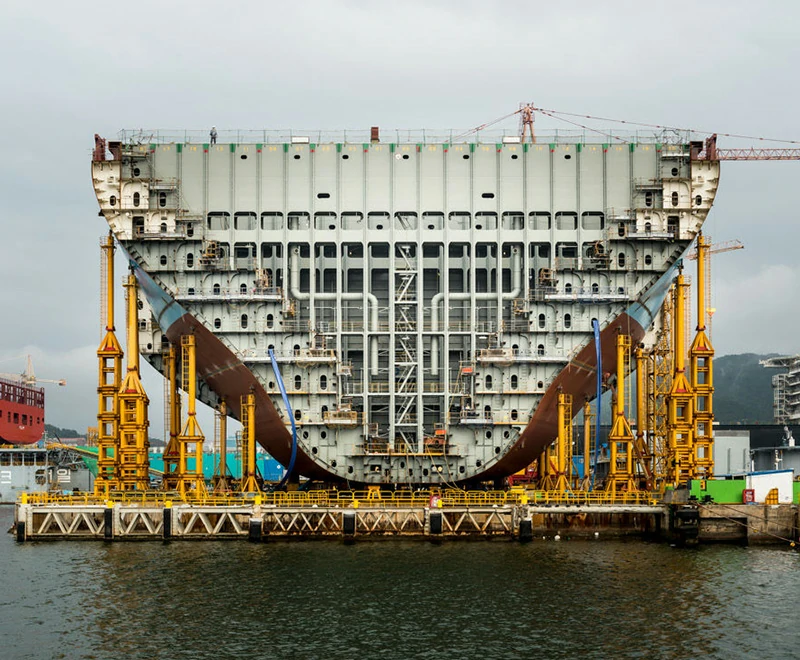
Service challenges. Seawater conducts well and current is easy to deliver, but flow-induced scouring, biofouling and restricted mounting locations are the main difficulties. Hulls also bring the drydocking interval into play — an anode that fails between dockings is extremely expensive to replace. Jetties, jackets and gates face uneven corrosion across the tidal and splash zones.
Coating direction. Seawater is a high-chloride medium and predominantly chlorine-evolving, which points to the Ru-Ir system.
Format and layout. Hulls and fixed offshore structures generally use disc anodes or purpose-built assemblies, externally mounted or flush-mounted, together with a dielectric shield to control near-field current density; tubular or rod anodes suit submerged steelwork and the interior of cooling systems. Mounting positions have to balance current distribution against flow effects.
Available: disc, tubular and rod anodes, plus purpose-built assemblies made to drawing.
For a quotation, please provide: structure type and submerged area, seawater velocity and temperature, mounting location and interface type, and applicable specification requirements.
Reinforced concrete structures
Service challenges. Corrosion of reinforcement in concrete is usually initiated by chloride ingress or carbonation. The steel being protected sits inside the matrix, so current has to pass through the cover and distribute evenly — excessive local current brings risks of its own. Cover thickness and reinforcement density vary widely between bridge decks, piers, parking structures and marine components.
Coating direction. Concrete is predominantly oxygen-evolving, which points to the Ir-Ta system.
Format and layout. Mesh and expanded mesh anodes can be fixed to the member surface and then covered with sprayed concrete or an overlay, suiting uniform area protection; ribbon anodes can be set into surface slots or tied to the reinforcement on new construction, suiting linear and localized layouts. Assessment of protection effectiveness can reference the criteria in EN ISO 12696.
Available: mesh and expanded mesh anodes, ribbon anodes and matching current distributor bars.
For a quotation, please provide: member type and protected area, cover thickness and reinforcement density, new build or repair, and target design life.
Coating selection: Ir-Ta or Ru-Ir MMO for your electrolyte
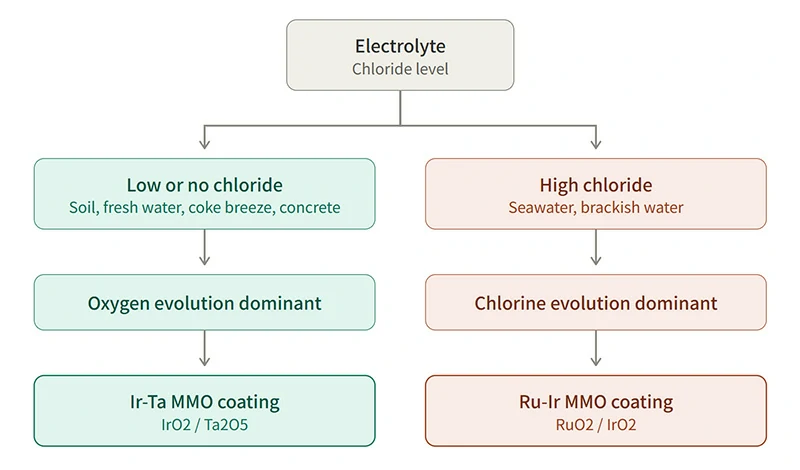
Coating choice is the step most easily overlooked in MMO anode selection, and the one that most directly affects service life. There is only one criterion: which reaction dominates at the anode surface.
Where chloride concentration in the medium is low or essentially absent — soil, fresh water, coke breeze backfill, concrete — oxygen evolution dominates at the anode surface. Where chloride is high — seawater, brackish water — chlorine evolution dominates. The two reactions place different demands on the catalyst.
Ir-Ta MMO (oxygen-evolving) — coating system of IrO₂ and Ta₂O₅
Recommended for oxygen-evolving environments such as soil, fresh water, coke breeze backfill and concrete.
Tantalum acts as the stabilizing component in the system and helps improve coating durability under strongly oxidizing interfacial conditions. This is the formulation direction most commonly used on buried pipeline groundbeds, tank bottoms and concrete structure CP projects.
Ru-Ir MMO (chlorine-evolving) — for high-chloride media such as seawater and brackish water
It offers a lower chlorine-evolution overpotential and good electrocatalytic activity where chlorine evolution is the dominant reaction.
Offshore structures, ship hulls and seawater cooling system CP projects generally use this direction.
What happens if the formulation is wrong: using a chlorine-evolving formulation in a predominantly oxygen-evolving medium can shorten the effective life of the catalytic layer well below design expectations. Confirming the medium type and chloride level at the enquiry stage is therefore more useful than adjusting rectifier output after the fact.
On coating loading, typical figures are approximately 8 g Ru + 2 g Ir/m² for the chlorine-evolving type and approximately 8 g Ir/m² for the oxygen-evolving type. Actual loading is configured to the service environment and design life; specific loadings are available to specification.
If you can provide a medium analysis or resistivity data, we can confirm the appropriate coating direction on that basis.
Impressed current vs sacrificial anode cathodic protection
There are two technical routes to cathodic protection.
Impressed current cathodic protection uses an external rectifier to supply DC and delivers it into the medium through auxiliary anodes. A sacrificial anode — also called a galvanic anode — drives current naturally from the potential difference between itself and the protected metal, and is consumed in the process.
| - | Impressed Current (ICCP) | Sacrificial / Galvanic |
| Driving mechanism | Powered by an external rectifier | Potential difference between anode and structure |
| Current adjustability | Adjustable as required | Set by material and environment; essentially fixed |
| Suitable scale | Large, long-distance, high-resistivity environments | Small, localized, low-resistivity environments |
| Anode consumption | MMO coating wears very slowly; dimensionally stable | Anode body consumed continuously |
| Operation and maintenance | Needs power supply and monitoring; remotely adjustable | No power supply; periodic inspection and replacement |
| Typical applications | Transmission pipelines, tank bottoms, jetties, ship hulls | Small buried facilities, localized marine protection |
Neither route is universally better. Where the asset is small, the design period short, the medium conductive and external power inconvenient to provide, a sacrificial anode system is often simpler and lower in initial cost;
where the asset is large, design life long, soil resistivity high, or protection current needs to be adjusted in service, ICCP is generally the better fit. Using both on the same project is also common in practice.
Henan Chalco supplies MMO auxiliary anodes and associated components for ICCP systems. We do not supply zinc, magnesium or aluminum sacrificial anode blocks.
Current output and design life — how MMO anodes are rated
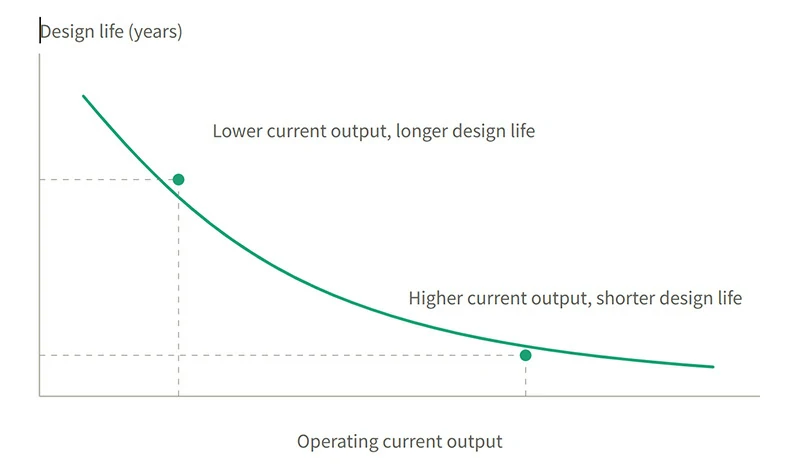
Within an anode's normal discharge range, current output and design life are approximately inversely related.
An anode rated 5 A for 20 years, operated instead at 2.5 A, corresponds to a design life extended to roughly 40 years; raising current output shortens life accordingly.
Four factors mainly govern the rating:
- Coating loading — the amount of precious metal oxide per unit area, which directly sets the consumable reserve of the catalytic layer;
- Operating current density — the higher the output per unit area, the faster the catalytic layer wears;
- Electrolyte type — dominant reactions and wear mechanisms differ between soil, coke breeze backfill, fresh water and seawater;
- Backfill arrangement — coke breeze backfill improves current distribution and changes the actual working conditions at the anode surface.
How are life figures obtained?
The established industry practice is accelerated life testing: discharging to failure in a controlled electrolyte at a current density far above service conditions, then extrapolating the result to the actual current density range. Methods can reference AMPP/NACE TM0108.
Send us your current requirement and design life target, and we can come back with matching format and size recommendations.
Standards and acceptance criteria
| Standard | Scope |
| ISO 15589-1 | Cathodic protection of onshore pipeline systems |
| ISO 15589-2 | Cathodic protection of offshore pipeline systems |
| AMPP/NACE SP0169 | External corrosion control of buried or submerged metallic piping systems; includes the −850 mV vs CSE and 100 mV polarization criteria |
| API RP 651 | Cathodic protection of aboveground storage tank bottoms |
| EN ISO 12696 / SP0290 | Cathodic protection of steel in concrete; includes the 100 mV potential decay criterion |
| AMPP TM0108 | Test method for catalyzed anodes in soil or natural waters |
| AMPP TM0294 | Test method for embeddable ICCP anodes in concrete |
| ASTM B265 / B338 / B348 | Grades and technical requirements for titanium substrate |
Anodes can be supplied to the technical requirements agreed in the project specification, with the corresponding documentation provided.
Substrate quality, coating process, and what actually affects anode life
MMO anode life is often attributed to the coating formulation, but in actual production the substrate pretreatment matters just as much.
Total coating thickness is typically only a few microns, and its adhesion depends heavily on the condition of the substrate surface before coating — inadequate pretreatment can also lead to early spalling.
Our anode manufacturing sequence is as follows:
- Substrate selection — Grade 1 / TA1 titanium is used. Compared with TA2, TA1 has lower iron and oxygen content and behaves more consistently as an electrode base;
- Machining and forming — bending, thread turning, welding and similar operations are completed to order specification with tolerances controlled;
- Annealing and flattening — annealing and flattening above 500 °C (932 °F) relieves working stress and secures flatness;
- Oxide removal by grinding — annealing forms a dense titanium oxide layer on the surface, which is ground off until the metallic luster of titanium shows;
- Pickling — several hours in 10% oxalic acid at a gentle boil etches the surface to a uniform gray matte texture, with surface roughness of approximately 6 μm;
- Coating and sintering — the precious metal solution is formulated for the service environment, applied, then sintered in the furnace; the part cools naturally to room temperature before the next pass, repeated 12–20 times or more until the coating reaches design thickness, with typical coating thickness of about 6.5 μm;
- Coupon testing with each furnace batch — coupons sintered in the same furnace run undergo life testing, and the batch is packed and shipped only after they pass.
Two points about anode selection are worth knowing in advance:
The copper-cored titanium wire trade-off. Some wire anodes use a bimetallic construction with a thin titanium layer extruded over a copper core — lower cost and better longitudinal conductivity. But copper is far less corrosion resistant than titanium, and once the coating or the titanium layer develops a defect, the risk of substrate attack in strongly acidic media rises markedly. Whether to use it should be weighed against the medium conditions.
The "breakdown voltage" concern about titanium. When titanium was first promoted as an anode substrate, the industry was concerned that polarization above a certain threshold would rupture the passive film and cause pitting dissolution of the titanium, and on that basis regarded high-voltage supplies as risky.
Subsequent industry testing has shown that as long as the electrocatalytic coating remains intact, the titanium substrate does not polarize to that degree — the high conductivity of the coating keeps titanium in a conductor role. The concern does not hold under normal operating conditions, though it does illustrate, from the other direction, how important coating integrity is.
On quality management, supply can be executed in line with the requirements of an ISO 9001 quality management system.
Other names you may see — DSA, DSE, PMTA, OCTA
The same product family goes by several names across regions and industries, and you may encounter any of them in procurement: DSA (dimensionally stable anode), DSE (dimensionally stable electrode), PMTA (precious metal coated titanium anode), OCTA (oxide coated titanium anode), along with format-based names such as titanium tube anode and conductive ribbon.
They all point to the same technical route; the differences that matter are in coating formulation, loading and physical format, not in the name itself.
Installation, backfill, and operating considerations
Anode quality is only part of system reliability. In actual projects, early failures more often originate in installation and operation.
Connections and sealing are the weakest link
The joint between the anode lead and the power cable should have low contact resistance and be reliably sealed to prevent moisture ingress along the connection. Once water gets in at this point, the circuit typically fails long before the anode itself approaches its design life.
Coke breeze backfill does more than conduct
The backfill provides an active medium for the electrochemical reaction and improves current distribution. In confined spaces such as tank bottoms, it also helps limit the depolarizing effect of evolved oxygen on the structure.
Rectifier output quality affects anode condition
ICCP systems are rectifier-fed, and the DC output should be stable — ripple factor is best kept within 5%. Excessive ripple means actual conditions deviate from design, which over long-term operation works against stable anode condition.
Confirm polarity
If an MMO coating is operated as a cathode, reduction occurs at the surface, the precious metal oxides revert to metal and lose effective bonding with the titanium substrate, and the coating comes off. Verify polarity during wiring and commissioning, and avoid reverse-polarity operation.
Avoid coating damage in handling and installation
Total coating thickness is only a few microns, and a scratch can become the starting point for localized corrosion in service. Wear clean gloves when handling, grip the anode by its ends or edges, keep contact to uncoated areas where possible, and keep hard objects away from the coated surface.
Shutdown and maintenance
During extended shutdowns, leaving anodes immersed in the electrolyte with the power fully off is not recommended; a small protective current is better maintained. For maintenance, clean the surface with fresh water or dilute acid rather than by mechanical scrubbing.
Tell us about unusual constituents in the medium. If the soil or water contains fluoride or other species aggressive to the titanium substrate, this should be stated at the selection stage so suitability can be assessed.
Supply options, inspection documents, and RFQ boundaries
Supply scope
Henan Chalco supplies both Ir-Ta and Ru-Ir coating systems, in formats covering tubular and multi-segment tubular, deep well canister, ribbon and conductive bar, mesh and expanded mesh, wire and flexible linear, rod, probe, discrete and disc anodes, with custom items made to drawing.
Plate-type components can be single-side coated where service conditions require it. The core deliverable is MMO auxiliary anodes and assemblies for ICCP; complete impressed current cathodic protection systems are configured per project and fall within optional scope.
Titanium substrate also retains recovery value: after service, anodes can be assessed for recoating and reuse.
Packing and shipping
Coiled products can be supplied on wooden or steel reels; other formats are packed for export according to the shipping mode and destination requirements.
Inspection documents
Documents that can be quoted with an order include material test certificates (MTC), coating records, inspection reports, packing lists and certificates of origin; the exact list is confirmed per project.
Quotation boundaries
We can provide a cross-reference quotation against your specification or drawing — that is, a corresponding product proposal to your technical requirements.
FAQ
What is MMO in cathodic protection?
MMO stands for mixed metal oxide — the mixed metal oxide coating on the surface of a titanium substrate. The coating acts as the electrocatalyst that drives the anodic reaction, while the titanium substrate serves as base and conductor.
Is titanium the anode or the cathode in an ICCP system?
In an ICCP circuit, the MMO titanium anode connects to the rectifier's positive terminal and acts as the anode, while the protected steel structure is the cathode. The interface where the electrochemical reaction actually occurs is the coating on the anode surface.
Impressed current or sacrificial anode — which should I use?
It depends on asset size, design life, medium resistivity and power availability. ICCP is generally chosen for large, long-life, high-resistivity applications or where protection current needs to be adjustable; for small, localized, low-resistivity situations where power is inconvenient, a sacrificial anode system is simpler.
Should I use an Ir-Ta or Ru-Ir MMO coating?
Choose by the dominant reaction. Use Ir-Ta in oxygen-evolving environments such as soil, fresh water, coke breeze backfill and concrete; use Ru-Ir in high-chloride, chlorine-evolving environments such as seawater and brackish water.
Do you supply sacrificial anodes or water heater anode rods?
No. The products on this page are industrial MMO titanium anodes for ICCP systems protecting pipelines, storage tanks, marine structures and concrete assets. Zinc and magnesium sacrificial anode blocks and residential water heater anode rods are not within our supply scope.
Request a CP anode review
If you are selecting ICCP anodes for a pipeline, storage tank, marine structure or concrete project, send us your project parameters and we will come back with matching format and coating recommendations, together with a corresponding quotation.
Information needed: asset type, protected area or length, environment/medium and resistivity, existing coating condition, current requirement and design life, format preference, cable and monitoring requirements, and documentation requirements.


