

TC25 Titanium Alloy Bar Forgings
Updated : Sep. 7, 2026TC25 titanium alloy, known as BT25 in the Russian designation system, is an α+β high-strength high-temperature titanium alloy designed for rotating hardware that runs for long periods at 450–550 °C (842–1022 °F) in aero engines and gas turbines.
What we supply is solid material in the forged and hot-rolled condition — bar and forgings. Not general-purpose structural titanium, and not powder for additive manufacturing.
Henan Chalco supplies TC25 bar in Ø16–500 mm (0.63–19.7 in) and isothermal die forgings with a projected area up to 2 m² (21.5 ft²). We can also review your drawing and supply to it.
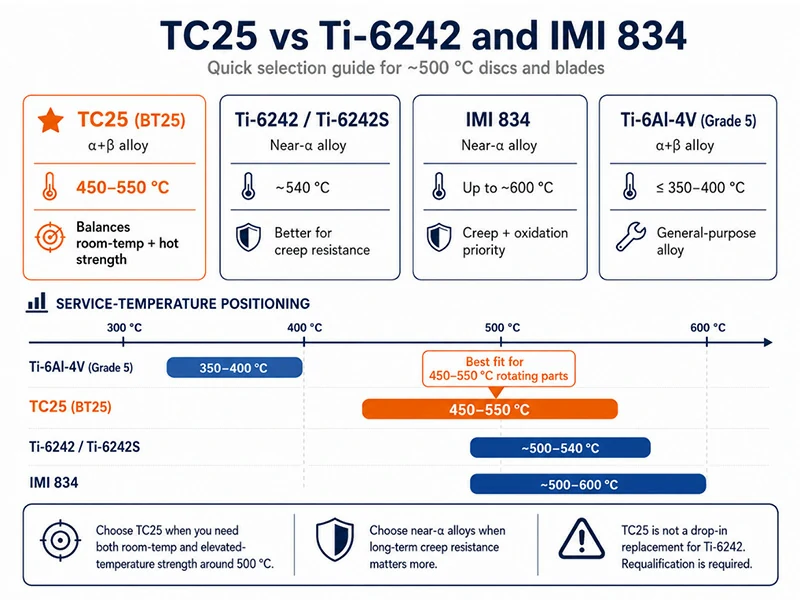
TC25 vs Ti-6242 and IMI 834: where this alloy sits
If you are choosing material for a disc or blade running at around 500 °C, Ti-6242 or IMI 834 is probably already on your shortlist.
TC25 belongs on that same shortlist — not because it is cheaper, but because it takes a different strengthening route.
At a Glance:
- TC25 (BT25) — α+β, tungsten-bearing, for 450–550 °C rotating parts; holds both hot strength and room-temperature strength
- Ti-6242 / Ti-6242S — near-α, creep resistance its strong suit, long-term service around 540 °C
- IMI 834 — near-α, service temperature up to about 600 °C, creep and oxidation resistance first
- Ti-6Al-4V (Grade 5) — the general-purpose workhorse, long-term service ceiling around 350–400 °C
| TC25 (BT25) | Ti-6242 (-S) | IMI 834 | Ti-6Al-4V | |
| Alloy type | α+β | Near-α | Near-α | α+β |
| Nominal composition | Ti-6.5Al-2Sn-2Zr-2Mo-1W-0.2Si | Ti-6Al-2Sn-4Zr-2Mo(-Si) | Ti-5.8Al-4Sn-3.5Zr-0.7Nb-0.5Mo-0.35Si | Ti-6Al-4V |
| Typical RT tensile | ~1,050–1,090 MPa (152–158 ksi) | ~1,000–1,100 MPa | ~1,100 MPa | ~900–950 MPa |
| Service window | 450–550 °C; 6,000 h at 500 °C, 3,000 h at 550 °C | About 540 °C, long-term | About 600 °C, long-term | ≤ 350–400 °C |
| Typical parts | HP compressor disc, blade, labyrinth seal ring | Compressor disc, blade, casing | Compressor disc, blade | Airframe, fasteners, general structural parts |
The difference between α+β and near-α comes down, in practice, to the strengthening route.
TC25 gets its hot strength from about 1% tungsten — a eutectoid β-stabilizer — working together with silicon, which puts the composition on the α+β high-strength side. Ti-6242 takes the Sn-Zr-Mo solid-solution plus silicide route, sits closer to near-α, and is stronger on creep resistance.
So although the two grades overlap on service temperature, they lean in different directions. For a disc that has to hold both room-temperature and elevated-temperature strength, TC25 is usually the easier fit; for a part whose design is driven by long-term creep, the near-α side suits better.
One point has to be made up front: overlapping temperature ranges does not mean the grades are interchangeable. TC25 is not a drop-in replacement for Ti-6242. The microstructure type, the heat-treatment response and the thermal stability behaviour are all different, so switching grades means running the qualification again under your own acceptance system. That is not a formality.
TC25 titanium alloy — product data
| Product name | TC25 High Temperature Titanium Alloy Bar and Forgings |
| Grade / designation | TC25 (China GB designation); BT25 / VT25 (Russian equivalent designation) |
| Nominal composition | Ti-6.5Al-2Sn-2Zr-2Mo-1W-0.2Si (nominal) |
| Condition | Forged or hot rolled; solution treated and aged, or annealed to an agreed schedule |
| Specification | Supplied to the GB grade designation and to the agreed technical protocol |
| Size range | Bar Ø16–500 mm (0.63–19.7 in); isothermal die forgings, projected area up to 2 m² (21.5 ft²) |
| Tolerance | To specification; agreed at RFQ |
| Processing | Fast forging, radial forging, isothermal die forging, hot extrusion, turning, grinding, cut-to-length |
| Surface | As-forged, turned / peeled, ground, machined |
| Applications | HP compressor discs and blades, rotor blades, labyrinth seal rings, drum rotors, industrial gas turbine hot-section rotating parts |
| Minimum order | Quoted per specification and quantity |
| Documentation | Mill test certificate (MTC), chemical and mechanical test reports, ultrasonic C-scan report, grain size and microstructure report, dimensional report; third-party inspection can be arranged |
What to send for a quote:
- Grade and condition
- Dimensions and tolerance, or a drawing
- Quantity and delivery destination
- Surface condition required
- Documentation needed (MTC, C-scan report, third-party inspection)
- End use, end user and destination
The last item is not box-ticking. TC25 goes into hot-section rotating parts, so before we can put an accurate supply proposal together we need to confirm the end use and the destination.
Sending all of this in one go usually saves two or three rounds of back-and-forth.
Forms, sizes and custom forgings
Standard sizes
- Bar: Ø16–500 mm (0.63–19.7 in)
- Isothermal die forgings: projected area up to 2 m² (21.5 ft²)
Other forms quoted to specification
discs, rings, billet, closed-die forgings, near-net-shape forgings, extruded shapes, plate.
These forms are covered at the equipment level — our fast forging, radial forging, hot extrusion and cold pilger lines all run titanium and titanium alloys. But for TC25 specifically, the available sizes need to be confirmed against your requirement before we quote.
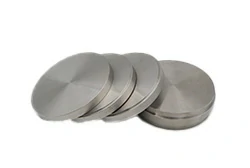
TC25 titanium discs
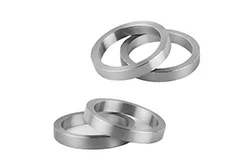
TC25 titanium rings
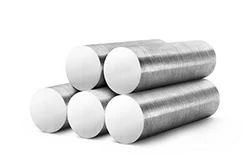
TC25 titanium billet
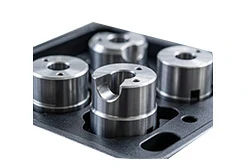
TC25 titanium forgings
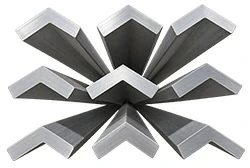
TC25 titanium extruded shapes
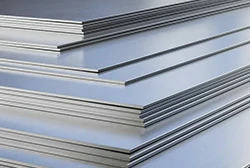
TC25 titanium plate
Forged to your drawing
Forged to your drawing.
Send us the part print. We will review the forging envelope, the grain flow that can realistically be achieved, and the machining allowance to leave, and then quote.
If the geometry does not suit isothermal die forging, we will say so and propose a better forming route — rather than taking the order first and working it out afterwards.
Chemical composition and physical properties
Nominal composition, wt%
| Ti | Bal. |
| Al | 6.5 |
| Sn | 2 |
| Zr | 2 |
| Mo | 2 |
| W | 1 |
| Si | 0.2 |
Composition limits are agreed per order, and measured values are reported on the mill test certificate.
If your drawing calls for a tighter band on Sn, Si or interstitial elements such as O, N and H than the standard range, tell us at enquiry stage and we will confirm feasibility before quoting.
Physical properties
- Density: ≈ 4.5 g/cm³ (typical)
- β-transus: approximately 1000–1020 °C (1832–1868 °F), varying with heat and product form
On β-transus, we have measured approximately 1020 °C on Ø250 mm forged bar by metallographic method, with ingot-stage values falling in the 1000–1010 °C range. This temperature is the reference point for every hot-working and heat-treatment schedule, and production works to the measured value for each heat.
Two elements in the composition table are worth a sentence of their own, because they decide what this alloy can and cannot do: W and Si.
W is where the hot strength comes from. Adding about 1% of this eutectoid β-stabilizer noticeably lifts hot strength and thermal stability in the 500–550 °C band, and it is the most visible compositional difference between TC25 and the near-α alloys that share the same temperature range.
Si cuts both ways. Silicide precipitation provides extra high-temperature strengthening, but it is also one of the reasons ductility falls after long exposure at high temperature.
Mechanical properties by product form
TC25 properties are strongly tied to product form.
Sampling location, deformation history and heat-treatment path are not the same for a bar test piece and a finished forging, so the numbers you get are not the same set.
Bar, Ø250 mm
| Condition | Rm, MPa | A, % | Z, % | Stress rupture | Impact AKU2, J |
| Room temperature | 1,069 / 1,092 | 13.5 / 14.5 | 45 / 45 | — | 34 / 35 |
| 500 °C (932 °F) | 840 / 825 | 23.5 / 20.0 | 60 / 57 | 51 h @ 441 MPa | — |
| 550 °C (1022 °F) | 740 / 770 | 26.0 / 24.5 | 73.5 / 73.5 | 51 h @ 441 MPa | — |
| After 550 °C thermal stability exposure | 1,076 / 1,109 | 8.5 / 7.5 | 16 / 15 | — | — |
Typical acceptance limits: room temperature Rm ≥ 980 MPa, A ≥ 10%, Z ≥ 20%; 500 °C Rm ≥ 735 MPa; 550 °C Rm ≥ 686 MPa; stress rupture at 441 MPa ≥ 50 h at both temperatures; Rm ≥ 980 MPa after 550 °C thermal stability exposure; impact ≥ 23.5 J.
Forgings
| Part | Condition | Rm, MPa | A, % | Z, % | Stress rupture | Impact AKU2, J | HB(d), mm |
| Disc | Room temperature | 1,050 / 1,040 | 12.0 / 15.0 | 15.0 / 21.0 | — | 38 / 40 | 3.28 |
| Disc | 500 °C | 740 / 740 | 19 / 18 | 44 / 45 | > 101 h @ 637 MPa | — | — |
| Disc | 550 °C | 725 / 710 | 21 / 20 | 51 / 60 | > 101 h @ 441 MPa | — | — |
| Disc | After 550 °C exposure | 1,070 / 1,080 | 12.5 / 15.0 | 15.0 / 21.0 | — | — | — |
| Seal ring | Room temperature | 1,080 / 1,070 | 14.0 / 13.5 | 41.0 / 40.0 | — | 38 / 38 | 3.28 |
| Seal ring | 500 °C | 760 / 745 | 17 / 14 | 55 / 49 | > 101 h @ 637 MPa | — | — |
| Seal ring | 550 °C | 720 / 745 | 20 / 18 | 67 / 54 | > 101 h @ 441 MPa | — | — |
| Seal ring | After 550 °C exposure | 1,060 / 1,070 | 11.5 / 11.5 | 15.5 / 17.0 | — | — | — |
Put the two tables side by side and one thing stands out: at 441 MPa, stress rupture life is around 51 h on bar test pieces and above 101 h on disc and seal ring forgings. Same grade, twice the life.
That is not a data error, and neither set is better material. The bar test piece comes from rolled stock, the forging test piece comes from a specified location on the finished part, and the two have been through completely different amounts of deformation, different deformation modes and different thermal histories.
Plenty of customers have compared a raw material MTC against the test report on a finished part, found the numbers did not line up, and started questioning the lot. In most cases those two sets were never supposed to match. Making them match requires the same sampling location and the same condition — which is worth writing into the technical protocol rather than arguing about at inspection.
Service temperature — and how long you actually get
The long-term service band for TC25 is 450–550 °C (842–1022 °F).
More useful are these two numbers:
- 500 °C (932 °F): up to 6,000 hours of continuous service
- 550 °C (1022 °F): up to 3,000 hours of continuous service
A temperature limit without a time attached is not a design input.
Most other pages on high-temperature titanium alloys drop a single temperature figure and stop there — "maximum service temperature 550 °C".
With that alone a customer can neither set a life nor choose between two grades, because there is no way to tell whether that 550 °C means 100 hours or 3,000.
What actually decides material selection is the combination of temperature and time.
Put TC25 back into the full temperature spectrum:
- Ti-6Al-4V: long-term service ceiling around 350–400 °C. By 500 °C creep is already out of hand.
- TC25: 450–550 °C, with the hours above
- Near-α alloys (Ti-6242, IMI 834, Ti-1100 and similar): up to about 540–600 °C, creep resistance first
- Nickel-base superalloys: higher temperature, but a density of about 8.2 g/cm³ — close to twice that of titanium
That last line deserves extra care on rotating hardware. The main load on a rotating part comes from its own mass — heavier disc, higher centrifugal load, and the design margin on the disc, the shaft system and the bearings all tighten together.
So in the 450–550 °C band, the difference between "titanium will do" and "this has to be nickel-base" is often not the material price. It is redesigning the whole rotor.
Temperature and time only solve half the problem. The other half is what the material has left after several thousand hours at 550 °C. We cover that separately below.
How the material is melted, forged and inspected
With titanium for aero-engine rotating parts, the first question customers ask is rarely tensile strength. It is cleanliness and internal quality.
Here is the route this material takes from melting to despatch.
Melting route
Vacuum induction melting VIM / AIM → plasma arc cold hearth melting PAM and electron beam cold hearth melting EB → multiple vacuum arc remelting VAR → pressurised electroslag remelting PESR.
The cold hearth step is the critical one. Hard alpha and high-density inclusions (HDI) are where the failure chain starts on aerospace titanium rotating parts, and once one reaches a high-stress region of a disc the consequences are unacceptable.
Plasma arc and electron beam cold hearth melting exist precisely to separate out that class of defect during melting, and combined with multiple vacuum arc remelting they raise compositional uniformity and internal cleanliness together. Most suppliers never mention this step, but what it decides matters more than any single number in a table.
Hot working
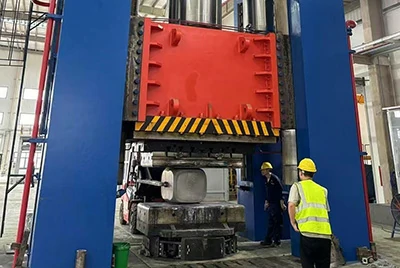
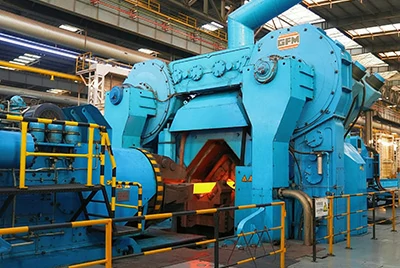
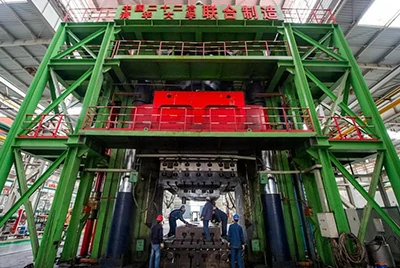
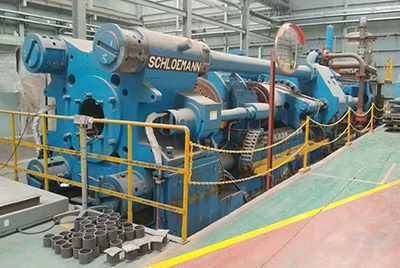
Isothermal die forging matters for TC25 discs. Forming with die and billet at the same temperature and at a low strain rate makes near-net-shape possible, gives a more uniform microstructure, and lifts material utilisation at the same time.
The machining allowance removed from titanium alloy forgings is often startling. What near-net-shape saves is both money and lead time.
Inspection
Our inspection capability covers the full chain from raw material to finished product:
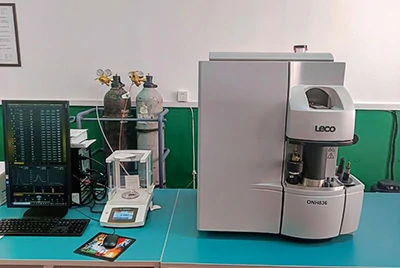
- Chemical analysis: ICP-MS, ICP-AES, GFAAS, XRF, carbon and sulphur analysers, hydrogen determinators, oxygen and nitrogen analysers
- Mechanical properties: creep and stress-rupture machines, fatigue testing machines, tensile, impact, hardness, fracture toughness, low-cycle and high-frequency fatigue
- Metallography and microanalysis: optical metallography, scanning electron microscopy, electron probe microanalysis, thermomechanical simulation, simultaneous thermal analysis
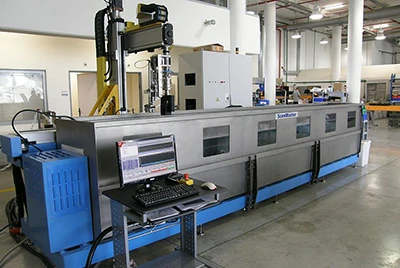
- Non-destructive testing: immersion ultrasonic inspection, multi-zone ultrasonic C-scan systems for large-diameter bar, automated ultrasonic C-scan for discs and rings, 3D dimensional measurement of forgings and dies
Control of O, N and H directly determines the ductility and thermal stability of titanium. A few hundredths of a percent more of these interstitial elements and the ductility left after long high-temperature exposure is in a different order of magnitude. Gas element analysis is not a box-ticking test here — it is the precondition for using this grade at 550 °C.
Multi-zone C-scan determines defect detection sensitivity in large-section forgings. Put plainly, it determines what you can see at inspection. The interior of large-diameter bar and of discs and rings cannot be resolved that finely by conventional inspection methods, which is why we list this equipment separately. Ultrasonic acceptance class can be agreed to your specification.
Heat treatment and microstructure control
For the general hot-working temperature range of TC25 and the standard solution-plus-ageing schedules for bar and forgings, we produce to the established practice for the grade, and we can also work to a schedule you specify.
What is worth noting is how decisively the heat-treatment schedule governs microstructure type. Our production records show a consistent pattern: the annealing temperature decides whether TC25 comes out with an equiaxed or a duplex microstructure. As the annealing temperature approaches the transus, primary α partially dissolves and clear secondary α appears in the transformed β matrix, moving the structure from equiaxed to duplex — and the duplex structure gives better tensile properties both at room temperature and at elevated temperature.
For purchasing and process engineering this means something very practical: the heat-treatment schedule is not a delivery detail, it belongs in the technical protocol. On the same piece of material, a different schedule makes a considerable difference to hot strength. Rather than arguing over inconsistent data at inspection, it is better to fix the condition and the heat-treatment path at the time you place the order.
Where TC25 is not the right choice
Every grade has places it should not be used. Here are four of them, stated up front.
Ductility falls after long exposure at high temperature
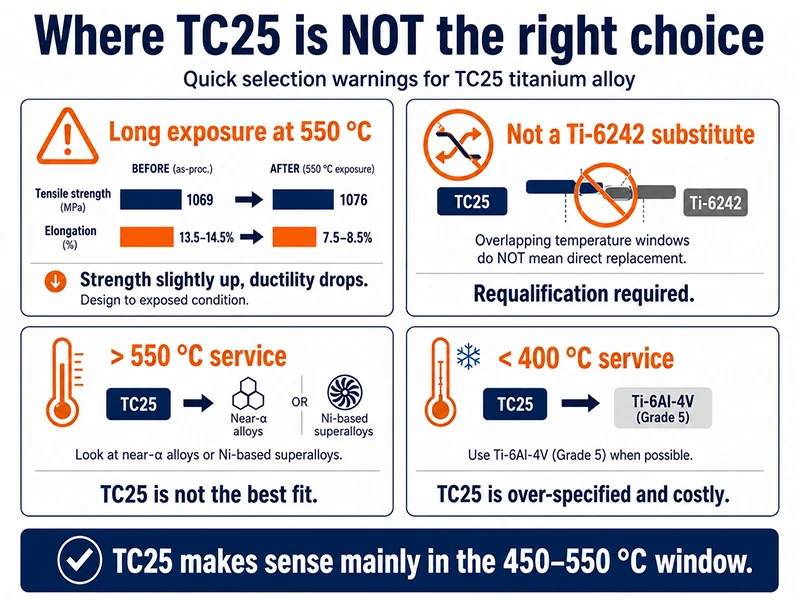
This is not speculation, it is our own test data. Elongation on Ø250 mm bar is about 13.5–14.5% at room temperature; after the 550 °C thermal stability test, tensile strength edges up from 1,069 MPa to 1,076 MPa while elongation falls to about 7.5–8.5%. Strength up, ductility down by roughly half.
Published research offers the mechanism: after long exposure at 550 °C, TC25 develops a surface oxide layer, α2 phase precipitation and grain-boundary silicides acting together. Dislocation movement is impeded, which raises strength, while strain localisation drives the clear loss of ductility.
The difference between product forms is interesting. Under the same test conditions, elongation on disc and seal ring forgings is essentially flat from room temperature to the exposed condition (disc 12.0–15.0% → 12.5–15.0%), a far smaller drop than on bar test pieces. This comes down to microstructural condition and sampling location, and it is another reminder that data from one product form cannot be used to predict another.
For the customer it comes down to one sentence: set your life margin on the exposed ductility, not on as-supplied data.
Not a drop-in replacement for Ti-6242
Said earlier, worth repeating. Overlapping temperature bands do not mean direct substitution. Changing grade requires requalification under your own system. Any supplier who tells you it is a "direct replacement" is carrying a risk on your behalf that they cannot actually carry.
Continuous service above 550 °C — look at something else
If the duty runs above 550 °C for long periods, a near-α alloy (IMI 834, Ti-1100 and similar) or a nickel-base superalloy is the better fit. TC25 is not the optimum in that band and we would not push it there.
Below 400 °C it is money wasted
For structural and rotating parts below 400 °C, Grade 5 titanium (Ti-6Al-4V) is cheaper, easier to source and easier to machine, with a far more complete standards framework behind it.
What the premium on TC25 buys is capability in that 450–550 °C band. If you are not using it, there is no reason to pay for it.
联系我们按钮
Supply options, inspection documents
Supply basis
Bar Ø16–500 mm and isothermal die forgings with a projected area up to 2 m² are the standard supply range; other forms are quoted to specification. Delivery condition can be forged, hot rolled, solution treated and aged, or annealed to an agreed schedule.
Surface and packing
Surface condition can be as-forged, turned / peeled, ground or machined. Export packing and protection are set according to the destination and the mode of transport.
Inspection documents
Orders can be quoted with a mill test certificate, chemical and mechanical test reports, an ultrasonic C-scan report, a grain size and microstructure report, and a dimensional report. Third-party inspection can be arranged.
Certification and compliance
Material is produced under an AS9100-certified quality system, at a mill holding Nadcap accreditation for non-destructive testing, materials testing and heat treatment, and CNAS laboratory accreditation. The producing mill's test centre also holds approvals from major civil aero-engine OEMs. Certificates are supplied with the order.
TC25 is supplied for civil aerospace, industrial gas turbine and high-performance engineering applications. Please state the end use, end user and destination with your enquiry so that we can confirm supply before quoting.
Related titanium alloys
TC11 titanium alloy

TA15 titanium alloy
TC18 titanium alloy
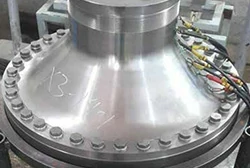
Ti55531 titanium alloy
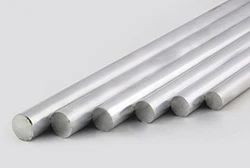
Titanium bar
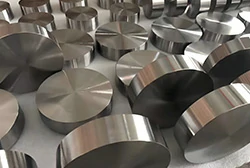
Titanium forgings
These grades come from the same supply chain and the same set of inspection documents — one enquiry, one contact, one shipment.
Frequently asked questions
What is TC25 titanium alloy?
TC25 is an α+β high-temperature titanium alloy, nominally Ti-6.5Al-2Sn-2Zr-2Mo-1W-0.2Si. It is used for engine rotating parts operating between 450 and 550 °C, mainly compressor discs, blades and seal rings.
Is TC25 equivalent to Ti-6242?
No — the service windows overlap, but they are not interchangeable. TC25 relies on tungsten for hot strength and sits on the α+β side; Ti-6242 is a near-α alloy. Substitution requires requalification.
Are TC25 and BT25 the same alloy?
Yes. TC25 is the Chinese GB designation and BT25 (transliterated VT25) is the Russian designation for the same alloy family. Composition and service window are equivalent; acceptance limits follow whichever specification you order to.
What is the maximum service temperature of TC25?
450–550 °C for long-term service. Typical figures are 6,000 hours at 500 °C and 3,000 hours at 550 °C. Qualification for your specific duty cycle should be confirmed.
Is TC25 available as a powder for 3D printing?
This page covers forged and hot-rolled TC25 bar and forgings. If you need powder for additive manufacturing, tell us at enquiry stage — it is a different product route with different acceptance criteria.
What standard is TC25 supplied to?
TC25 is supplied to the GB grade designation and to the technical protocol agreed with you. Composition limits and measured values are reported on the mill test certificate.
Does TC25 lose ductility after long exposure at 550 °C?
Yes. In our thermal stability testing, Ø250 mm bar elongation fell from about 13.5–14.5% to about 7.5–8.5%, while tensile strength rose slightly. Design your life margin on the exposed condition.
Talk to us about your application
If you already have a duty cycle or a drawing in hand, the first step is simple: send us the service temperature, the loading, the expected time at temperature, and the part print or material specification. We will run a technical review first — confirming whether TC25 is the right grade for that position, and which product form makes the most sense to supply.
What we need from you: grade and delivery condition, dimensions and tolerance or a drawing, quantity and destination port, surface condition required, inspection documents needed, plus the end use, end user and destination.
Once the technical review is done, we come back with a specific supply proposal and a quotation.
The whole process is handled by a fixed customer representative and product engineer — material selection advice, order coordination, quality documentation and technical queries all go through the same people. You are not passed between departments.


