

Titanium Electrodes for EDI and Electrodialysis Stacks
Updated : Sep. 3, 2026Henan Chalco supplies titanium-based electrodes for the electrode chamber at either end of ED, EDI, and EDR membrane stacks — the titanium electrode for EDI used in electrodeionization ultrapure water systems and in electrodialysis systems.
EDI here means electrodeionization — a water treatment process, unrelated to electronic data interchange.
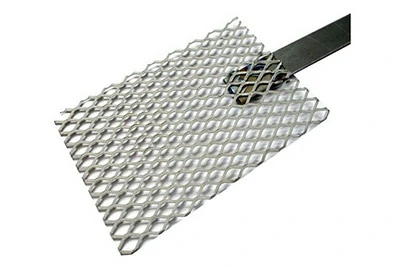
Electrodes are supplied as anode and cathode pairs, in formats including titanium mesh electrode, plate electrode, and custom profiles machined to drawing.
The coating system is set by the actual duty inside the electrode chamber and by the polarity scheme; we can run a specification review against your drawing and operating conditions.
Choosing the coating: what your electrode compartment actually sees
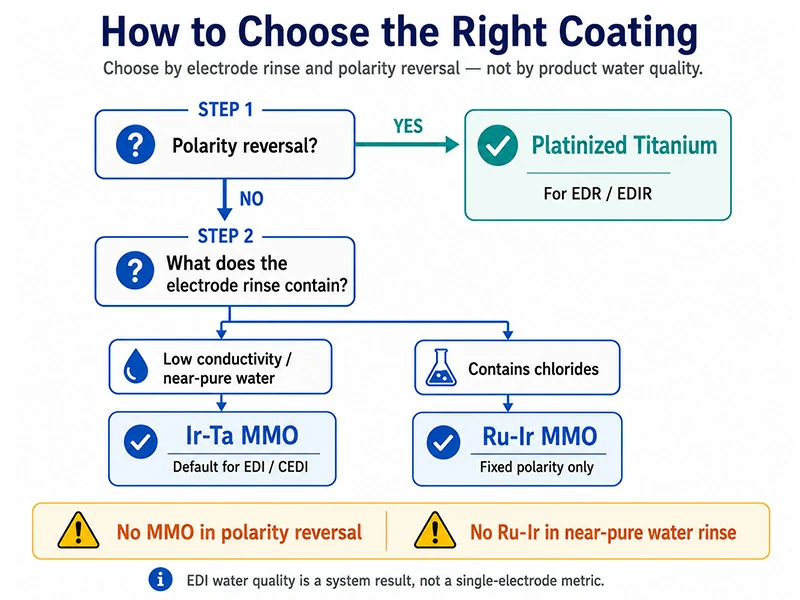
What decides the coating is not product water quality, but the stream flowing through the electrode chamber and whether polarity reverses.
In many ED and EDR stacks the two end electrode compartments run a separate electrode rinse (also called the electrode stream), commonly a sodium sulfate or sodium chloride solution. It is not the same water as the product water produced in the middle of the stack.
| - | Fixed polarity | Periodic polarity reversal (EDR / EDIR) |
| Low-conductivity / near-pure-water rinse | Ir-Ta and Ir-Ta-based multi-component MMO | platinized titanium |
| Chloride-containing rinse | Ru-Ir MMO | platinized titanium |
Fixed polarity with a low-conductivity rinse is the normal case for EDI and CEDI: the main anode reaction is oxygen evolution, which points to an iridium tantalum coated titanium anode. Tantalum acts as a stabilizing component in the coating and improves its tolerance in strongly oxidizing media. This is the default choice for a titanium electrode for EDI.
Polarity reversal (EDR / EDIR): the two end electrodes serve alternately as anode and cathode. Under our operating requirements, a precious metal oxide coating used as a cathode undergoes reduction at the surface and readily converts to metallic form, at which point it can no longer bond effectively to the titanium substrate and the coating comes away; bare titanium used as an anode faces vigorous surface oxidation and dissolves readily. No MMO coating is therefore suited to reversing-polarity operation, and this has nothing to do with the coating formulation.
Electrode compartments in ED and EDR normally use platinized titanium electrodes, and short-cycle electrodialysis reversal shortens electrode life significantly. For reversing duty the EDR electrode points to a platinized titanium electrode — that is, platinum-coated titanium — on either a titanium or a niobium substrate.
Fixed polarity with a chloride-containing rinse is the one window where Ru-Ir applies, and there it offers a low chlorine evolution overpotential and good value.
Outside that window it does not apply: a ruthenium-iridium coating is chlorine-evolving, and in near-pure, low-conductivity water the anode reaction shifts to oxygen evolution. Oxygen entering between the coating and the titanium substrate can cause irreversible coating damage. Ruthenium-based coatings are therefore not suitable for the electrode chamber of an EDI ultrapure water system.
| Coating system | Precious metal loading | Coating thickness | Substrate | Current density |
| Ir-Ta and Ir-Ta-based multi-component MMO | typical 8 g Ir/m² | approx. 6.5 µm | Grade 1 (TA1) default; Grade 2 available to specification | ≤2000 A/m² (approx. ≤186 A/ft²); higher available to specification |
| Platinized titanium | typical 21 g Pt/m² | typically 1–5 µm; 0.3–10 µm available to specification | Grade 1 / Grade 2; niobium substrate available to specification | Confirmed per project duty |
| Ru-Ir MMO | typical 8 g Ru + 2 g Ir/m² | approx. 6.5 µm | Grade 1 (TA1) | ≤2000 A/m²; higher available to specification |
The table gives typical values. Precious metal loading affects both the tolerance margin of the coating and unit price; coating thickness governs how much room is left for later recoating. Actual specifications are confirmed against the project drawing and duty — final values per project specification.
Substrate grades correspond to ASTM B265 plate, ASTM B348 bar, and ASTM B338 tube; Grade 1 titanium is also designated TA1 / UNS R50250.
EDI is normally the polishing step after RO, with product resistivity commonly quoted across the industry in a 10–18.2 MΩ·cm range, serving ultrapure water duties such as electronics, pharmaceuticals, and power plant boiler make-up. That figure is set by the whole system; it is not a performance rating of any single electrode.
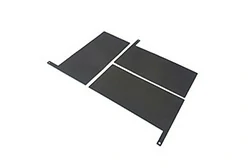
Ir-Ta Titanium Electrode
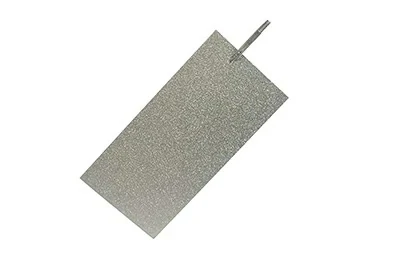
Platinized Titanium Electrode
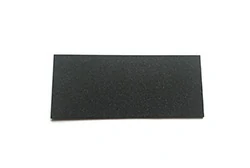
Ru-Ir Titanium Electrode
Will it fit your stack
Once the coating system is settled, whether an electrode gets used usually turns on one other thing: will it fit into your existing membrane stack. An end electrode carries current, takes part in the reaction, and forms part of the sealing interface all at once, so it has to be aligned with your stack item by item.
Formats
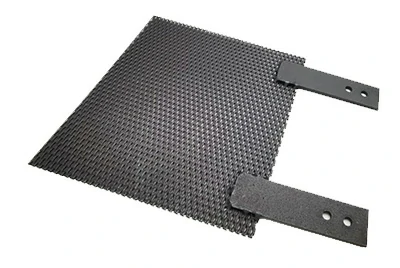
- titanium mesh electrode (including expanded mesh): large reaction area and low flow resistance, which helps electrode rinse circulation and gas release on the anode side.
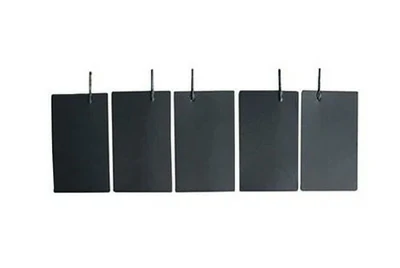
- plate electrode: compact, suited to stack end plates where space is limited.
- custom profile: shaped parts machined to drawing, including custom titanium electrode plate for membrane stack.
Available formats are plate / mesh / tube / custom profile.
Anode and cathode are supplied as a pair
The electrode compartments at the two ends of an ED or EDI stack are a pair, not a single piece. We supply anode and cathode for EDI module as a pair and review both ends together — replacing only one side changes current distribution and cell voltage.
In fixed-polarity systems the two poles have fixed roles and can each be designed around their own reaction. In reversing systems both ends alternate as anode and cathode, so both must follow the same scheme — not MMO on one side and bare titanium on the other.
Gas is released on the cathode side during operation; venting and ventilation of the electrode chamber should be handled per the system design requirements.
Coated face has a direction
A single-side coated electrode is a directional assembly part. The black oxide-coated face is the working face and must face the counter electrode on installation. The uncoated face forms a titanium dioxide (TiO₂) film during sintering, appearing blue or grey; it is electrochemically inert, passes no current to the electrolyte, and has no electrode function.
The coating orientation of single-side coated parts must therefore be marked on the drawing — fitted the wrong way round, the working gap has no catalytic face in it.
Colour variation on the uncoated face is often mistaken for a cosmetic defect. The actual reason: titanium electrodes are sintered repeatedly in an oxidation furnace during processing, and the precious metals in the coating oxidize and form a uniform crystalline structure with TiO₂. The uncoated face, by contrast, varies with the coating system (ruthenium-iridium and iridium-tantalum are oxidized at different temperatures), with size, with thickness, and with machined shape, so its colour after oxidation is not consistent. This is normal.
The table below is for identification only and is not a quality criterion:
| Temperature | Colour of the uncoated face |
| 200 °C (392 °F) | Silver-white |
| 300 °C (572 °F) | Pale yellow |
| 400 °C (752 °F) | Golden |
| 500 °C (932 °F) | Blue |
| 600 °C (1112 °F) | Purple |
| 700–800 °C (1292–1472 °F) | Reddish grey |
| 900 °C (1652 °F) | Grey |
Connection and sealing
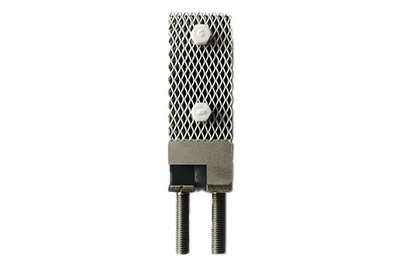
For electrical connection, terminal post, busbar, welded lug, and similar arrangements are confirmed against the stack design.
For assembly, the flatness and thickness consistency of the end electrode directly affect clamping of the cell stack and gasket sealing — which is why we anneal and flatten at the substrate stage.
All of the above is to be confirmed against your drawing. Send a drawing, or send one old electrode, and we return a point-by-point specification review before deciding whether to quote.
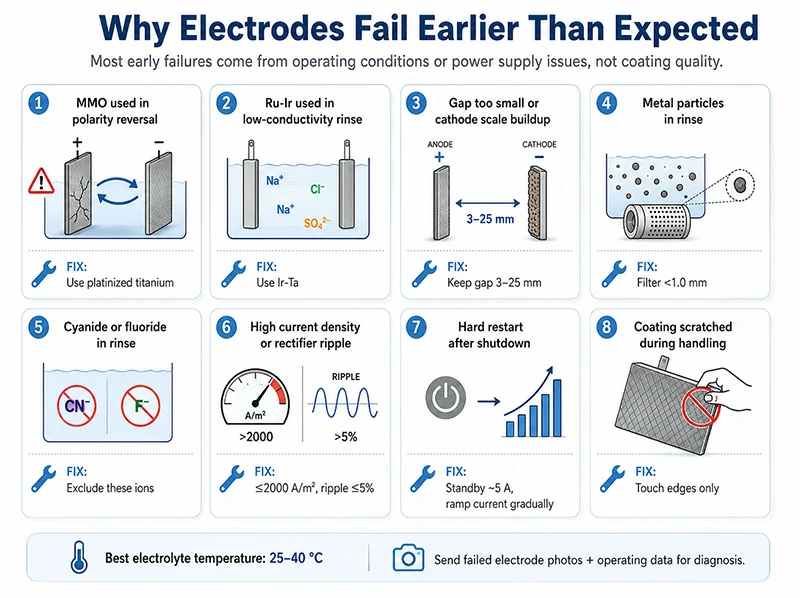
Why electrodes fail earlier than expected
Electrodes that fail early usually do not have a coating quality problem; the duty or the power supply conditions have moved outside what the electrode was designed for.
Below are the causes we meet most often around EDI electrode life, for you to check against.
| Symptom | Common cause | Condition we recommend |
| Local coating loss, life noticeably short | The system actually runs reversing polarity while the electrode is MMO coated | Switch to platinized titanium for reversing duty |
| Coating damaged across the whole face, cell voltage rising | A ruthenium-based coating used in near-pure-water rinse, with the anode shifting to oxygen evolution | Switch to Ir-Ta for low-conductivity rinse |
| Honeycomb-like electrochemical corrosion on the anode surface | Electrode gap too small; cathode scale short-circuits the plates | electrode gap generally 3–25 mm (0.12–0.98 in) |
| Short circuit between anode and cathode | Coarse metal particles in the rinse | Fit particulate filtration upstream, particle size <1.0 mm (0.04 in) |
| Corrosion of the titanium substrate | Cyanide or fluoride ions in the rinse | Both ion types must be excluded |
| Generally short life with no obvious single-point damage | Current density too high, or excessive rectifier ripple | current density ≤2000 A/m²; rectifier ripple factor ≤5% |
| Degradation as soon as the unit restarts after a shutdown | Soaking with the power off, or current raised to full in one step | Apply about 5 A standby current during shutdown; ramp current up and down gradually |
| Corrosion spreading outward from one point | The coating has been scratched | Handle by the uncoated areas and edges only |
Rectifier ripple is often overlooked, yet it is the classic case of "nothing wrong with the electrode, something wrong with the power supply" — the lower the rectifier ripple factor the better, and it should not exceed 5%.
Temperature: electrolyte temperature should not run too high; the ideal band is 25–40 °C (77–104 °F), with a heat exchanger added where conditions allow.
Scratches: the titanium substrate itself is not conductive. It is the outer precious metal oxide coating that carries the electrocatalytic activity, conductivity, and oxidation resistance, and that coating is only about 6.5 µm thick.
Once scratched, the electrode begins to corrode from the damaged point during electrolysis, which then affects the performance of the whole electrode and can shorten service life substantially if a heavy current is applied suddenly.
Wear clean gloves when handling, installing, and removing; grip the ends or the edges, and ideally touch only uncoated areas. Dilute acid or clean water may be used for cleaning during shutdown, but do not scrub with nylon or mechanical media.
If you have an electrode that failed early, send photos of the failed part together with the operating parameters and we will give a preliminary reading of the failure mode.
Batch-to-batch consistency
When switching to a second source, the question customers ask is usually not "how do you make it" but "will batch ten be the same as batch one". Our answer sits in three places.
Pre-shipment verification
After each machined batch is sintered, witness coupons are put through an accelerated life test — accelerated life testing on witness coupons sintered in the same furnace run — and the batch is packed and shipped only once the test passes.
The coupons go through the same furnace run as the product, so they reflect the actual coating condition of that batch. This is batch-level verification and is not extrapolated into a service life guarantee for the finished part.
Substrate and surface preparation
An electrodeionization electrode conventionally uses a Grade 1 titanium electrode substrate, also designated TA1 / UNS R50250; compared with Grade 2, Grade 1 has lower iron and oxygen content and higher purity.
Grade 2 and niobium substrates are available to specification. Substrates are annealed and flattened at >500 °C (>932 °F) to relieve machining stress and hold flatness, which bears directly on stack assembly and on how well the sealing faces mate.
They are then pickled for several hours in 10% oxalic acid held at a gentle boil, taking surface roughness to 6 µm. The acceptance criterion for pickling is a uniform grey matte structure across the surface — this step determines the bond strength between coating and substrate.

Coating and sintering
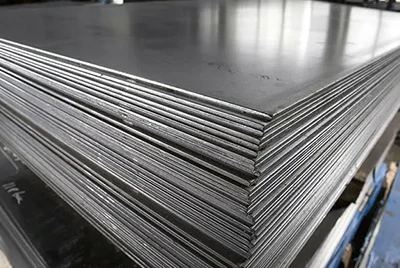
The precious metal solution is formulated qualitatively and quantitatively for the application environment, applied by hand, then sintered at a set temperature; parts cool naturally to room temperature out of the furnace before the next application, for a cumulative 12 to more than 20 coat-and-sinter passes. Mixed metal oxide (MMO) coating thickness is about 6.5 µm.
A dimensionally stable anode (DSA) of this kind holds its dimensions during electrolysis, so the interelectrode gap does not drift in service and cell voltage stays steadier. Against graphite and lead anodes, coated titanium electrodes can reduce DC power consumption by roughly 10%–20%.
About us
We are located in China's titanium resource base and run our own CNC machining equipment, which secures machining lead time and dimensional control; our sintering equipment is improved on an ongoing basis to keep batch production consistent.
On the R&D side we hold 2 invention patents and 7 utility model patents, and develop multi-component coatings using an electrochemical workstation. Manufacturing is carried out under ISO 9001 / ISO 14001 / ISO 45001 management system certification.
Replacement, recoating, and pilot batches
Replacement parts
EDI electrode replacement does not require you to identify a model number first. Send the dimensions and photos of the old electrode, or the original drawing, and we confirm dimensions and coating system against it. If the failure mode of the old part suggests the coating system did not match the duty, we say so in the review.
Recoating
Depending on how far the anode coating has been consumed, we offer return-to-works electrode recoating and anode refurbishment as a technical service.
Where the substrate is not excessively worn, it can be reused repeatedly, which helps lower total cost of ownership — the titanium substrate is usually the bulk of electrode cost.
Recoating feasibility is assessed on the returned substrate: whether a part can be recoated depends on the actual substrate condition once it arrives, and a sample can be sent first.
Pilot batches
For a new machine type or a first order, a small trial batch can be fitted before moving to volume, so you can verify assembly and running performance on your own stack.
Supply options, inspection documents, and RFQ boundaries
Supply basis
Supplied as anode and cathode pairs; formats plate / mesh / tube / custom profile; Grade 1 substrate as default, with Grade 2 and niobium available to specification.
Everything is made to drawing and to duty. Titanium frames, brackets, and other structural parts can be supplied alongside, likewise machined to drawing.
Packaging
Because the coating is only about 6.5 µm thick and sensitive to scratching, packaging is itself part of delivered quality.
Inspection documents
At project quotation stage, the following document types can be quoted with: material test certificate (MTC), certificate of conformity (COC), dimensional report, precious metal coating loading record, and the accelerated life test record for the witness coupon.
A few points to be clear about
- Ion exchange membrane and resin are outside our supply scope.
- An electrode cannot compensate for inadequate pre-treatment; feed water and electrode rinse quality should be controlled per the system design.
- Product resistivity, TOC, and pharmacopoeia-type figures are set by the whole system and are system-level performance.
- If the system runs short-cycle polarity reversal, an MMO coating is not the right choice and the case should be discussed as a reversing-duty one.
- Lead time, MOQ, and price are confirmed per order.
- HS code classification differs between a single electrode and a complete unit; confirming this early is advisable.
Three ways buyers come to us
Most enquiries come from one of three situations. Each needs different information from you, and each gets something different back.
An existing stack needs replacement electrodes
You have an EDI or ED stack in service and the OEM spare price or lead time does not work. What we need is the dimensions and photos of the old electrode, or the original drawing. What you get back is a point-by-point confirmation of dimensions and coating system, plus a judgement on whether the old part can be recoated first.
Selection for a new stack or a new machine type
You are designing or modifying and need to know what range the electrode can be made to. What we need is the electrode chamber duty and the polarity scheme. What you get back is the available coating systems, formats, and specification limits, plus a pilot batch recommendation.
Electrode life shorter than expected
The electrode failed early and the cause is unclear. What we need is photos of the failed part, the operating current, and the electrode rinse composition. What you get back is a preliminary reading of the failure mode, and an opinion on whether the coating system matches the duty.
Related products
Henan Chalco provides one-stop supply of MMO and platinized electrodes, titanium mesh anodes, niobium-based electrodes, and complete titanium anode equipment.
Iridium-tantalum MMO titanium anode

Platinized titanium anode
Ruthenium-iridium MMO titanium anode
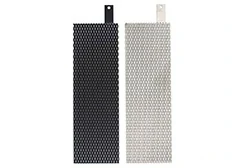
MMO titanium mesh anode
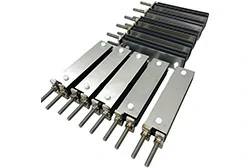
Titanium anode equipment
Platinized Niobium Electrode
Frequently asked questions
Which coating should I use for an EDI stack electrode?
For an EDI electrode running fixed polarity with a low-conductivity electrode rinse, the usual choice is an iridium-based oxygen-evolving coating, Ir-Ta.
Selection follows two steps: first ask whether polarity reverses periodically, then whether the electrode rinse contains chlorides. Once those two answers are settled, the coating system for a titanium electrode for EDI is essentially determined.
Can MMO coated electrodes be used with polarity reversal (EDR / EDIR)?
It is not suitable. An MMO coating used as a cathode undergoes reduction at the surface, readily converts to metallic form, and comes away from the titanium substrate, so reversing-polarity operation does not suit any MMO formulation.
For reversing duty the EDR electrode is normally a platinized titanium electrode.
Is Ru-Ir suitable for high-purity water?
It is not suitable. Ru-Ir is a chlorine-evolving coating; in near-pure, low-conductivity water the anode reaction shifts to oxygen evolution, and oxygen works its way in between the coating and the titanium substrate and damages the coating.
Where it genuinely applies is fixed-polarity ED with a chloride-containing electrode rinse.
Do I need a cathode as well as an anode?
Yes. An ED or EDI stack has an electrode compartment at each end, and anode and cathode work as a pair; Henan Chalco supplies them in pairs.
In reversing systems the two end electrodes alternate as anode and cathode, so both must be designed to the same scheme.
Can you make an electrode to match my existing stack?
Yes — reviewed either against a drawing or against the old part. Send the drawing, or the dimensions and photos of the old electrode, and we return a point-by-point specification review; once dimensions, coating system, and connection type are confirmed, we quote. You do not need to identify a model number first.
Which way does a single-side coated electrode face?
The black coated face is the working face and must face the counter electrode on installation.
The uncoated face is electrochemically inert and passes no current to the electrolyte, so the coating orientation of single-side coated parts should be clearly marked on the drawing.
Why is the back of my electrode a different color?
That is the titanium dioxide film formed on the uncoated face during sintering. Its colour varies with sintering temperature, running from silver-white through golden, blue, purple, and grey. It is normal, not a cosmetic defect.
Is this the same EDI as electronic data interchange?
No. EDI here means electrodeionization, an ultrapure water process that combines ion exchange resin with electrodialysis and continuously regenerates the resin in an electric field.


