

Titanium Electrodes for Electrolyzed Water Appliances
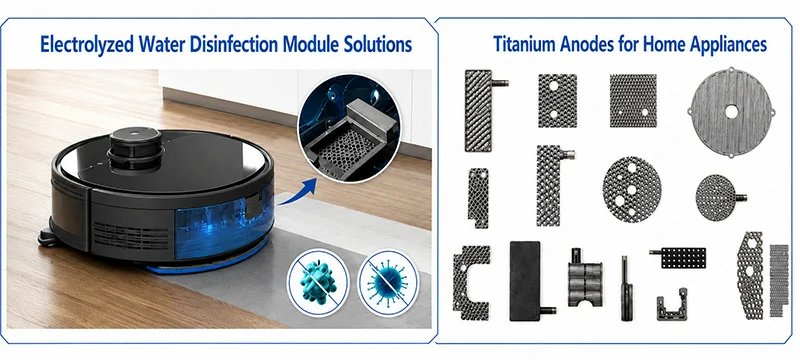
Updated : Aug. 21, 2026Henan Chalco supplies titanium electrodes and electrolysis modules for built-in electrolyzed water disinfection in home appliances.
We supply five surface systems — Ru-based, Ru-Ir, Ir-based, Sn-Sb and platinized — in mesh, plate, sheet, tube and rod forms, customized to drawing and to your feed-water conditions.
What Henan Chalco supplies
Supply levels:
| Supply level | Product | Best for |
| Single electrode | Single anode or cathode | You already have a complete cell design |
| Electrode pair | Matched anode–cathode pair with gap setting and insulators | You have the flow path and need the matched pair |
| Electrode stack | Multiple pairs assembled into an electrode pack | You need a larger electrolysis area |
| Complete module | Complete cell with flow path, housing and connections | You would rather not build flow-field validation in-house |
Customization covers: outline dimensions, apertures and mesh openings, terminal position and conduction method, electrode gap, flow-path design, housing interfaces, coating system and coating loading.
Substrate: Grade 1 / Grade 2 titanium per ASTM B265.
Documents: material certificate, dimensional report, coating system description, RoHS test report
Henan Chalco operates automated electrode production lines with stable volume output, in-house product inspection, and its own R&D capability for coating formulations and processes.
The quality management system is ISO 9001 certified, with the certification scope covering the manufacture of metal anode products.
Send us your electrode drawing or cell drawing together with the feed-water TDS and hardness, and we will run a first review of coating system and structure.
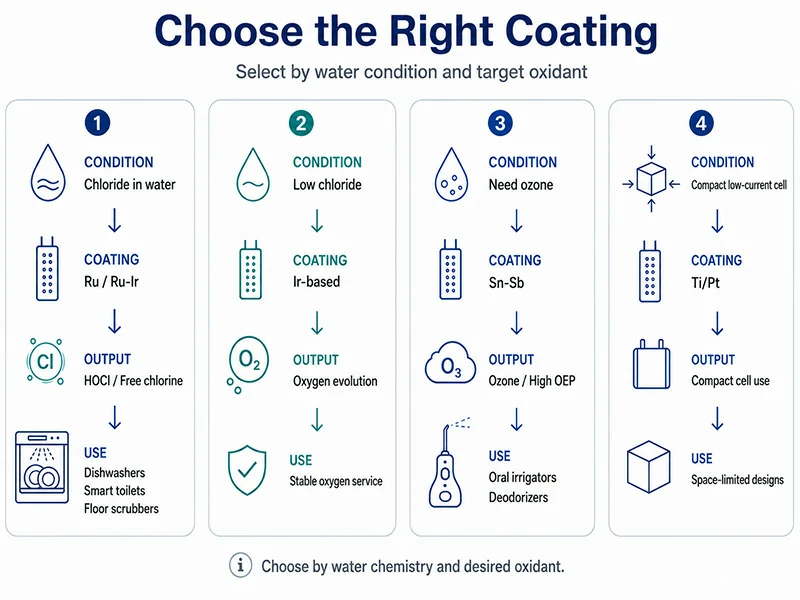
Coating options and what they evolve
Choosing a coating is not a question of which one lasts longest. It is a question of what is in your water and what oxidant you need to produce.
| Coating | Main electrolysis product | Typical fit |
| Ru / Ru-Ir mixed metal oxide | Chlorine → HOCl | Chloride-bearing water; the mainstream route |
| Ir-based mixed metal oxide | Oxygen | Low-chloride, acidic or oxidizing service, chosen for stability |
| Sn-Sb oxide | Ozone | Personal-care and deodorizing small appliances |
| Platinized titanium (Ti/Pt) | Depends on service conditions | Compact cells and current-limited designs |
The first three are mixed metal oxide (MMO) coated titanium electrodes, also commonly called DSA (dimensionally stable anodes) in the industry.
Platinized titanium is not an MMO — it is a metallic platinum plating, not a metal oxide coating.
Choosing a coating by the oxidant you need
Chlorine-evolving coatings for HOCl generation
Ru-based and Ru-Ir mixed oxides have a low chlorine evolution overpotential in chloride-bearing water. The anodic reaction is 2Cl⁻ − 2e⁻ → Cl₂, followed by Cl₂ + H₂O → HOCl + HCl, producing hypochlorous acid.
This is the mainstream route for electrolyzed water disinfection in appliances: salt-dosed produce washers and dishwashing sinks, along with smart toilets and floor scrubbers that electrolyse tap water directly, mostly follow this path.
These coatings depend on sufficient chloride ion in the water. When the feed approaches pure water and chloride is severely short, the anodic reaction shifts from chlorine evolution to oxygen evolution — and chlorine-evolving coatings are not designed for sustained oxygen evolution, so running in that condition long-term accelerates coating loss.
Iridium-based coatings for oxygen-evolution service
Ir-based coatings are positioned for stability under oxygen evolution service, not for chlorine production. They suit low-chloride water or acidic and oxidizing electrolytes, and their value lies in coating durability under those conditions.
Ir-based coatings are often described as "highly efficient at generating hydroxyl radicals and well suited to breaking down organics." Under the accepted active / non-active anode classification the opposite is true — published research groups RuO₂, IrO₂ and Pt as active anodes: their oxygen evolution overpotential is low, surface hydroxyls are chemisorbed and tightly bound, and fewer free hydroxyls remain available for reaction;
while SnO₂, PbO₂ and BDD are grouped as non-active anodes, with a high oxygen evolution overpotential and hydroxyls that are physisorbed and more freely available — this is the material family behind ·OH-dominated oxidation.
So if your goal is to break down organic residues via ·OH, the selection should point to the high-oxygen-overpotential material family — the Sn-Sb system in our range — not to Ir-based coatings.
Tin-antimony coatings for electrolytic ozone and high-overpotential service
Sn-Sb coatings belong to the non-active family described above, with a high oxygen evolution overpotential.
Their main use in appliances is electrolytic ozone generation. The anodic reaction is 3H₂O − 6e⁻ → O₃ + 6H⁺, and typical applications are oral irrigators and compact deodorizing units — products with very small water volumes where salt-dosed chlorine evolution is not practical.
Sb-doped and Ni-Sb co-doped SnO₂ systems can reach substantial ozone current efficiency in acidic electrolyte at room temperature.
Platinized titanium for compact, low-current cells
Ti/Pt platinized electrodes are available with plating thickness from 0.5 to 20 μm, selected against current density and service life requirements.
They belong to the active material family and are chosen where the cell is compact, the current budget is limited, or the service conditions make MMO unsuitable.
Compared with MMO oxide coatings, platinum carries a clearly higher material cost and is usually not the first choice for large-area electrodes.
How to choose
| Your feed water | Oxidant you need | Suggested direction | What to send us |
| Chloride-bearing (tap water or salt-dosed) | Free chlorine / HOCl | Ru or Ru-Ir | TDS range; whether salt is dosed |
| Low chloride, acidic or oxidizing | Stable oxygen-evolution service | Ir-based | Electrolyte composition; current density |
| Tap water, ozone or ·OH route needed | Ozone / high-oxygen-overpotential service | Sn-Sb | Cell dimensions; power scheme; expected validation timeline |
| Space and current limited | Depends on the case | Platinized Ti | Structural drawing; current ceiling |
Tell us your feed-water conditions and target oxidant, and we will identify the coating that fits best.
Electrode specifications
| Item | Specification |
| Substrate | Grade 1 / Grade 2 titanium per ASTM B265 (equivalent grades TA1 / TA2) |
| Coating systems | Ru-based, Ru-Ir mixed oxide, Ir-based, Sn-Sb, Pt plating |
| Coating thickness | MMO systems 0.2–20 μm; platinized 0.5–20 μm, available to specification |
| Forms | mesh, plate, sheet, tube, rod, perforated disc |
| Dimensions / open area | custom to drawing |
| Electrode gap | custom to cell design |
| Chlorine evolution potential | Appliance series ≤1.07 V; brine-reversing and chlorine-generation series ≤1.13 V |
| Chlorine evolution polarization rate | ≤40 mV |
| Oxygen evolution potential | ≥1.9 V |
Potential values cannot be compared across sources without their test conditions; a complete statement includes reference electrode, electrolyte composition and concentration, temperature, current density, effective electrode area and test method.
A few assembly-level items also need to be fixed during design: inlet and outlet direction and flow field (which govern bubble release and concentration uniformity), terminal position and conduction method, and protection of the coated face during handling and assembly — a scratch on the coated face becomes a local failure point.
Whether you need an electrode sheet, a matched pair of electrolytic plates or a complete electrode pack, all can be built to drawing.
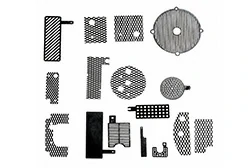
Titanium anodes for home appliances

Brine polarity-reversing electrodes
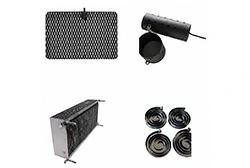
Tap-water polarity-reversing electrodes
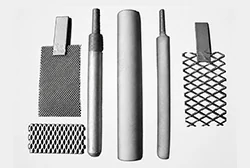
Chlorine-generation electrodes
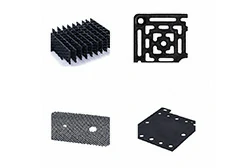
Ozone-generation electrodes
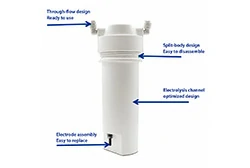
Under-sink electrolytic cell
Anode, cathode, and polarity-reversing pairs
This section answers a question that selection tables usually skip but structural design always runs into: the coatings above apply to which face?
Fixed-polarity designs
Anode and cathode requirements are entirely different.
The anode carries the oxidation reaction and needs an electrocatalytic coating; the cathode mainly evolves hydrogen and its coating requirements are far lower — many designs simply use uncoated titanium or another conductive material.
Polarity-reversing designs are a different case
When the pair reverses periodically, both faces take the anodic duty in turn, so both usually need coating, and the formulation has to survive repeated polarity switching. This is the direct reason a reversing electrode costs more per piece than a fixed-polarity one.
For appliance design this means three inputs that must be settled before prototyping:
- Fixed polarity or periodic reversal
- If reversing, at what interval
- Whether the cathode side also needs coating (which follows from item 1)
Until these three are fixed, any coating recommendation or quotation can only be a range.
Two polarity-reversing electrode series: tap water and brine
Reversing electrodes are not a single specification but two product lines split by electrolysis medium. The medium sets the coating formulation and the chlorine evolution potential, and it sets the price.
| Item | Tap-water reversing electrode | Brine reversing electrode |
| Substrate | Grade 1 / Grade 2 titanium (TA1 / TA2) | Grade 1 / Grade 2 titanium (TA1 / TA2) |
| Coating system | Ru / Pt / Ir based | RuO₂-based mixed oxide |
| Chlorine evolution potential | ≤1.07 V | ≤1.13 V |
| Forms | mesh, plate, sheet | mesh, plate, tube, rod, custom to drawing |
| Coating thickness | 0.2–20 μm | 0.2–20 μm |
| Typical appliances | Disinfecting dishwashers, produce washers, smart toilets, disinfecting washing machines, food purifiers, portable sanitizers, floor scrubbers and mopping robots | Sodium hypochlorite generators, hypochlorous acid generators, disinfecting dishwashing sinks, produce washers, pool disinfection equipment, water-electrolysis chemical controllers |
The tap-water type faces low chloride concentration and scaling; the brine type faces a sustained chlorine evolution load at high chloride concentration.
The two are not interchangeable — running a salt-dosed appliance on tap-water-type electrodes puts the chlorine evolution load beyond the design condition.
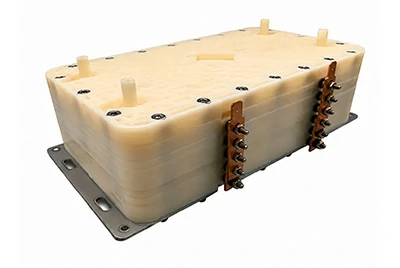
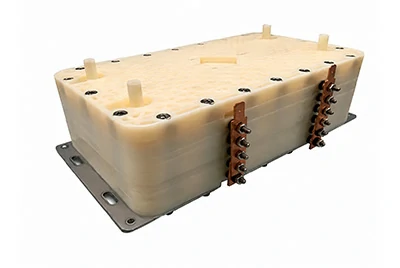
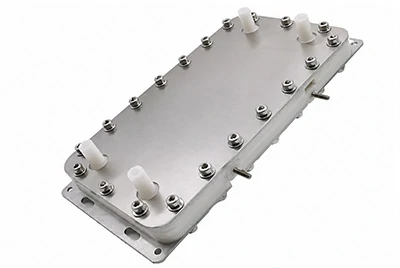
From electrode pairs to complete electrolysis modules
If you already have flow-path and sealing design capability, buying electrode sheets is usually more flexible and cheaper; if the appliance project needs a shorter development cycle and you would rather not validate flow field and bubble release yourself, a module is the faster path.
The operating windows of the five appliance-grade module types are below:
| Module type | Feed water | Temperature | Electrical | Flow rate | Output |
| Under-sink cell | Municipal tap water, TDS 160–225 ppm | 5–40 °C (41–104 °F) | DC 12 V constant voltage, 0.2–1.0 A | 200–800 ml/min | Free chlorine 0.5–1.0 mg/L |
| Ozone-and-chlorine cell | Municipal tap water, TDS 160–250 ppm | 5–40 °C (41–104 °F) | DC 12 V constant voltage, 0.2–1.0 A | 200–800 ml/min | Ozone 0.3–1.0 ppm; free chlorine output |
| Membrane HOCl cell | NaCl solution | 0–40 °C (32–104 °F) | 0–36 V, 0–14 A constant current | 1 L/min | Free chlorine 10–100 ppm, pH 2–4 |
| Membrane-free HOCl cell | Dilute hydrochloric acid feed | 0–40 °C (32–104 °F) | 0–36 V, 0–22 A constant current | 1–3 L/min | Free chlorine 50–1,000 ppm, pH 7–9 |
| Acid–alkaline cell | NaCl solution or tap water | 0–40 °C (32–104 °F) | ≤0.2 MPa | 1–3 L/min each | Acidic water pH 1.5–6.5; alkaline water pH 7–12.5 |
Working pressure: the first two types 0.07–3.0 kgf/cm²; the last three ≤0.2 MPa. Typical working life of the membrane-free and acid–alkaline types is >5,000 h.
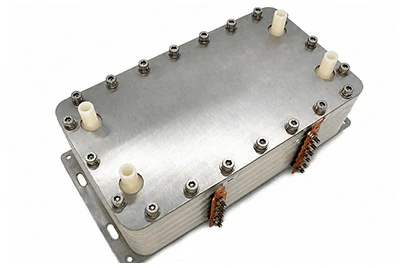
The membrane and acid–alkaline types use a multi-layer electrolysis structure, and stages can be stacked to match output volume and concentration. The acid–alkaline type is available in 3 / 5 / 7 / 9 / 11 stages, 206 × 105 mm in outline, with thickness from 35 to 76.5 mm depending on stage count.
The under-sink type is a flow-through design that produces on demand with no storage; the split housing is easy to open and the electrode pack can be replaced on its own — this directly drives later maintenance cost and spare-part strategy for the appliance, and is worth settling at the structural design stage.
The first two types electrolyse tap water directly, so output depends on the chloride already present in the water; when the feed TDS falls below the window, free chlorine output drops noticeably. That is not a module fault — the electrochemical condition simply is not met. Appliances sold into soft-water regions need this accounted for at the design stage.
Electrode selection by appliance type
Water volume, duty cycle and feed-water conditions differ widely between appliance types, and so does electrode selection.
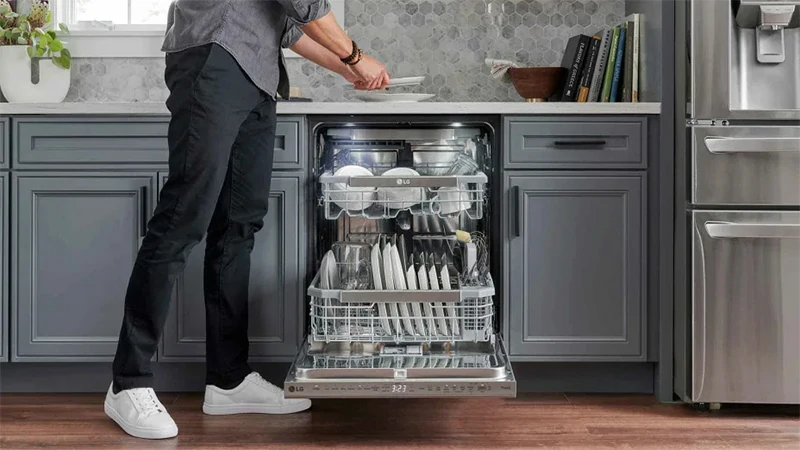
Dishwashers and produce washers
What they share is high water volume, a need for large contact area, and food contact.
The coating direction depends on whether salt is dosed: with salt, the chlorine evolution route produces HOCl; without salt, first verify that the chloride in the water is sufficient to sustain chlorine evolution.
In form, large-area sheet or mesh electrode packs are common.
For an RFQ we need: cell dimensions and mounting method, whether salt is dosed, run time per cycle, and target market.
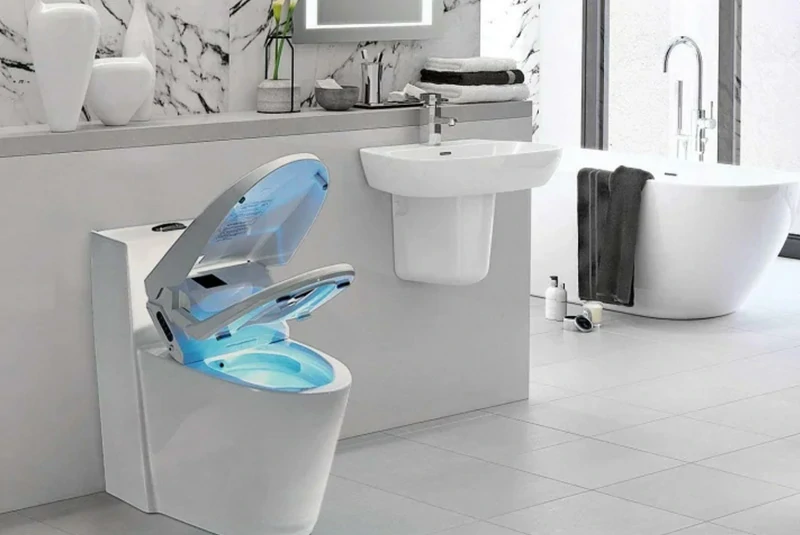
Smart toilets and bidet seats
Electrolyzed water here is mainly used for nozzle self-cleaning and ceramic bowl spray, with small water volume per cycle, intermittent duty and tight installation space.
Coatings are mainly chlorine-evolving, electrodes are usually small sheets, and operating current is low. Selection focuses on stability under long-term intermittent duty.
For an RFQ we need: available installation space, run time and interval per cycle, and feed-water quality.
Floor scrubbers and mopping robots
These electrolyse tap water directly without salt dosing, ship into regions with widely different TDS, and run continuously.
This category is the most sensitive to reversal strategy — in hard-water regions the cathode scales quickly and the reversal interval has to be shorter, while more frequent reversal consumes the coating. It is worth fixing the target-market water-quality range before selection.
For an RFQ we need: tap-water TDS and hardness range in the target market, tank capacity, and run time per cycle.

Oral irrigators, ozone washers and compact deodorizing units
This group follows the Sn-Sb electrolytic ozone route, covering oral irrigators, household ozone sanitizing water units (hand rinsing, tableware sanitizing, kitchenware and indoor pet odours) and compact deodorizing purifiers (refrigerator, shoe cabinet, bathroom).
Water volumes run from very small to moderate, and electrodes are usually miniature to small sheets. The constraint comes from structural space and power scheme rather than electrolysis area; allow a fuller prototype validation window.
For an RFQ we need: electrolysis chamber dimensions, power supply method and current ceiling, and run time per cycle.
Sterilizing cabinets, washing machines and air sanitizers
These products mostly use filter wetting or spray: hypochlorous acid solution generated by salt-dosed electrolysis wets the filter, contaminated air is sanitized and deodorized through gas–liquid contact, and on some models an exhaust fan carries a trace of hypochlorous acid out to suppress bacteria on surrounding surfaces.
The same structure appears in wall-mounted and ducted fresh-air systems. Electrodes are mainly chlorine-evolving sheets or mesh, and the key is matching circulation method to duty cycle.
For an RFQ we need: circulation method, cycle duration, chamber or tank capacity, and whether salt is dosed.
Service life, polarity reversal and water-quality windows
Electrode service life is not an intrinsic product property but a function of service conditions. At least three variables set it together: current density, polarity-reversal interval, and water chemistry.
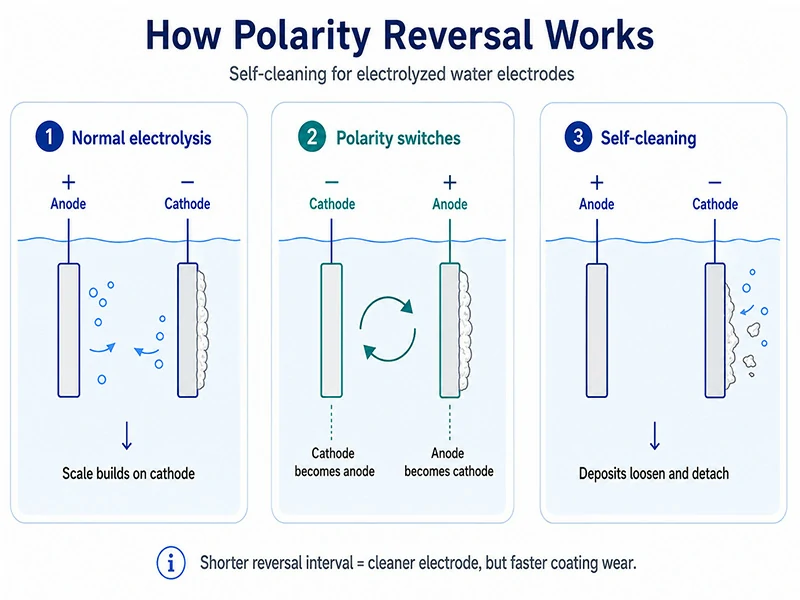
Why polarity reversal is required
In tap water, and especially in hard water, the cathode side continuously deposits scale consisting mainly of Ca(OH)₂, CaCO₃ and Mg(OH)₂.
The deposit blocks contact between electrode and water, raises cell voltage, and pulls down free chlorine or ozone output. Periodic polarity reversal briefly turns the former cathode into an anode, loosening and shedding the deposit for self-cleaning.
The cost of reversal
Reversal is not free.
Published research has systematically studied coated titanium electrodes under current reversal, and the conclusion is clear: the higher the reversal frequency and the greater the current density, the shorter the coating life — and under identical reversal conditions, life can differ several-fold between coating formulations.
How we define service life
| Test condition | Current density | Reversal interval | Result |
| 1 M H₂SO₄ (accelerated) | 20,000 A/m² | — | ≥ 200 h |
| 1 M H₂SO₄ | 1,000 A/m² | 5 min | ≥ 100,000 cycles |
| Tap water, TDS ≥ 350 ppm | 500 A/m² | 5 min | ≥ 5,000 cycles |
| Pool water, NaCl ≤ 2,000 ppm | 2,000 A/m² | 5 min | ≥ 6,000 cycles |
Data source: Henan Chalco test data under the conditions listed. Test reports can be supplied with samples.
Water-quality windows
- TDS floor: below the module window, output drops noticeably; as the feed approaches pure water, chlorine evolution shifts to oxygen evolution, which is a damaging condition for chlorine-evolving coatings.
- Hardness: the higher the Ca and Mg content, the faster the scaling and the shorter the reversal interval needed — which in turn consumes coating life directly. For export models covering hard-water regions, this needs to be fixed at the design stage.
- Temperature: the module working window is 5–40 °C (41–104 °F) or 0–40 °C (32–104 °F), depending on type.
How to recognize failure
- Free chlorine or ozone output falls steadily at the same settings
- White deposit appears on the electrode surface and output does not recover after cleaning
- Cell voltage rises abnormally under constant-current operation
- Visible spalling or exposed substrate on the coated face
Return for recoating
Electrodes and cells can be returned for recoating and refurbishment, which lowers later maintenance cost.
Whether it applies depends on substrate condition and failure mode, and can be confirmed after a repair assessment.
What an electrode supplier can and cannot certify
What we can certify: substrate material identity (Grade 1 / Grade 2 per ASTM B265), coating system, electrochemical performance and reversal life results under stated test conditions, and the substance compliance documents we can supply.
What we cannot substitute for: appliance-level disinfection efficacy validation, product authorisation and labelling compliance in your target market, and the specific wording of end-user instructions. These must be completed by the appliance maker in its markets of sale.
Supply, inspection documents
The following documents can be confirmed at quotation: titanium substrate material certificate, coating system description, dimensional report, RoHS test report, REACH SVHC statement.
Packaging is designed to buyer requirements and product form; the coated face must not be scratched during handling and assembly, and packaging design starts from protecting that face.
On customs classification: tariff classification of electrodes and electrolysis modules varies with product completeness (whether housing and power supply are included), whether the goods are declared as finished articles or as parts, and the importing country's current customs interpretation — applicable duty rates and trade measures vary with it.
We recommend confirming this separately against your final product form and destination country before purchase.
Related products
The product lines below share the same coating systems and titanium substrate processes as the built-in appliance modules on this page;
if your appliance solution also involves standalone electrodes or complete electrolysis equipment beyond the module, list them in the same RFQ and we will give specification recommendations for each service condition.
Ru-Ir Titanium Anodes
Platinized Titanium Anodes
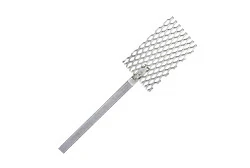
Titanium Mesh Anodes
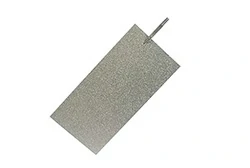
Titanium Plate Anodes
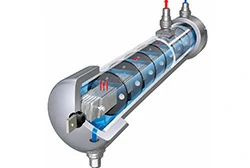
Sodium Hypochlorite Electrodes
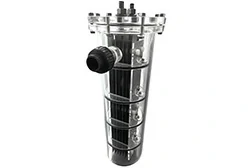
Water Treatment Electrolytic Cells
Frequently asked questions
How is the service life of an electrolyzed water electrode defined?
By cycle count or operating hours under a stated water quality, current density and reversal interval — not as a blanket number of years.
Does hard water shorten electrode life?
Yes. Hard water accelerates cathode scaling and usually calls for a shorter reversal interval, and more frequent reversal consumes the coating.
This is a trade-off to be calibrated against target-market water quality, not something a "better coating" gets you around.
What TDS is needed for a tap-water electrolysis module to produce free chlorine?
Each module type has its own feed-water TDS window, below which output drops noticeably. For reference, modules that electrolyse tap water directly sit around TDS 160–225 ppm, while electrode life testing uses TDS ≥ 350 ppm as one of its conditions.
Which coating should I choose — Ru-Ir, iridium-based, Sn-Sb or platinized?
Choose by what you need to electrolyse out, not by which coating is better.
For HOCl, use Ru or Ru-Ir; for ozone or high-oxygen-overpotential service, use Sn-Sb; Ir-based coatings are chosen for stability under oxygen evolution; where space and current are limited, consider platinized.
Do iridium-based coatings generate hydroxyl radicals?
Under the accepted active / non-active anode classification, IrO₂ is an active anode: its oxygen evolution overpotential is low and fewer free hydroxyls remain available for reaction.
The ·OH-dominated route generally belongs to the high-oxygen-overpotential material family, such as SnO₂ and BDD.
Is more frequent polarity reversal always better?
No. More frequent reversal keeps the cathode cleaner but consumes the coating faster.
The right interval depends on feed-water hardness and duty cycle, and needs calibrating at the prototype stage.
In a polarity-reversing design, do both electrodes need coating?
Usually yes.
Under reversal both faces take the anodic duty in turn, so both generally need coating, and the formulation has to survive repeated polarity switching — which is also why reversing electrodes cost more than fixed-polarity ones.
Can I advertise a disinfection rate for my appliance?
It depends on your target market and your efficacy data. In the United States, efficacy claims must be supported by test data; in the EU, products generating active chlorine in situ require product authorisation. Efficacy data must be obtained at appliance level.
Is this the same as a hydrogen-water or alkaline-water electrode?
No. This page covers chlorine-evolving, oxygen-evolving and ozone electrodes for disinfection. Hydrogen-rich water and alkaline ionized water belong to a different electrode system and a different application.
Are "electrolysed water", "EO water" and "ECA" the same thing?
They are broadly the same technology named differently across industries and regulatory texts. "Electrolysed" is the British spelling, EO water means electrolyzed oxidizing water, and ECA means electro-chemical activation.
What to send with your RFQ
Send the following together and we can quote quickly:
- Electrode dimensional drawing or cell drawing, including apertures and mounting
- Target oxidant: free chlorine / ozone / high-oxygen-overpotential service
- Feed-water quality: TDS range, hardness, whether salt or acid is dosed
- Electrical conditions: voltage, current, constant voltage or constant current
- Polarity scheme: fixed polarity or periodic reversal; if reversing, at what interval
- Flow rate and operating temperature
- Per-unit quantity and estimated annual volume
- Target market, for document alignment
- Whether you need OEM / white-label supply


