

Titanium Finned Tube
Updated : Aug. 24, 2026A titanium finned tube is an enhanced heat transfer tube with continuous spiral fins formed on the outside surface of a titanium heat exchanger tube. It is primarily used in condensers, steam condensers, and shell-and-tube heat exchangers. The external fins increase shell-side heat transfer area, disrupt and thin the local condensate film, and promote condensate drainage from the tube surface.
The design combines external fin enhancement with a smooth internal bore, balancing condensation heat transfer, tube-side flow, and cleaning and maintenance requirements. It is suitable for seawater, brine, chloride-bearing cooling water, and other corrosive condensing services. Fin geometry and tube dimensions can be customized to heat exchanger drawings, circulating-water quality, and operating conditions.
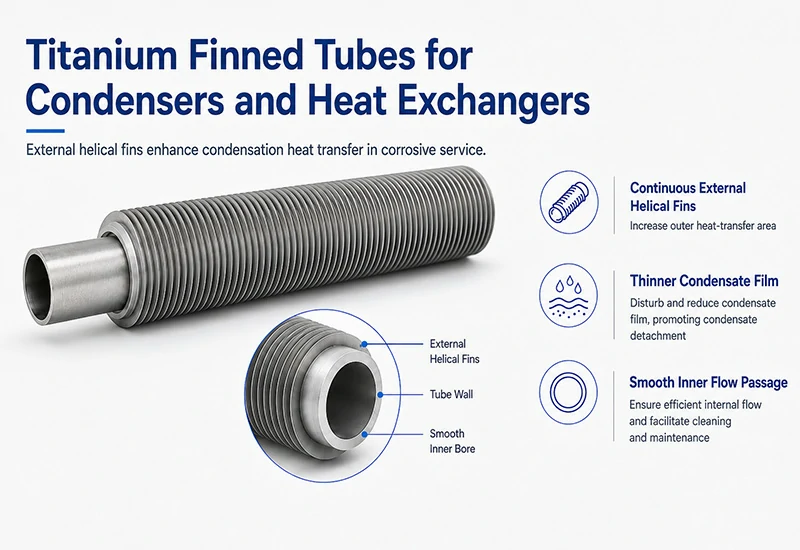
- Enhanced shell-side condensation: Increases outside heat transfer area and promotes condensate drainage.
- Smooth internal bore: Helps control tube-side pressure drop and supports easier cleaning.
- Designed for corrosive service: Suitable for seawater, brine, and chloride-bearing cooling-water systems.
- Customized to operating conditions: Fin height, fin density, helix angle, fin-tip profile, plain-end length, and overall tube length.
Submit drawings and operating conditions for specification review and quotation.
Titanium Finned Tube Specifications and Customization
Tube dimensions and external fin parameters can be adjusted to condenser geometry, thermal design, and operating conditions. The following represents the typical supply range; special dimensions and fin configurations can be evaluated against project drawings.
| Parameter | Typical Specifications and Options |
| Material | Grade 1 / Grade 2; other titanium grades subject to project review |
| OD | 12.7-25.4 mm |
| Nominal wall | 1.0-2.0 mm |
| Fin density | 19-36 FPI (fins per inch) |
| Fin height | 0.4-1.44 mm |
| Helix angle | Determined by circulating-water quality, product drawing, and heat exchanger design |
| Fin-tip profile | Continuous flat fin tip or serrated fin tip |
| Internal surface | Smooth bore, without internal threads |
| Tube length | Up to 11 m |
| Special requirements | Plain ends, tube-end dimensions, and dimensional tolerances confirmed to drawing |
For quotation, please provide OD, wall thickness, tube length, fin height, fin density or pitch, helix angle, fin-tip profile, and quantity. Where the tubes must match an existing tubesheet, baffle arrangement, or tube bundle, also provide product drawings or sample-tube measurements, including plain-end and tube-end requirements.
Titanium Finned Tube Types
Based on how the fins are formed and joined, titanium finned tubes are commonly classified as integral spiral low fin tubes, wrapped or embedded fin tubes, and extruded high fin tubes. These designs differ in heat transfer medium, equipment type, and fin geometry and should not be interchanged simply because they share the name "Titanium Finned Tube."
The comparison below distinguishes common titanium finned tube constructions. This page focuses on titanium integral spiral low fin tubes (Titanium Integral Low Fin Tube). The continuous low fins are rolled directly from the titanium tube wall to enhance shell-side condensation and fit shell-and-tube condenser and steam-condenser bundles. Other constructions are subject to separate project review.
Comparison of Three Titanium Finned Tube Types
| Comparison | Integral Low Fin Tube | Wrapped / Embedded Fin Tube( L / LL / KL / G Type) | Extruded High Fin Tube |
| Fin forming | Rolled directly from the titanium tube OD | Fin strip wrapped, tensioned, or embedded | Outer metal layer extruded into fins |
| Construction | Fins integral with the tube body | Fin and base tube assembled together | Continuous outer layer over the base tube |
| Fin geometry | Low, closely spaced fins for compact bundles | Higher fins with several joint designs | Continuous high fins with a large air-side area |
| Enhancement | Shell-side condensation and drainage | Air- or gas-side heat transfer | Air- or gas-side heat transfer |
| Typical equipment | Condensers, steam condensers, chillers | Air coolers, air heaters, fin-fan heat exchangers | Industrial air coolers and air-cooled equipment |
| Design focus | Fin height, density, root wall thickness, plain ends | Joint method, bond integrity, operating temperature | Fin height, material combination, extrusion quality |
Integral spiral low fin tubes are better suited to shell-and-tube condensing equipment, while wrapped, embedded, and extruded high fin tubes are generally used for air- or gas-side heat transfer. The three constructions are not normally interchangeable.
How Titanium Low Fin Tubes Enhance Condensation Heat Transfer
Integral spiral low fins primarily enhance shell-side heat transfer. In addition to increasing surface area, they thin the condensate film and promote continuous drainage, reducing the thermal resistance caused by liquid-film accumulation.
Increase Effective Shell-Side Heat Transfer Area
Continuous low fins increase the outside surface area per unit tube length, providing more active heat transfer area within essentially the same tube-bundle envelope.
Thin the Condensate Film
When vapor or refrigerant condenses outside the tube, the liquid film covers the heat transfer surface and creates thermal resistance. Spiral fins redistribute the condensate and help keep the local film thinner.
Promote Continuous Condensate Drainage
Continuous fins and the channels between them provide drainage paths, helping condensate leave the heat transfer surface more quickly so fresh vapor can continue contacting the tube wall.
The standard titanium finned tube retains a smooth internal bore, focusing enhancement on shell-side condensation while supporting controlled tube-side pressure drop, fouling management, and cleaning access.
The value of titanium finned tubes does not come from higher thermal conductivity of the titanium itself. It comes from combining titanium corrosion resistance with an externally finned condensing surface for reliable long-term operation in corrosive condensing service.
Applications of Titanium Finned Tubes
Titanium finned tubes are primarily used where condensation occurs on the tube outside surface and the equipment requires high corrosion resistance, operating reliability, and tube-bundle service life. Continuous spiral fins increase shell-side heat transfer area and promote condensate drainage, while the smooth bore helps control tube-side pressure drop and supports cleaning and maintenance.
Chiller Condensers
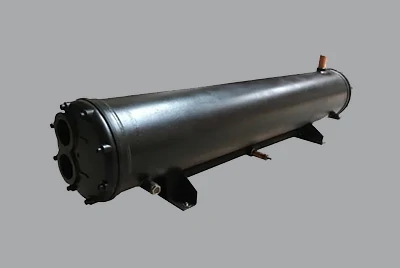
Used as condensing heat transfer elements in centrifugal and screw chillers. The external fin structure enhances shell-side condensation and is suited to condenser designs requiring more outside heat transfer area per unit tube length.
Power Plant Steam Condensers
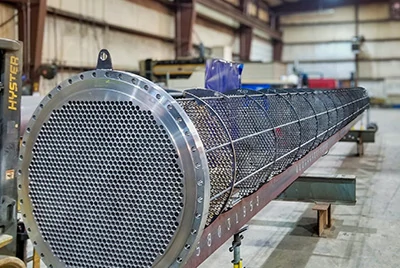
Used for steam condensation against circulating cooling water. Titanium is suitable for condenser projects where tube-bundle corrosion resistance, leakage risk, and long-term operating reliability are critical.
Corrosive Industrial Condensers
Used in industrial condensers where conventional metal tubes face higher corrosion risk or where shutdown, retubing, and maintenance costs are high. Suitability should be confirmed against tube- and shell-side media, temperature, pressure, water quality, and bundle geometry.
Titanium finned tubes are primarily designed for shell-side condensation enhancement. Flooded boiling, falling-film evaporation, and tube-side evaporation require the corresponding enhanced titanium tube design.
How to Choose Between Titanium, Copper, and Stainless Steel Finned Tubes
No material is universally superior; the correct choice depends on the process medium, equipment design, and operating objectives. Copper favors high thermal conductivity and mature fabrication; stainless steel balances strength, cost, and moderate corrosion resistance; titanium generally offers stronger long-term value in seawater, brine, chloride-bearing cooling water, and other high-corrosion-risk services. Final selection should consider medium chemistry, temperature, and material combinations.
| Factor | Titanium Finned Tube | Copper Finned Tube | Stainless Steel Finned Tube |
| Main strength | Corrosion resistance, lower weight, and long-term reliability | High thermal conductivity and mature fabrication | High strength with a balanced cost-to-corrosion-resistance profile |
| Main limitation | Higher initial cost and more demanding fabrication | Corrosion and service life require evaluation in complex water chemistry | Lower conductivity than copper; corrosion resistance depends on grade and medium |
| Suitable media | Seawater, brine, chloride-bearing cooling water, and corrosive media | Clean water, common refrigerants, and low-corrosion environments | Industrial cooling water, moderate corrosion, and higher-pressure service |
| Heat transfer | Thin wall and external fins enhance condensation heat transfer | Strong material-conductivity advantage | Typically relies on thin wall and fin area to improve heat transfer |
| Fabrication | Rolling, welding, and tube expansion require close process control | Mature forming, tube expansion, and supporting processes | Higher stiffness; forming and tube expansion are more difficult than for copper |
| Selection focus | Corrosion resistance, low leakage risk, and life-cycle cost | Heat transfer, ease of fabrication, and initial cost | Balance of strength, budget, and corrosion resistance |
Selection Guidance
- Choose titanium finned tubes: For seawater, brine, or chloride-bearing cooling water, especially where retubing, shutdown, or leakage costs are high.
- Consider copper finned tubes: For clean, low-corrosion media where thermal conductivity and mature fabrication are priorities.
- Consider stainless steel finned tubes: Where strength, material cost, and moderate corrosion resistance must be balanced.
Copper has higher thermal conductivity, but actual heat exchanger performance also depends on fin geometry, wall thickness, condensate film, flow conditions, and fouling. The primary value of titanium finned tubes is their ability to combine condensation enhancement with long-term reliability in corrosive service.
Titanium Finned Tube Quality Control and Inspection
Titanium finned tube production focuses on material consistency, fin-forming quality, and tube integrity to ensure that finished dimensions comply with drawings and support tube-bundle assembly.
Material and Dimensional Control
Verify the titanium grade and heat or batch traceability, and inspect OD, wall thickness, fin height, fin density, minimum root wall thickness, plain-end length, and overall tube length.
Tube Integrity Testing
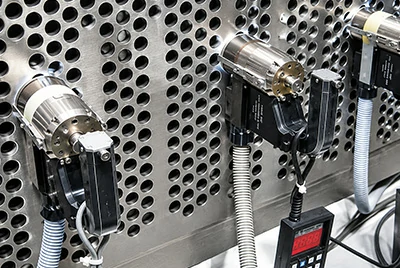
Depending on project requirements, testing may include eddy-current examination and leak-tightness or pressure testing. Welded tube blanks can also be subject to weld-performance testing.
Documentation and Shipping Protection
Material certificates, inspection records, and batch identification can be provided. Packaging protects fin surfaces and tube ends to reduce deformation during transportation.
Inspection scope and acceptance criteria are confirmed against product drawings and project specifications.
Titanium Finned Tube Quotation and Specification Review
Titanium finned tubes are customized to the heat transfer duty, operating conditions, and tube-bundle geometry. Taller or denser fins are not automatically better, and a thicker tube wall is not always the right choice. Complete operating and dimensional data support reliable specification review and accurate quotation.
- Heat transfer duty and operating conditions: Equipment type, tube- and shell-side media, temperature, pressure, and circulating-water quality.
- Tube and fin parameters: Titanium grade, OD, wall thickness, length, quantity, fin height, fin density, and helix angle.
- Tube-end and assembly dimensions: Finned OD, plain ends, transition sections, and fit requirements for tubesheets and baffles.
- Inspection and delivery requirements: NDT, leak-tightness or pressure testing, inspection documentation, and packaging.
For replacement-tube or bundle-retrofit projects, provide original drawings, sample-tube measurements, and site photographs where available.
Submit drawings and operating data for specification review and project quotation.
Related Enhanced Titanium Heat Exchanger Tubes
Different enhanced tube designs target different heat transfer locations and phase-change conditions. Select the tube geometry to match the equipment design and thermal duty.
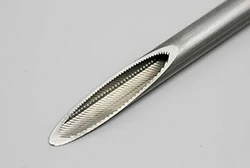
Titanium Inner Grooved Tube
Available with straight or helical internal grooves to increase internal surface area and induce tube-side turbulence for enhanced heat transfer.
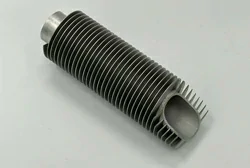
Titanium Shallow Grooved Tube
A shallow-groove inner surface balances tube-side heat transfer and pressure drop for coolers and condensers.
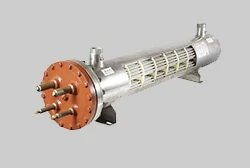
Titanium Flooded Evaporator Tube
Designed for flooded or falling-film evaporation service to improve liquid wetting, boiling, and evaporative heat transfer.
Frequently Asked Questions About Titanium Finned Tubes
Can an existing condenser that has been confirmed suitable for retubing be converted from copper or stainless steel tubes to titanium low fin tubes?
It can be evaluated, but the replacement cannot be based on the original tube OD and length alone. Finned OD, baffle-hole diameter, plain-end length, tube-end joint, heat duty, and pressure drop must also be checked. If these conditions cannot be met, replacement of the entire tube bundle may be required.
When a drawing lists only OD, wall thickness, and length, what additional information is needed for quotation?
Please provide fin height, fin density or pitch, helix angle, fin-tip profile, finned length, plain ends, and transition-section dimensions. Tubesheet, baffle, and tube-pitch requirements are also needed for tube-bundle assembly.
Should titanium finned tube wall thickness be specified by the tube blank or by the minimum root wall thickness after fin rolling?
Both should be specified. The tube-blank wall thickness defines the starting tube, while the minimum root wall thickness after fin rolling relates directly to tube integrity, pressure capability, and tube-end joint reliability.
For condensing service, are taller and denser fins always better?
No. Taller or more closely spaced fins increase external area, but they can also affect condensate drainage, flow resistance, tube spacing, and cleaning access. Fin geometry should be selected to the thermal load, water quality, bundle 板式, and equipment design.
How should plain-end length, transition sections, and tube-end tolerances be defined for tube expansion or welding?
They should be based on tubesheet thickness, joint method, baffle arrangement, and assembly allowance. Plain-end length, tube-end OD, wall thickness, and tolerances should be called out separately on the drawing.
Should a condenser project use welded or seamless titanium tube blanks?
Either can be used for integral titanium low fin tubes. Selection should be based on the applicable standard, design pressure, size range, inspection requirements, and budget. Welded tube blanks also require clearly defined weld inspection and acceptance criteria.
What inspection and documentation should be specified for a production order?
Typical requirements include material certificates, finished dimensions, fin-form inspection, minimum root wall thickness, and eddy-current examination, with leak-tightness or pressure testing where required. Inspection records, batch identification, and packaging requirements should also be agreed.
Can a physical sample be used to confirm titanium finned tube specifications when no complete manufacturing drawing is available?
A complete sample tube can support preliminary measurement and manufacturing review, but site photographs cannot replace critical dimensions. OD, wall thickness, fin height, fin density, plain ends, tube-end geometry, and operating conditions must still be confirmed. For equipment modifications, the equipment owner or engineer should first confirm that retubing or bundle replacement is feasible.
Request Titanium Finned Tube Specification Review and Quotation
Submit the equipment type, heat transfer mode, process media, tube dimensions, fin parameters, and quantity. We will review the drawings and operating conditions to confirm the specification, manufacturing feasibility, inspection requirements, and delivery plan.
Submit drawings or technical data for a project quotation.


