

Titanium Flooded Evaporator Tube
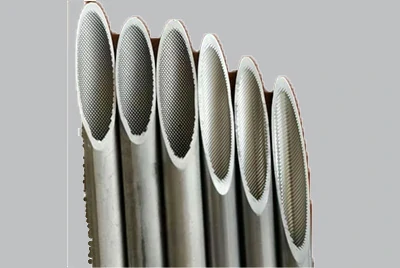
Updated : Sep. 8, 2026Titanium flooded evaporator tube is used in horizontal shell-and-tube chiller evaporators, where the refrigerant boils on the outside of the tube. Outside diameter 12.7–25.4 mm, in Gr1 / Gr2 titanium.
Knurl pattern, fins per inch, plain-end and transition-section lengths can all be made to your drawing. The same line also produces the falling film and inner-grooved types, which can be quoted together with this one if you need them.
Three evaporator tube types: which one your shell needs
Our evaporator tubes are one product family with three types. Choosing the type matters more than choosing the material, because it decides the heat transfer logic of the whole shell.
There is only one thing that decides which one you need: whether the refrigerant runs outside the tube or inside it.
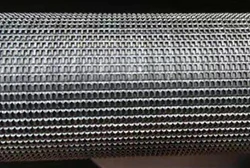
Flooded evaporator tube
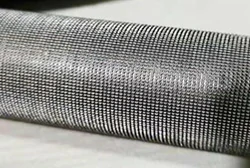
Falling film evaporator tube
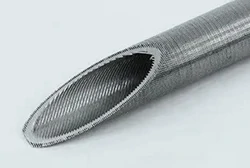
Inner-grooved (dry expansion) tube
| Flooded evaporator tube | Falling film evaporator tube | Inner-grooved (dry expansion) tube | |
| Refrigerant side | Shell side, pool boiling | Shell side, sprayed film | Tube side, flow evaporation |
| Enhancement focus | Omega grooves outside provide nucleation sites | Cross-mesh outer fins thin the liquid film | Inner spiral grooves add contact area and change the flow pattern |
| Typical outside diameter | 12.7–25.4 mm | 12.7–25.4 mm | 7.00–15.88 mm |
| Typical equipment | Flooded evaporators in centrifugal and screw chillers | Falling film shell-and-tube evaporators | Dry expansion evaporators, air coolers, evaporative coolers |
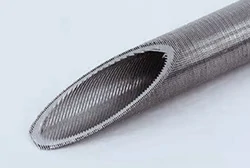
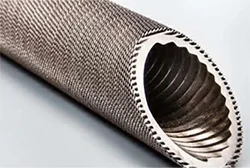
The inner-grooved type takes a different route. The enhancement sits on continuous or interrupted spiral grooves on the inner wall: refrigerant evaporates as it flows inside the tube, and water is cooled on the outside.
The tube-side heat transfer coefficient reaches 1–2 times that of a plain tube of the same size. Unlike the spin-forming process used for conventional inner-grooved copper tube, the ridge profile can be designed for a specific refrigerant and duty, and length is not limited.
Common sizes: OD 7.00 / 7.94 / 9.52 / 12.7 / 15.88 mm, 28–116 ridges, helix angle 18–45°, ridge height 0.12–0.21 mm, inside surface area 0.0199–0.0280 m²/m per unit length.
Titanium flooded evaporator tube: product data
| Product name | Titanium flooded evaporator tube (straight knurl / cross-hatched knurl) |
| Material grade | Gr1 / Gr2 titanium (TA1 / TA2; UNS R50250 / R50400); austenitic and ferritic stainless steel can also be produced on the same line |
| Condition | Base tube annealed; enhanced section as rolled |
| Base tube | Heavy-wall welded or seamless tube blank, formed by three-roll skew rolling with dedicated tooling |
| Product standards | Base tube: ASTM B338 / ASME SB338; welded ASTM B862, seamless ASTM B861; GB/T 3625 as the Chinese equivalent. |
| Size range | Standard sizes OD 15.88 / 19.05 / 22.1 / 25.4 mm; machining range OD 12.7–31.8 mm, wall 0.8–3.0 mm; length <7 m |
| Tolerances | Available to specification |
| Fin geometry | Omega groove with upset fin tips; straight or cross-hatched knurl; 21 / 25 / 32 fpi |
| Inside options | Plain / internally grooved / twisted-tape insert |
| Processing | Cut to length; plain ends at both ends and mid-span per drawing; straight, U-bend or coiled |
| Surface | Mill finish or pickled |
| Applications | Horizontal flooded evaporator tube bundles, close-approach shell-and-tube exchangers, seawater-source heat pump evaporators, chemical process heat exchangers |
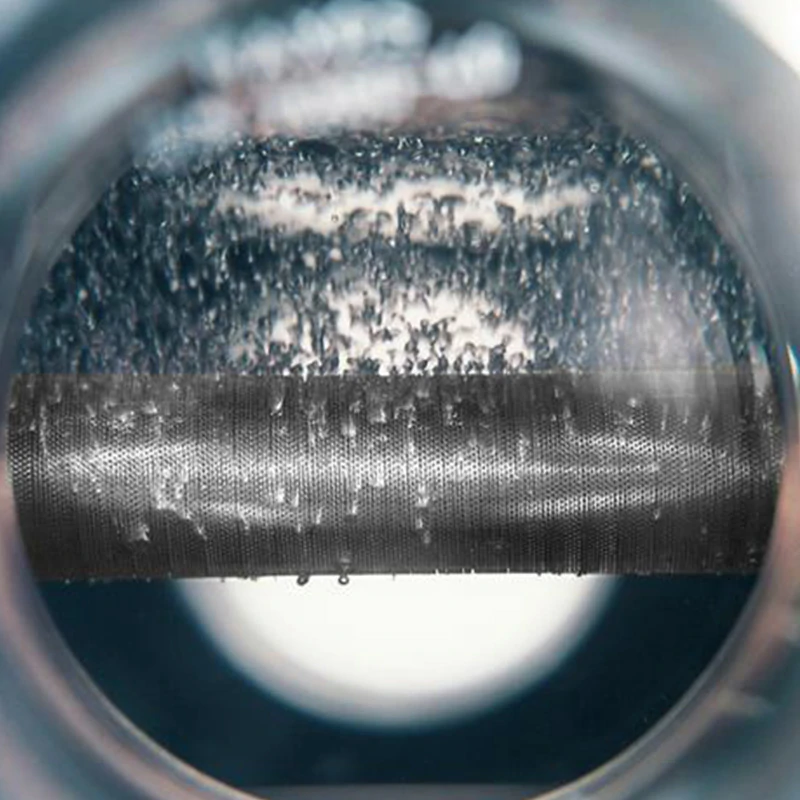
Flooded evaporator tube: standard sizes and machining range
Standard sizes and stock sizes
These are our standard stocked sizes, and they are the quickest to order.
| Code | 1 | 2 | 3 | 4 |
| OD (mm) | 15.88 | 19.05 | 22.1 | 25.4 |
| Nominal wall (mm) | 0.64 | 0.64 | 0.64 | 0.64 |
| Finned-section wall (mm) | 1.0–2.0 | 1.0–2.0 | 1.0–2.0 | 1.0–2.0 |
| Fin OD (mm) | 15.88 | 19.05 | 22.1 | 25.4 |
| Fin height (mm) | 0.60 | 0.60 | 0.60 | 0.60 |
| Min wall under fins (mm) | 0.56 | 0.56 | 0.56 | 0.56 |
| Fins per inch | 32 | 32 | 32 | 32 |
| Ridge height (mm) | 0.20 | 0.20 | 0.25 | 0.25 |
| Number of ridges | 34 | 34 | 34 | 34 |
Machining range
We also make tubes to your drawing.
| Item | Custom range |
| Outside diameter | 12.7 / 15.88 / 19.05 / 25.4 mm (skew-rolling capability 12.7–31.8 mm) |
| Wall thickness | 0.8–1.5 mm (12.7, 15.88); 0.8–2.0 mm (19.05, 25.4); skew-rolling capability up to 3.0 mm |
| Fin OD | 12.6–12.5 / 15.78–15.68 / 18.95–18.85 / 25.3–25.2 mm |
| Min wall under fins | ≥0.65 mm (12.7, 15.88); ≥0.7 mm (19.05, 25.4) |
| Fin height | 0.4–0.6 mm |
| Fin pitch | 0.8 / 1.0 / 1.2 mm |
| Helix angle | 0–35° |
| Circumferential knurl count | Outer circumference / 0.8 |
| Internal ridges | Count = (inside diameter × 3.14) / 2; ridge height 0–0.2 mm |
| Plain end / Transition section | Any length / 15–40 mm |
| Tube length | <7 m |
Note: the outer helix angle sets the path bubbles take along the tube axis; the inner ridges break up the water-side boundary layer and lower tube-side resistance.
Fins per inch and fin pitch conversion
Whether your drawing calls out fpi or mm depends on the industry and the region. This table has the conversion done, so you can read straight across.
| Fins per inch | 25.4 ÷ fpi | Actual fin pitch |
| 32 fpi | 0.794 mm | 0.8 mm |
| 25 fpi | 1.016 mm | 1.0 mm |
| 21 fpi | 1.210 mm | 1.2 mm |
Higher fpi is not automatically better. More fins per inch means more effective outside surface and more nucleation sites, but the grooves also get narrower, which makes the tube more sensitive to swings in water quality and to fouling.
Where circulating water quality is unstable, 32 fpi will not necessarily last longer than 25 fpi.
Titanium falling film evaporator tube
The falling film type is another of our high-volume products.
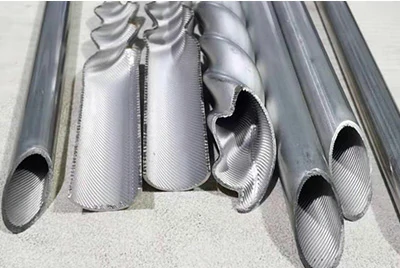
Its outer surface carries a cross-mesh fin pattern. The fins are rolled integrally from the same parent metal as the tube, so there is no contact resistance, which is where it differs from wrapped-fin or welded-fin tube.
This surface helps thin the refrigerant film and lets sprayed liquid spread quickly along the tube axis and around the circumference. That is what produces the falling film effect and raises the evaporating heat transfer coefficient. It is used in all kinds of falling film shell-and-tube evaporators.
The flooded profile can also serve falling film duty, so the two are not mutually exclusive. Which one to pick depends on your product structure: if you build both platforms and want to carry one part number fewer, let the flooded type cover both; if you run a single falling film platform in volume, the dedicated type is the better fit.
Standard sizes:
| OD (mm) | Nominal wall (mm) | Finned-section wall (mm) | Fin OD (mm) | Min wall under fins (mm) | Fins per inch | Ridge height (mm) |
| 12.7 | 0.60 | 0.8–1.5 | 12.65 | 0.55 | 32 | 0.20 |
| 15.88 | 0.60 | 0.8–1.5 | 15.70 | 0.55 | 32 | 0.20 |
| 19.05 | 0.60 | 0.8–1.5 | 19.0 | 0.6 | 32 | 0.20 |
| 22.1 | 0.65 | 0.8–1.5 | 22.05 | 0.65 | 32 | 0.20 |
| 25.4 | 0.65 | 0.8–1.5 | 25.35 | 0.7 | 32 | 0.20 |
Straight knurl or cross-hatched knurl?
The flooded tube comes with two knurl patterns. Both are made by upsetting the needle-shaped fin tips of a condenser tube profile.
Straight knurl is a set of separate needle ribs arranged helically; once the tips are upset they form the omega groove. Cross-hatched knurl is a regular array of pyramid cells, with the tips upset the same way.
The difference does not show up in the heat transfer table. It shows up in your expansion step: cross-hatched knurl is less likely to damage the expander head during mechanical expansion, and it costs more to produce.
So the call is straightforward. If your line uses mechanical expansion and you retube often, the extra processing cost usually comes back in expander head wear. If you use hydraulic expansion, or your retubing interval is long anyway, straight knurl is enough.
Straight knurl has one more use: it performs better where the liquid film needs to spread evenly over the tube wall, and it can serve as a falling film tube when required.
Inside the tube: plain, internally grooved, or twisted-tape
Plain, no tube-side machining
Lowest pressure drop, and easiest to clean. Consider this first where water quality is poor and fouling risk is high.
Internally grooved, with inner spiral ridges
Ridge count is (inside diameter × 3.14) / 2, ridge height 0–0.2 mm. It breaks up the water-side boundary layer and lowers tube-side resistance.
Twisted-tape insert
A twisted tape inserted into the tube generates swirl flow. Its advantage is that it can be fitted later, so existing bundles can be retrofitted.
How to choose? Tube-side enhancement raises heat transfer, but it also raises pressure drop and makes cleaning harder. If your pump head is already tight, or the circulating water comes from an open cooling tower, do not max out the tube side. Starting with inner grooves is easier to live with than going straight to a twisted tape.
One thing to keep straight: in flooded and falling film duty the refrigerant boils outside the tube and the water flows inside, so tube-side enhancement addresses the water side. It solves a different resistance from the omega grooves on the outside.
Can titanium replace your enhanced copper evaporator tube?
Can it actually be expanded?
This is the question customers ask us most.
Mechanical expansion generally needs 5–25% elongation in the material. And plastic working has a rule of thumb: the deformation applied should not exceed half the material's ultimate elongation.
Beyond that the tube will not necessarily split, but micro-cracks form. You cannot see them, yet pressure capability and fatigue-pulse resistance have already dropped. That is a more troublesome failure than an outright split, because it may not show up in factory inspection.
Elongation in the annealed condition looks roughly like this:
- Copper about 90%
- 316L about 70%
- 304 about 65%
- Titanium about 45%
Half of the titanium figure is 22.5%, which sits inside the 5–25% band that expansion needs.
So the conclusion is clear: titanium can be expanded, but the margin is much smaller than copper's. The expansion ratio has to be recalculated for titanium and the first piece has to be trial-expanded. You cannot carry the copper settings straight over.
What higher yield strength buys, and what it costs
In the annealed condition, titanium's yield strength is roughly twice that of copper. That cuts both ways.
On the good side: higher pressure capability at the same wall thickness; a stiffer tube at the same size, which relaxes the requirements on support spacing and unsupported length; and less chance of damage during processing and shipping.
On the cost side: expansion, bending and fin rolling all get harder. Once a complex profile becomes harder to roll, either the rolling cost goes up or the profile falls short and heat transfer suffers.
This is one reason titanium enhanced tube cannot carry fins as tall as copper tube does.
The real barrier is not the tube
Across the HVAC industry, most fabricators' processes, equipment and tooling were designed around copper tube.
The real cost of switching to titanium is not the unit price of the tube. It is the time spent adapting the line and validating the first article. If your line cannot adjust its expansion process and tooling at all, switching now does not pay.
Check whether it can be swapped
- Plain-end OD against the tubesheet hole
- Finned-section OD (usually 0.1–0.2 mm smaller than the plain end; expansion is located off the plain end)
- Fins per inch: 21, 25 or 32
- Tube-side form: plain, internally grooved, or twisted-tape insert
- Plain end and transition section lengths
- Existing expansion process, expander head type and expansion ratio
Send us these few items and we will match a titanium tube to your existing geometry, so you can trial-expand it first.
How the omega-groove boiling surface works
How the profile is formed
Starting from a heavy-wall welded or seamless tube blank, dedicated tooling and three-roll skew rolling raise needle-shaped fins, and the tips are then upset into a mushroom shape. The groove that results is wide at the bottom and narrow at the top, the omega structure.
This structure does three things. First, it holds stable nucleation sites, so bubbles leave evenly through the narrow opening and film boiling does not degrade heat transfer. Second, the groove bottoms interconnect, so liquid can move freely through them and replenish, which prevents local dry-out. Third, the surface becomes porous, which improves how well the fluid wets the tube wall.
About thermal conductivity
Titanium conducts at about 14.6 W/(m·°C) and copper at about 386.4 W/(m·°C), more than twenty times apart. Plenty of people see that number and strike titanium off the list, which is too quick a call and not the right one.
On a plain tube that gap actually matters little. The wall is thin, and the convective resistance on both sides of the metal is far larger than the conduction resistance through it, so the metal resistance is essentially negligible.
What is genuinely affected is fin efficiency on a finned tube, the ratio of the fin area actually doing the work to its theoretical area. Lower conductivity lowers fin efficiency, and the taller the fin, the more obvious the effect.
So the point is not that titanium will not work, but that titanium fins cannot copy copper fin heights. It also explains why customers usually specify fin height in the 0.4–0.6 mm range on this kind of titanium enhanced tube, rather than pushing it ever taller.
What we have seen, and what the research says
In flooded evaporation service, with R22 and R717 as the refrigerant and a plain tube used as the evaporating tube, the overall heat transfer coefficient is on the order of 450–870 W/(m²·°C).
Minimum wall under fins
After fin rolling, it is the minimum wall under fins at the fin root that feeds the pressure calculation, not the nominal wall.
There is a specific reason this gets missed. In the copper world, ASTM B359 writes this dimension into the standard, so everyone assumes it will be called out. Titanium has no equivalent finished-product standard, so the customer has to state this dimension separately on the drawing or in discussion. Otherwise our reading of it differs, and what we supply will not be what you expected.
Our quotations and drawings list minimum wall under fins on its own line, never mixed in with the nominal wall. The values for the standard types are in the two tables above: 0.56 mm for the flooded type, 0.65–0.7 mm or more across the custom range, and 0.55–0.7 mm for the falling film type.
Titanium, copper or stainless: what actually changes
| Property | Copper | 304 | 316L | Titanium |
| Yield strength (MPa) | 70 | 200 | 170 | 140 |
| Elongation (%) | 90 | 65 | 70 | 45 |
| Thermal conductivity W/(m·℃) | 386.4 | 16.3 | 16.2 | 14.6 |
| Density (g/cm³) | 8.9 | 8 | 8 | 4.5 |
| Biocompatibility | Mildly toxic | Mild allergic response | Almost no response | Fully biocompatible |
Yield strength. Titanium is higher than copper, so pressure capability and stiffness both improve at the same wall thickness, and the requirements on support spacing and unsupported length relax. The cost is harder plastic working and a higher rolling cost for complex profiles.
Elongation. Titanium is lower than copper and stainless, so the margin for expansion and bending is smaller, and deformation has to stay within half the ultimate elongation.
Thermal conductivity. Titanium and both stainless grades are close to each other, and all are far below copper. The effect lands on fin efficiency, not on wall resistance.
Biocompatibility. This one is often overlooked, but it is a reason to choose a material that is entirely separate from corrosion resistance. Solid metal is harmless in itself; what matters is the metal cations released once corrosion puts them into the water. Titanium barely reacts this way, whereas copper ions bind to proteins and denature them. So in potable water, food, pharmaceutical, medical and domestic hot water duty, many specifications call for titanium regardless of how large the corrosion risk actually is.
Standards and acceptance criteria for enhanced titanium tube
So what is this tube actually accepted against? Here is the answer.
The base tube material and dimensions do have a standard
ASTM B338 / ASME SB338 covers Gr1 and Gr2 titanium tube for heat exchangers and condensers;
welded tube falls under ASTM B862 and seamless under ASTM B861; the Chinese equivalent is GB/T 3625.
The enhanced geometry does not
ASTM B359 / B359M-18 covers only copper and copper-alloy integrally finned condenser and heat exchanger tube.
There is no equivalent finished-product standard for enhanced titanium tube.
So the enhanced geometry has to be fixed by drawing or technical agreement. We suggest putting the following eight items on the drawing you send with your enquiry, which avoids any difference in interpretation:
- Fin height
- Fins per inch, or fin pitch
- Minimum wall under fins
- Plain-end OD and inside diameter
- Fin-section OD (usually 0.1–0.2 mm smaller than the plain end)
- Transition section length
- Knurl type: straight or cross-hatched
- Tube-side form: plain, internally grooved or twisted-tape
A material standard proves chemistry and base-tube acceptance. It does not prove how the finished part performs in your system. Pressure design still runs through ASME BPVC Section VIII-1 and II-D; a material standard cannot stand in for system-level design.
Our approach: we supply to your drawing and technical agreement, issue the MTC for the base tube material to ASTM B338, and inspect the enhanced geometry against the drawing.
Inspection, testing and documentation
Our inspection capability covers the following:
- Inline / offline eddy current testing, carried out per GB/T 12969
- Mechanical testing: yield strength, tensile strength, elongation, hardness
- Metallographic examination: coarse grain, and chromium depletion at the weld grain boundaries
- Weld performance testing: flare, flattening, spread and reverse bend
- Air tightness and pressure holding tests
On documentation, can be quoted with MTC, COC, dimensional report, eddy current report, and third-party inspection report.
Our production runs under an ISO 9001 quality management system; third-party inspection of a specific product can be arranged per project.
Our technical team covers metallurgy, metal forming, welding, fluid heat transfer and equipment design and manufacture, and the core members have more than ten years in this field. New products account for over forty percent of total sales.
When titanium is not the right answer
There are situations where titanium is not the best answer.
Closed-loop fresh water, stable water quality, no chloride risk. Stainless steel makes more sense on value, and titanium's corrosion margin goes unused in this duty.
Comparing single-tube heat transfer coefficient alone, without life-cycle cost. Inner-grooved copper tube still leads on pure heat transfer, and there is no arguing that.
The line cannot adjust its expansion process at all, and the existing retubing interval is already long. The conversion cost will not be recovered. The supply chain transition across the industry will take roughly 5–10 years and will happen gradually, not as a single switch.
High-viscosity or heavily fouling media. Narrow grooves at high fpi become a liability in this duty; move toward lower fpi or a plain tube.
The project has strict existing qualification requirements on the fin profile. Enhanced profiles of this kind are still being improved, and both heat transfer efficiency and processing cost are still moving. If your project will not accept requalification, the safer route for now is to build to the geometry you have already qualified, rather than adopt the newest profile.
Related titanium heat transfer tubes
Titanium condenser tubes
Titanium materials for heat transfer systems
Titanium inner fin tubes
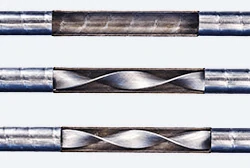
Titanium helical grooved tubes
Titanium spiral flattened tubes
Grade 2 titanium tube
Condenser, evaporator and inner-grooved tubes come off the same supply chain - one order, one set of inspection documents, one shipment.
FAQ
Can titanium evaporator tubes replace enhanced copper tubes without redesigning the shell?
In most cases, yes. Six items need checking: plain-end OD, fin OD, fins per inch, plain-end and transition-section lengths, tube-side form, and expansion method. The expansion ratio has to be recalculated for titanium and the first article trial-expanded.
Titanium conducts heat far worse than copper - does that kill performance?
No. The wall is thin and convective resistance on both sides far exceeds the metal's, so wall resistance is negligible. The effect lands on fin efficiency, which is why titanium fin height is not copied from copper but set in the 0.4–0.6 mm range.
Do I calculate pressure from the nominal wall or the wall under the fins?
Use the minimum wall under fins. The fin root is the thinnest point of the tube, and the nominal wall overstates pressure capability. State this dimension separately on the drawing.
What is 32 fpi in millimetres?
32 fpi works out to 0.794 mm fin pitch, made as 0.8 mm. 25 fpi is 1.016 mm, made as 1.0 mm; 21 fpi is 1.210 mm, made as 1.2 mm.
Is a flooded evaporator tube the same as a falling film evaporator tube?
Not quite. The flooded profile can also serve falling film duty, but the dedicated falling film type uses a cross-mesh fin pattern. Separately, the vertical falling film evaporating tube used in chemical processing is an entirely different product, with different diameters and structure.
Which ASTM standard covers enhanced titanium heat exchanger tube?
The base tube follows ASTM B338 / ASME SB338. ASTM B359 covers only copper and copper-alloy integrally finned tube; titanium has no equivalent finished-product standard, so the enhanced geometry must be fixed by drawing or technical agreement.
Will titanium crack during mechanical tube expansion?
Not at normal settings. Expansion generally needs 5–25% elongation, and deformation should stay within half the ultimate elongation; annealed titanium runs about 45%, half of which is 22.5%. Still inside the band, but with less margin than copper.
Our flooded evaporator lost capacity - is it the tube?
Not necessarily. Published experimental work shows that non-condensable gas strongly affects the condensing-side overall coefficient, while its effect on the evaporating side is small. Check for non-condensables and check the condenser before you suspect the evaporating tube.


