

Titanium Spiral Grooved Tube
Updated : Aug. 24, 2026Titanium spiral grooved tube is produced from a smooth titanium tube or a welded internally finned titanium tube. A dedicated tool continuously forms spiral grooves or corrugations on both the inner and outer surfaces through spiral extrusion. Compared with a conventional smooth titanium tube, the spiral grooves change the fluid's straight-line flow pattern and increase turbulence on both sides of the tube, improving convective heat transfer.
Chalco Titanium can supply spiral grooved tubes based on TA1 and TA2 titanium tubing in straight and coil forms. Tube diameter, wall thickness, number of spiral starts, spiral angle, groove depth and rib spacing can be customized to suit the equipment structure. These tubes are suitable for coaxial tube-in-tube heat exchangers, shell-and-tube heat exchangers and custom coil heat exchange equipment.
Specifications available from Chalco Titanium
Chalco Titanium can supply Grade 1, Grade 2, TA1 and TA2 titanium spiral grooved tubes made from seamless or welded tubing. Straight tubes, coils, heating coils, cooling coils and custom-formed bends can be produced to suit the heat exchanger structure.
| Material | Grade 1,Grade 2,TA1,TA2 |
| Outside diameter | 4–168 mm |
| Wall thickness | 0.3–10 mm |
| Inside diameter | 0.5–100 mm |
| Maximum length | 18,000 mm |
| Number of spiral starts | Single-start, double-start, 3-start, 4-start, 6-start, 8-start |
| Spiral angle | 30°–50° |
| Groove depth | 1–6 mm |
| Rib spacing | 3–6 mm |
| Groove root radius | R1–R3 |
| Base-tube type | Smooth titanium tube, internally finned titanium tube, seamless titanium tube, welded titanium tube |
| Supply form | Straight tube, coil, heating coil, cooling coil, custom-formed bend |
| Processing | Cold rolling, seamless processing, welding and spiral extrusion forming |
| Surface finish | Polished or finished as required |
| Reference standards | ASTM B337,ASTM B338,ASTM B861,ASTM B862 |
| Customization | Tube diameter, wall thickness, length, spiral parameters and end configuration can be customized to drawings |
Actual specifications can be customized according to the heat transfer medium, installation space, tube-side and shell-side arrangement, and customer drawings.
Titanium spiral grooved tube forms available from Chalco Titanium
Chalco Titanium can supply straight titanium spiral grooved tubes, coils and custom-formed bends according to the heat exchanger design, installation space and connection method. The grooved length, smooth end sections, bending radius and connection configuration can all be produced to customer drawings.
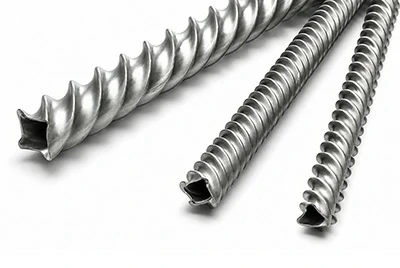
Straight titanium spiral grooved tube
Suitable for shell-and-tube heat exchangers, coaxial tube-in-tube heat exchangers and equipment with straight flow paths. Smooth sections can be retained at both ends for expansion, welding, flange connections or subsequent assembly.
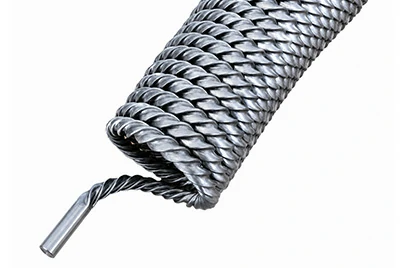
Titanium spiral grooved coil
Suitable for heating tanks, cooling tanks, immersion heat exchangers and other equipment requiring a longer heat transfer path. The compact coil can be customized for coil diameter, number of turns, number of layers, and inlet and outlet direction according to the vessel dimensions.
U-bends, serpentine tubes, wound coils and other custom configurations can be formed to fit the internal equipment space and match existing heat exchangers, tanks or process piping.
Spiral starts and groove parameters
The average outside diameter, number of spiral starts, spiral angle, groove depth and rib spacing must be matched to one another. Chalco Titanium can design single-start, double-start or multi-start grooves according to tube diameter, wall thickness, medium velocity and heat exchanger structure. Three-start, four-start and six-start configurations are commonly used.
| Average outside diameter | Permissible wall thickness | Spiral starts | Spiral angle | Groove depth | Rib spacing | Groove root radius |
| 7.00 mm | 0.30–0.60 mm | 3-start | 30°–50° | 1–2 mm | 3–5 mm | R1–R2 |
| 7.94 mm | 0.30–0.60 mm | 3-start | 30°–50° | 1–2.5 mm | 3–5 mm | R1–R2 |
| 9.52 mm | 0.30–0.70 mm | 3-start, 4-start | 30°–50° | 1–3 mm | 3–6 mm | R1–R2.5 |
| 12.70 mm | 0.30–0.80 mm | 3-start, 4-start | 30°–50° | 2–3 mm | 3–6 mm | R1–R3 |
| 15.88 mm | 0.30–0.80 mm | 4-start | 30°–50° | 2–3.5 mm | 4–6 mm | R1–R3 |
| 19.05 mm | 0.30–0.90 mm | 4-start | 30°–50° | 2–4 mm | 6 mm | R1–R3 |
| 22.10 mm | 0.30–0.90 mm | 4-start, 6-start | 30°–50° | 2–5 mm | 6 mm | R1–R3 |
| 25.40 mm | 0.30–0.90 mm | 4-start, 6-start | 30°–50° | 3–6 mm | 6 mm | R1–R3 |
Number of spiral starts: Small-diameter tubes typically use three-start or four-start grooves. Larger-diameter tubes may use four-start or six-start configurations to distribute the grooves more evenly around the circumference.
Wall thickness and groove depth: Wall thickness determines the available forming allowance for spiral extrusion and the tube wall's load capacity. Groove depth should be matched to the average outside diameter and wall thickness to avoid excessive thinning or localized stress concentration.
Spiral angle and rib spacing: The spiral angle is typically 30°–50°, and rib spacing is 3–6 mm. They can be selected according to the required turbulence, heat transfer performance and allowable pressure drop.
Groove root radius: An R1–R3 radius transition at the groove root helps reduce stress concentration in the formed area and improves the tube's ability to accommodate bending, vibration and thermal cycling.
Dimensional tolerances and length control
Titanium spiral grooved tubes normally need to fit accurately with tube sheets, outer tubes or equipment connections, so stable length and critical dimensions directly affect on-site assembly. Chalco Titanium controls straight-tube tolerances according to tube diameter and cut length, while checking the average outside diameter, wall thickness, grooved length and smooth end sections to reduce connection misalignment and secondary machining.
| Straight-tube length | Outside diameter <25 mm | Outside diameter >25 mm |
| <600 mm | 0/+2 mm | 0/+3 mm |
| 600–1800 mm | 0/+3 mm | 0/+3 mm |
| 1800–4200 mm | 0/+6 mm | 0/+6 mm |
| 4200–10000 mm | 0/+10 mm | 0/+10 mm |
How does a titanium spiral grooved tube enhance heat transfer?
Continuous spiral corrugations change the fluid's original axial flow pattern, causing the medium to rotate along the tube wall and remain continuously disturbed. This weakens the stable fluid boundary layer near the wall and improves convective heat transfer between the tube wall and the medium.
- Rotational turbulence: The spiral grooves guide the fluid into rotational flow, improve mixing between fluid layers and reduce localized stagnation.
- Boundary-layer reduction: Continuous disturbance disrupts the stable boundary layer near the tube wall, allowing faster heat transfer between hotter and colder media.
- Simultaneous tube-side and shell-side enhancement: Spiral extrusion changes both the inner and outer tube surfaces, disturbing the media on both sides and improving overall heat exchanger performance.
- Combined enhancement: Spiral grooves can be combined with internal or external fin structures to increase turbulence and further improve heat transfer on both sides.
- Elastic compensation: The corrugated structure has radial and axial flexibility that can buffer thermal shock, pressure fluctuations and equipment vibration, helping the heat exchange system operate steadily.
Enhanced heat transfer
The continuous spiral grooves create rotational flow, improve mixing between fluid layers and reduce the boundary layer near the tube wall. With the same tube diameter, wall thickness and length, heat transfer efficiency can reach 1.3–2.6 times that of a smooth titanium tube.
Corrosion resistance and sealing reliability
Grade 1 and Grade 2 titanium offer excellent corrosion resistance and are suitable for chemical processing, electroplating, water treatment and other corrosive heating or cooling environments. Products can undergo a 43 bar high-pressure test, a precision halogen leak test and 100,000 pressure-fatigue cycles at 4.5 bar, helping reduce leakage risk during long-term operation with corrosive media.
Reduced scaling and maintenance costs
The spiral grooves maintain rotational flow, reducing stagnant areas and deposit adhesion. This can lower the likelihood of scaling, extend cleaning intervals and reduce equipment maintenance costs.
Accommodation of thermal shock and pressure fluctuations
The spiral corrugated structure has radial and axial flexibility and can absorb part of the displacement caused by thermal expansion and contraction, helping the tube accommodate thermal shock, pressure fluctuations and equipment vibration.
Easy bending and compact installation
The spiral grooved cross-section provides a degree of flexibility, allowing the tube to be formed into coils or wound structures to fit the available equipment space. It is suitable for space-limited coaxial tube-in-tube heat exchangers and custom equipment.
Self-supporting spiral structure
The spiral profile can provide support and spacing inside an outer tube or tube bundle, helping maintain stable flow channels and simplifying some internal heat exchanger support structures.
Multiple base-tube and combined enhancement options
Seamless or welded titanium tubing can be selected according to pressure, length and cost requirements. Internally finned titanium tubing can also be used as the base tube and combined with internal or external fin structures to further enhance heat transfer on both sides.
Multiple supply forms
Chalco Titanium can supply straight tubes, coils, heating coils, cooling coils and custom-formed bends to meet different heat exchanger layouts, installation spaces and connection positions.
TA1 vs. TA2 material selection
TA1 and TA2 are both commercially pure titanium grades with good corrosion resistance and formability. They can be used for titanium spiral grooved tubes, heat exchange coils and tube-in-tube heat exchangers. Their main differences are strength and elongation. Selection should consider groove depth, bending requirements, operating pressure and equipment structure.
| Material | Yield strength | Elongation | Hardness | Recommended use |
| TA1 | 150–300 MPa | 35%–45% | 150–200 HV | Better ductility and formability; suitable for deep groove forming, small bending radii, complex coils and structures requiring greater flexibility |
| TA2 | 300–400 MPa | 30%–40% | 150–200 HV | Higher strength; suitable for heat exchange equipment requiring greater load capacity, structural stability and operating pressure |
Selection guidance:
TA1: Better suited to complex forming. Its higher elongation helps maintain stable forming during spiral extrusion and coil bending, making it suitable for deeper grooves, multiple bends and heat exchanger structures with limited installation space.
TA2: Combines corrosion resistance with higher strength. Its higher yield strength provides better structural support while retaining the corrosion resistance of commercially pure titanium, making it suitable for equipment exposed to greater pressure fluctuations or requiring higher tube rigidity.
Chalco Titanium can select TA1 or TA2 according to the medium composition, design pressure, groove parameters and bending radius, and confirm the material condition and finished-product properties against the drawing.
Coaxial tube-in-tube and coil heat exchange applications
Titanium spiral grooved tubes combine fluid turbulence, structural flexibility and corrosion resistance. They are suitable for heat exchange systems with limited installation space, frequent temperature changes or corrosive media.
-
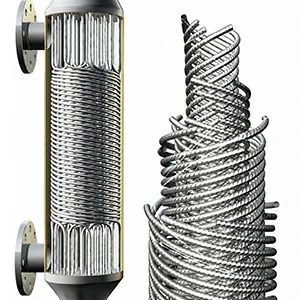 Coaxial tube-in-tube heat exchanger
A titanium spiral grooved tube can serve as the inner tube or enhanced heat transfer tube. The grooves disturb the media in both the tube and annular passages, improving heat transfer between hot and cold fluids, while the tube's flexibility helps accommodate thermal expansion, contraction and pressure fluctuations.
-
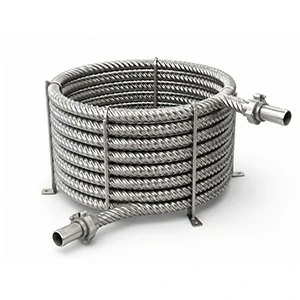 Wound-coil heat exchanger
The tube can be formed into multi-turn or multilayer coils to provide a longer heat transfer path within a limited space. This form is suitable for compact equipment, long heat exchange tube requirements or concentrated heat transfer surface arrangements.
-
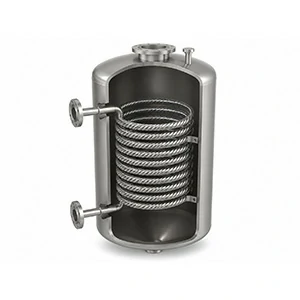 Custom coil heat exchange equipment
Coil diameter, number of turns and grooved length can be designed according to vessel dimensions, installation position and connection direction. Suitable applications include storage tanks, process vessels and other custom heating or cooling equipment.
Coaxial tube-in-tube heat exchangers
A titanium spiral grooved tube can serve as the inner tube or enhanced heat transfer tube in a coaxial tube-in-tube heat exchanger. The grooves disturb the media in both the tube and annular flow passages, improving heat transfer between the hot and cold fluids. The tube's flexibility also helps accommodate thermal expansion, contraction and pressure fluctuations.
Wound-coil heat exchangers
The tube can be formed into multi-turn or multilayer coils to provide a longer heat transfer path within a limited space. This form is suitable for equipment with compact internal space, long heat exchange tube requirements or concentrated heat transfer surface arrangements.
Custom coil heat exchange equipment
Coil diameter, number of turns and grooved length can be designed according to vessel size, installation position and connection direction. These coils are suitable for storage tanks, process vessels and other custom heating or cooling equipment.
Production and spiral forming process
Chalco Titanium uses TA1 or TA2 smooth titanium tubing or welded internally finned titanium tubing as the base tube. Dedicated forming tools continuously extrude the tube into a uniform spiral grooved structure. During production, the number of spiral starts, spiral angle, groove depth, rib spacing and groove root radius are closely controlled to maintain groove consistency and tube-wall integrity.
1. Base-tube selection
A seamless smooth titanium tube, welded titanium tube or internally finned titanium tube is selected according to the design pressure, heat transfer medium and required supply form. Outside diameter, wall thickness, surface condition and tube condition are inspected.
2. Spiral parameter design
The number of spiral starts, spiral angle, groove depth, rib spacing, groove root radius and grooved length are specified according to the customer drawing. The commonly used spiral angle is 30°–50°, with corresponding three-start, four-start or six-start grooves selected for different tube diameters.
3. Tooling and equipment setup
The appropriate forming tools are installed for the tube diameter and groove profile. Tube feed, rotation and extrusion positions are adjusted so that the spiral grooves are distributed evenly around the circumference.
4. Continuous spiral extrusion
As the base tube passes through the forming station, the tools continuously extrude the tube wall to gradually form the specified groove depth and spiral profile, while controlling localized thinning, groove-spacing variation and surface damage.
5. Straight-tube or coil forming
After the spiral grooves are formed, the product can remain as a straight tube or be further formed into a coil for coaxial tube-in-tube, wound-coil and other compact heat exchange equipment.
6. Cut-to-length and end preparation
The tube is cut to the drawing length, and the required smooth end sections are retained for subsequent welding, assembly or connection to the equipment interface.
7. Finished-product inspection
After forming, the average outside diameter, wall thickness, groove depth, rib spacing, spiral angle and surface condition are inspected. Conforming products proceed to nondestructive examination, leak testing and pressure testing.
Titanium spiral grooved tubes vs. smooth, internally finned and spiral flat tubes
Different enhanced tube types emphasize different structural features and applications. Titanium spiral grooved tubes focus on the fluid turbulence, flexibility and bendability created by external spiral corrugations, making them suitable for coaxial tube-in-tube heat exchangers and coil heat exchange equipment. Smooth tubes, internally finned tubes and spiral flat tubes address different heat transfer and structural requirements.
| Tube type | Structural features | Primary enhancement method | Typical advantages | Suitable applications |
| Titanium spiral grooved tube | The tube remains nearly round, with continuous spiral grooves or corrugations on the outer surface | Disturbs fluid on both sides while retaining flexibility and bendability | Easy to bend and install; suitable for straight tubes and coils; accommodates thermal shock and pressure fluctuations | Coaxial tube-in-tube heat exchangers, wound-coil heat exchangers and custom coil equipment |
| Smooth titanium tube | Smooth inner and outer surfaces without enhanced fins or spiral grooves | Conventional convective heat transfer | Simple structure, easy processing and lower cost | General heat transfer applications or use as a reference base tube |
| Internally finned titanium tube | Continuous or interrupted spiral fins on the inner surface; the outer surface may remain smooth or be further corrugated | Primarily enhances tube-side heat transfer | Increases internal surface area and changes the tube-side flow pattern | Evaporators, air coolers and shell-and-tube heat exchangers |
| Spiral flat titanium tube | A round tube is spirally flattened to form a flat helical flow channel | Enhances heat transfer while supporting compact structural arrangement | High heat transfer area utilization per unit space; suitable for specific compact structures | Self-supporting heat exchanger structures and specific shell-and-tube equipment |
Selection guidance:
Titanium spiral grooved tube is generally preferred when bendability, coaxial tube-in-tube use, coil arrangement and thermal-shock accommodation are priorities. A smooth titanium tube may be selected when conventional heat transfer and cost control are more important. An internally finned titanium tube can be considered when the primary objective is tube-side heat transfer enhancement. A spiral flat titanium tube may be evaluated when the equipment requires a specialized compact arrangement.
Packaging and delivery
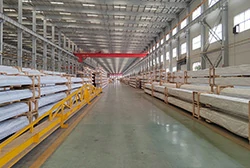
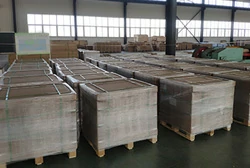
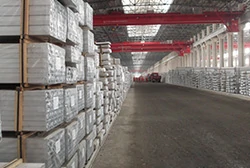
Straight-tube packaging
Straight titanium spiral grooved tubes are bundled by specification and length. Separators are placed between tubes to reduce groove impact damage, crushing and deformation during transport.
Coil securing
Titanium spiral grooved coils are secured with straps or dedicated supports to prevent the coil turns from loosening during handling and transport. Inlet and outlet ends are reinforced separately to avoid connection deformation under load.
Tube-end and surface protection
Plastic end caps or protective sleeves can be fitted to the tube ends. The grooved surface is packed with moisture-resistant film, cushioning material or other protective materials to keep the tube clean and reduce mechanical damage.
Export packaging
Depending on product size, weight and transport method, wooden cases, wooden pallets or reinforced frames can be used for sea, air or land transport.
Identification and documents
Each batch is marked with the material grade, specification, quantity, heat or batch number and order information. Material certificates, dimensional inspection records, pressure-test records and packing lists can be supplied with the shipment.
Related titanium heat exchanger tubes
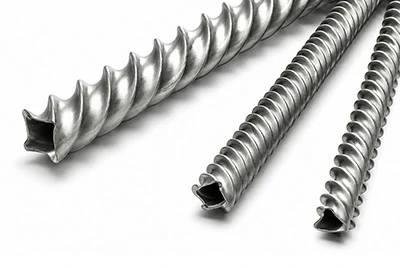
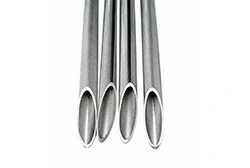
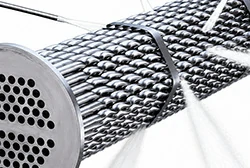
In addition to titanium spiral grooved tubes, Chalco Titanium can supply various titanium tube products for condensation, evaporation and enhanced heat transfer equipment. The suitable tube type can be selected according to the medium, heat transfer method and equipment structure.
Frequently asked questions
What materials are commonly used for titanium spiral grooved tubes?
TA1 and TA2 are commonly used and correspond to Grade 1 and Grade 2 commercially pure titanium. The specific grade can be selected according to the corrosive medium, forming requirements and equipment pressure requirements.
What titanium spiral grooved tube specifications are available?
Chalco Titanium can supply titanium spiral grooved tubes in different outside diameters, wall thicknesses, lengths and spiral parameters, with single-start, double-start, three-start, four-start, six-start and eight-start configurations.
Are straight tubes and coils available?
Yes. Titanium spiral grooved tubes are available in straight and coil forms for coaxial tube-in-tube heat exchangers, wound-coil heat exchangers and custom heat exchange equipment.
Can both seamless and welded tubes be processed?
Yes. Seamless or welded titanium tubing can be selected as the base tube according to the project requirements. Smooth or internally finned titanium tubing can also be used for spiral groove forming.
Are titanium spiral grooved tubes prone to scaling?
The spiral grooves increase rotational flow and turbulence, reducing localized stagnation and deposition. Compared with a conventional smooth tube, this can help reduce scaling risk. Actual scaling still depends on the medium composition, flow velocity and operating temperature.
Do spiral grooves increase flow resistance?
Spiral grooves increase fluid turbulence and heat transfer, but they also affect pressure loss. The spiral angle, groove depth, rib spacing and number of spiral starts should therefore be designed according to the allowable pressure drop.
How should the number of spiral starts be selected?
Small-diameter tubes typically use three-start or four-start grooves, while larger-diameter tubes may use four-start or six-start configurations. The specific selection depends on the average outside diameter, wall thickness, groove depth and heat transfer conditions.
How are finished tubes tested for leakage and pressure?
Straight tubes can undergo an underwater pneumatic leak test at 2.0–2.5 MPa with a hold time of at least 10 seconds. Coils can be held at 2.0–2.5 MPa for 24 hours, with pressure variation and overall sealing condition checked.
Can the tubes be customized to customer drawings?
Yes. Chalco Titanium can customize the tube diameter, wall thickness, length, number of spiral starts, spiral angle, groove depth, rib spacing, smooth end sections and coil dimensions according to customer drawings.
Information required for a quotation
For a quotation, please provide the material grade, average outside diameter, wall thickness, length, straight or coil form, number of spiral starts, spiral angle, groove depth and rib spacing, together with the heat transfer medium, operating temperature, design pressure, purchase quantity and connection requirements. Product drawings or equipment dimensions help Chalco Titanium confirm the processing plan, lead time and quotation more quickly.


