

Undivided Sodium Hypochlorite Electrolyzer
Updated : Jul. 23, 2026The undivided sodium hypochlorite electrolyzer continuously produces low-concentration sodium hypochlorite solution on-site by electrolyzing dilute brine. It is primarily used in disinfection systems for drinking water, wastewater, recirculating cooling water, swimming pools, and other water treatment applications. The system typically consists of an electrolytic cell, titanium electrode assembly, DC power supply, brine feed system, gas-liquid separator, hydrogen venting system, and control components.
Chalco can customize tubular, cylindrical, or plate-type undivided electrolyzers based on your target available chlorine output, brine concentration, operating hours, on-site power supply, and installation space. We also tailor the number of electrodes, cell dimensions, inlet/outlet connections, hydrogen venting structure, and control method accordingly. If you are developing a sodium hypochlorite generator or replacing existing electrolysis equipment, please send us your operating parameters and equipment drawings.
Structural types of undivided sodium hypochlorite electrolyzers
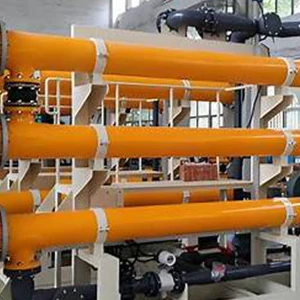
Tubular electrolyzer
The electrode assembly is installed inside a tubular cell body, with brine continuously flowing through the electrolysis unit along the channel. This compact design is ideal for equipment integration and multi-unit configurations.
Contact us now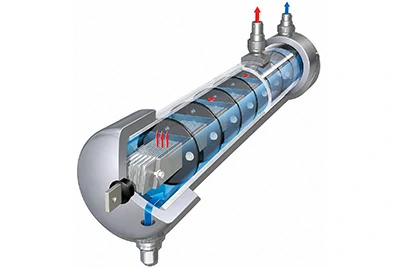
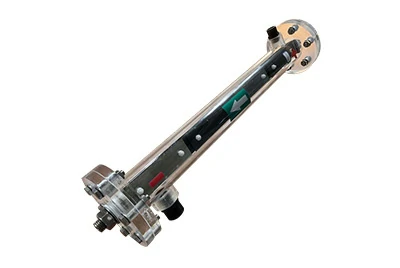
Plate-type electrolyzer
It uses multiple parallel plates to form an electrode stack. The number of plates, inter-electrode spacing, and electrolyte flow channels can be configured according to the required available chlorine output, making it easy to disassemble, inspect, and clean.
Contact us nowBelow are common specifications for both structural types
| Type | Structure | Solution medium | Available chlorine output | Available chlorine concentration | Cell body material | Electrode plate material | Service life |
| Single tubular cell | Tubular cell with bipolar plates | Sodium chloride / seawater feed / saline wastewater, etc. | ≥5 kg/h | ≤8500 ppm | PMMA / PTFE / UPVC, etc. | Ti/Ru-Ir coating | ≥3 years |
| Stacked plate-type cell | Plate-type cell with plate electrodes | Sodium chloride / seawater feed / saline wastewater, etc. | ≥10 kg/h | ≤8500 ppm | PMMA / PTFE / TA1 / TA2 | Ti/Ru-Ir coating | ≥3 years |
Equipment specifications for undivided sodium hypochlorite electrolyzers
Basic equipment specifications
| Item | Specification |
| Available chlorine output | 300–2000 g/h |
| Feed medium | 2%–5% brine or seawater |
| Operating pressure | ≤0.2 MPa |
| Anode material | Titanium-based oxide-coated anode |
| Cathode material | Commercially pure titanium plate |
| Cell body material | Acrylic or PVC |
| Electrode configuration | Plate-type, cylindrical, or tubular |
| Connection type | Monopolar or bipolar |
| Descaling method | Acid washing or polarity reversal descaling |
Operating parameters corresponding to different chlorine outputs
| Available chlorine output | DC current | DC voltage | Solution flow rate | Inlet connection | Hydrogen vent connection |
| 300 g/h | ≤84 A, ±20% | ≤20 V, ±5% | 30–35 L/h | G1/2″ | DN32 |
| 500 g/h | ≤120 A | ≤30 V | 75–85 L/h | DN15 | DN32 |
| 1000 g/h | ≤160 A | ≤40 V | 105–110 L/h | DN15 | DN32 |
| 2000 g/h | ≤220 A | ≤60 V | 140–155 L/h | DN15 | DN32 |
Working principle of sodium hypochlorite electrolyzer
When a dilute sodium chloride solution passes through the electrolyzer under the influence of positive and negative electrodes, a series of electrochemical reactions occur, producing sodium hypochlorite solution. Sodium hypochlorite is a strong oxidizing agent that generates hypochlorite ions in aqueous solution through electrolysis.
Contact us now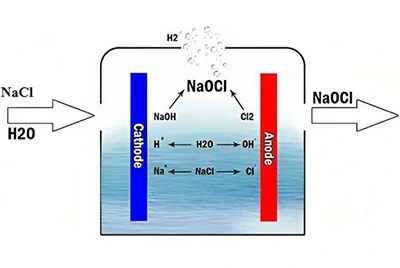
Electrode reactions:
Anode: 2Cl⁻ - 2e⁻ → Cl₂↑
Cathode: 2H⁺ + 2e⁻ → H₂↑
Overall reaction:
NaCl + H₂O → NaClO + H₂↑ (continuous)
Components of sodium hypochlorite electrolysis equipment
- Electrolyzer cell body: Houses the brine and electrode assembly, equipped with inlet, outlet, hydrogen vent, and drain ports.
- Anode assembly: Uses titanium-based MMO-coated anodes, primarily for chlorine evolution reaction.
- Cathode assembly: Typically made of commercially pure titanium plates, used for hydrogen evolution reaction.
- DC power supply: Provides stable operating current and voltage to the electrolyzer.
- Brine feed system: Includes a brine tank, filter, transfer pump, flow meter, and control valve.
- Gas-liquid separation system: Separates sodium hypochlorite solution from hydrogen gas generated during electrolysis.
- Hydrogen venting system: Safely vents hydrogen through a dedicated piping system.
- Control system: Monitors current, voltage, flow rate, temperature, and liquid level, providing alarms and interlock protection.
Operating procedure of undivided sodium hypochlorite electrolysis equipment
Brine preparation
Industrial salt is mixed with softened water at a specified ratio to produce dilute brine of the required concentration, providing a stable source of chloride ions for subsequent electrolysis.
Filtration and transfer
The prepared brine is filtered to remove insoluble solids and impurities, then pumped into the electrolyzer at a steady flow rate.
DC electrolysis
The DC power supply energizes the anode and cathode assemblies, enabling continuous electrochemical reactions within the electrolyzer.
Sodium hypochlorite generation
Chlorine produced at the anode reacts further with hydroxide ions formed at the cathode to generate low-concentration sodium hypochlorite solution.
Gas-liquid separation
Hydrogen gas and sodium hypochlorite solution exit the electrolyzer together and are separated via a gas-liquid separation device.
Storage and dosing
The separated sodium hypochlorite solution flows into a storage tank and is delivered to the downstream dosing system as needed for disinfection.
Advantages of undivided sodium hypochlorite electrolysis equipment
- Undivided structure: Anode and cathode share the same electrolysis chamber without an ion-exchange membrane, resulting in simpler equipment design and easier installation and maintenance.
- Optimized cell connections: Cell body and connection structures are designed specifically for sodium hypochlorite electrolysis, reducing stray current effects on electrodes during shutdown or idle periods.
- Specialized electrode coating: Titanium anodes feature oxide coatings engineered for sodium hypochlorite generators, promoting stable chlorine evolution, enhancing corrosion resistance, and extending electrode service life.
- Compatibility with low-concentration brine: Electrodes function effectively with low-concentration brine and maintain normal operation even at lower ambient temperatures.
- On-site continuous production: Uses only brine and water as raw materials to generate low-concentration sodium hypochlorite directly at the point of use, eliminating the need for transporting and long-term storage of finished disinfectant.
- Choice of plate-type or tubular design: Available in plate-type or tubular configurations to meet varying requirements for installation space, treatment capacity, and equipment integration.
- Easy cleaning and maintenance: Cell bodies and electrode assemblies are easily disassembled for channel cleaning, cathode descaling, and electrode condition inspection.
- Repair and recoating services: Original electrolyzer units can be inspected and refurbished, and used electrode plates can be recoated based on the condition of the titanium substrate, reducing overall maintenance costs.
Operating precautions for undivided sodium hypochlorite electrolysis equipment
- Feed medium: Use 2%–5% brine; seawater applications require separate confirmation based on water composition.
- Operating pressure: Electrolyzer operating pressure must not exceed 0.2 MPa.
- Brine quality: Minimize insoluble solids and scaling impurities such as calcium and magnesium; filtration or softening is recommended when necessary.
- Brine flow rate: Maintain stable feed flow to prevent excessive temperature rise or fluctuations in chlorine production.
- DC power supply: Current and voltage must match the required available chlorine output and number of electrolysis units.
- Operating temperature: Avoid excessively high electrolyte temperatures and ensure adequate ventilation in the installation environment.
- Hydrogen venting: Keep hydrogen vent lines unobstructed to prevent hydrogen accumulation in the electrolyzer, piping, or storage tank.
- Cleaning and maintenance: Periodically flush or descale based on cell voltage, chlorine output, and scaling conditions to maintain clean electrode surfaces and flow channels.
Applications of undivided sodium hypochlorite electrolysis equipment
-
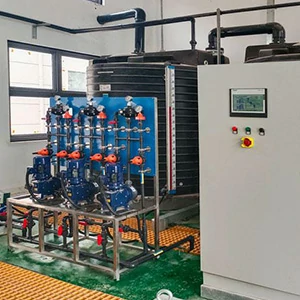 Drinking water disinfection
Used in municipal water treatment plants, secondary water supply systems, and small-scale water supply systems to produce sodium hypochlorite on-site for microbial disinfection and residual chlorine control.
-
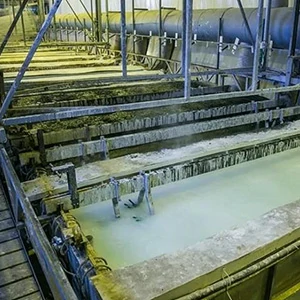 Wastewater treatment
Suitable for municipal sewage, industrial wastewater, and reclaimed water systems, providing continuous available chlorine for effluent disinfection.
-
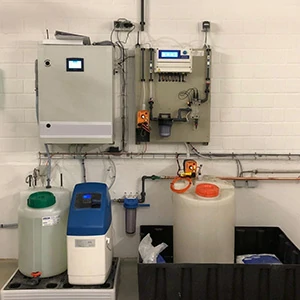 Recirculating cooling water
Applied in cooling towers and industrial recirculating water systems to inhibit bacterial growth, algae, and biofilm formation.
-
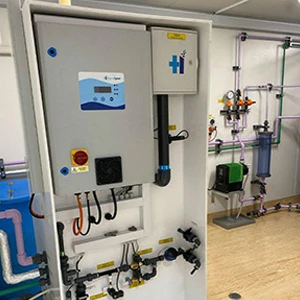 Swimming pool disinfection
Produces low-concentration sodium hypochlorite on-site for swimming pools and aquatic facilities, working with dosing systems to maintain water quality.
-
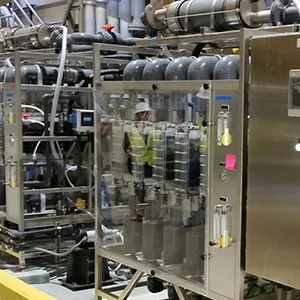 Industrial process water
Applicable to food processing, equipment cleaning, and other industrial water systems requiring continuous disinfection.
-
 Seawater electrolysis
Used in seawater cooling, marine antifouling, and coastal water treatment projects; equipment design must account for seawater composition and scaling tendencies.
Chalco Titanium's customization capabilities for undivided sodium hypochlorite electrolysis equipment
Chalco offers undivided sodium hypochlorite electrolysis equipment with available chlorine outputs of 300, 500, 1000, and 2000 g/h, matching appropriate electrolyzer structures and operating parameters to your specific application conditions.
- Electrolyzer structure: Chalco provides both plate-type and tubular electrolyzers.
- Electrode configuration: Available in monopolar or bipolar connections.
- Cell body material: Corrosion-resistant materials such as acrylic or PVC can be selected.
- Power supply configuration: DC current and voltage are matched to the required chlorine output.
- Interface design: Adjustable specifications for inlet, outlet, and hydrogen vent connections.
- Installation structure: Available in vertical, horizontal, or other configurations to suit equipment space constraints.
- Descaling method: Configurable with acid cleaning or polarity reversal descaling options.
What equipment parameters are required for a quotation?
To facilitate confirmation of electrolyzer specifications and operating parameters, please provide the following information when requesting a quote:
- Effective chlorine output: Required production capacity, e.g., 300, 500, 1000, or 2000 g/h.
- Feed medium: Whether diluted brine, concentrated brine, or seawater will be used.
- Brine concentration: Actual NaCl concentration and key impurity details.
- Operating mode: Continuous or intermittent operation, along with daily operating hours.
- Power supply conditions: Available voltage, frequency, and DC power configuration at the site.
- Installation space: Equipment mounting dimensions, orientation, and on-site layout.
- Connection requirements: Specify sizes for inlet, outlet, and hydrogen vent ports.
- Operating pressure: Design pressure of piping and the electrolyzer.
- Control requirements: Whether flow, level, temperature monitoring, alarms, or remote control are needed.
- Existing documentation: If replacing equipment, please provide original electrolyzer drawings, model number, or on-site photos.
After receiving the above parameters, Chalco can further confirm the equipment structure, operating parameters, and quotation.
FAQ
What is the difference between a membrane-free sodium hypochlorite electrolyzer and a sodium hypochlorite generator?
The electrolyzer is the core unit that carries out the brine electrolysis reaction. A sodium hypochlorite generator typically also includes brine preparation, DC power supply, storage tank, hydrogen venting, and control systems.
What brine concentration can the equipment handle?
Current equipment specifications are suitable for brine concentrations of 2%–5%. For seawater applications, calcium, magnesium, and other impurity levels, as well as scaling potential, must be confirmed.
What does effective chlorine output mean?
Effective chlorine output refers to the mass of available chlorine produced per hour, commonly expressed in g/h. It is a key parameter for selecting equipment capacity.
How should I choose between plate-type and tube-type electrolyzers?
Plate-type designs allow easy adjustment of electrode count and simplified disassembly for maintenance; tube-type designs are more compact and better suited for system integration and multi-unit arrangements.
Why does the electrolyzer voltage increase after running for some time?
Common causes include cathode scaling, changes in brine concentration, insufficient flow rate, loose electrode connections, or degradation of the anode coating.
How should hydrogen generated during operation be handled?
Hydrogen produced by electrolysis must be routed through gas-liquid separation and a dedicated vent line to a safe area to prevent accumulation inside the equipment or building.
How often does the electrolyzer need cleaning?
Cleaning frequency depends on feed water hardness, brine impurities, operating hours, and cell voltage trends, and should be determined based on actual scaling conditions.
Can old titanium electrodes be recoated?
Yes. The titanium substrate must first be inspected for corrosion, deformation, and connection integrity. If acceptable, the old coating can be removed and a new MMO coating applied.
Can a replacement electrolyzer be manufactured to match existing equipment dimensions?
Yes. Customers can provide original equipment drawings, connection dimensions, operating current and voltage, and on-site photos to confirm the replacement unit's design.


