

VT9 (BT9) Titanium Alloy Bar and Forgings Supplier
Updated : Nov. 2, 2026VT9 (BT9) is an α+β heat-resistant titanium alloy developed for high-temperature load-bearing components. It combines high room-temperature strength with good strength retention at around 500°C and is primarily used for aero-engine compressor discs, shafts, and other high-temperature load-bearing components.
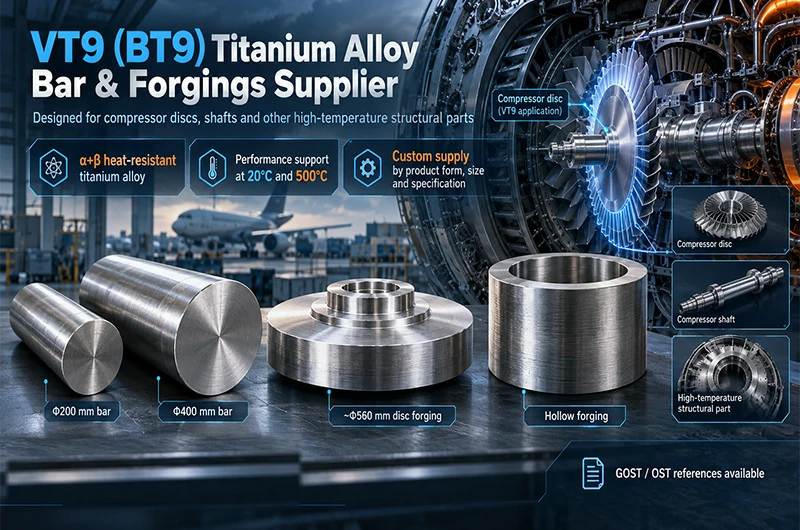
We supply large-diameter VT9 titanium bars, forging stock, and disc, shaft, and hollow forgings. Existing product examples include Φ200 mm and Φ400 mm bars, approximately Φ560 mm disc forgings, and thick-wall hollow forgings with variable cross-sections. Corresponding room-temperature and elevated-temperature mechanical property data are available for subsequent forging, machining, and high-temperature component projects.
For projects with defined drawings or purchasing specifications, the supply plan can be confirmed based on product form, dimensions, mechanical property requirements, and applicable GOST / OST specifications.
VT9 Titanium Bar & Forging Products
-
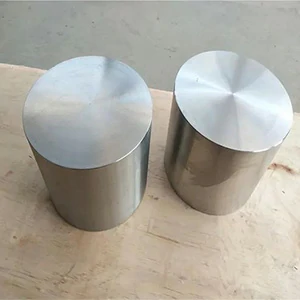 Large-Diameter VT9 Titanium Bar
We supply VT9 round bar and forging stock for large discs, shafts, and other forged components, suitable for subsequent forging and machining.
- Product Sizes: Φ200 mm, Φ400 mm
- Delivery Specification: Confirmed according to product size and customer project technical requirements
- Mechanical Property & Inspection Data: Macrostructure examination results for Φ400 mm bar and mechanical property data at 20°C / 500°C
Suitable as starting stock for compressor discs, shafts, and other large high-temperature load-bearing forgings.
-
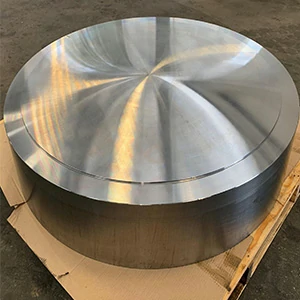 VT9 Disc Forgings
We supply VT9 disc forgings primarily for rotating components requiring high-temperature strength and load-bearing capability.
- Product Size: ≤Φ560 mm
- Reference Specification: OST 1 90197 / customer drawings and project technical requirements
- Mechanical Property & Inspection Data: Tensile strength, 0.2% proof strength, elongation, and other mechanical property data at room temperature and 500°C
Typical applications include aero-engine compressor discs and other high-temperature load-bearing disc components.
-
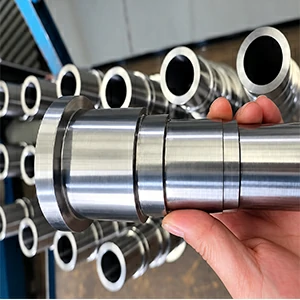 VT9 Shaft Forgings
We supply VT9 shaft forgings and machining stock. Cross-sections and machining allowances can be matched to the final component geometry.
- Product Forms: Solid and variable-section shaft forgings
- Reference Specification: OST 1 90197 / customer drawings and project technical requirements
- Mechanical Property & Inspection Data: Mechanical property data at room temperature and 500°C
Suitable for aero-engine rotor shafts, high-temperature shaft components, and other structural parts requiring both strength and elevated-temperature load-bearing capability.
-
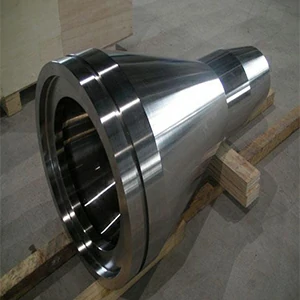 VT9 Hollow / Tubular Forgings
We supply thick-wall, hollow, and variable-section VT9 forgings for subsequent machining into hollow shafts, thick-wall structural parts, and other complex load-bearing components.
- Product Example: Thick-wall variable-section hollow forging, approximately 1000 mm long
- Supply Form: Hollow forging stock / variable-section forging
- Reference Specification: Customer drawings and applicable project technical requirements
- Mechanical Property & Inspection Data: Mechanical property data at room temperature and 500°C
Unlike conventional thin-wall titanium tubing, these products are primarily thick-wall or variable-section structures produced by forging and are better suited as machining stock for high-strength structural components.
VT9 (BT9) Grade and Chemical Composition
VT9 (BT9 / ВТ9) is a Ti-Al-Mo-Zr-Si α+β heat-resistant titanium alloy with the following typical nominal composition:
Ti-6.5Al-3.5Mo-1.5Zr-0.3Si
| Element | Content |
| Al | 5.8–7.0% |
| Mo | 2.8–3.8% |
| Zr | 1.0–2.0% |
| Si | 0.20–0.35% |
| Fe | ≤0.25% |
| O | ≤0.15% |
| N | ≤0.05% |
| H | ≤0.015% |
| Ti | Balance |
VT9 is valued not only for its high room-temperature strength, but more importantly for maintaining a strong overall mechanical property profile under load at around 500°C. This is a key reason for its long-standing use in high-temperature aero-engine compressor components.
VT9 Mechanical Properties at 20°C and 500°C
VT9's key material advantage is its strength retention at elevated temperature. For aero-engine compressor components and similar high-temperature load-bearing parts, room-temperature properties provide only a baseline; strength retained at 500°C is more directly relevant to application suitability.
Mechanical property data for the existing product examples are shown below. Final delivery requirements shall be based on the actual material certificate, heat-treatment condition, sampling location, and purchasing specification:
| Product Form | Tensile Strength at 20°C | 0.2% Proof Strength Rp0.2 at 20°C | Tensile Strength at 500°C | 0.2% Proof Strength Rp0.2 at 500°C |
| Φ200 mm Bar | 1150–1160 MPa | 1020–1040 MPa | 840 MPa | 660–675 MPa |
| Φ400 mm Bar | ≈1130 MPa | 1030–1040 MPa | ≈815 MPa | ≈650 MPa |
| Disc Forging | 1030–1060 MPa | 935–960 MPa | 715–725 MPa | 560–570 MPa |
| Shaft Forging | ≈1070 MPa | ≈967 MPa | 735–765 MPa | 615–625 MPa |
| Hollow / Tubular Forging | ≈1065–1075 MPa | 949–957 MPa | 750–755 MPa | ≈590 MPa |
The available data show that both Φ200 mm and Φ400 mm large-diameter bars maintain approximately 1100 MPa tensile strength at room temperature and around 500°C still retain approximately 800 MPa tensile strength.
For subsequently processed disc, shaft, and hollow forgings, mechanical properties vary with product form, section size, and processing condition. Therefore, the highest bar values should not be used as a substitute for the final forging requirements.
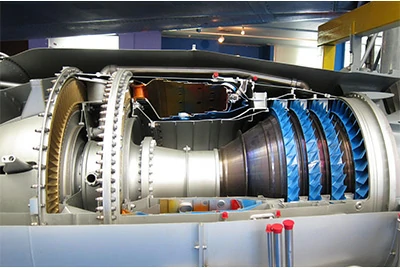
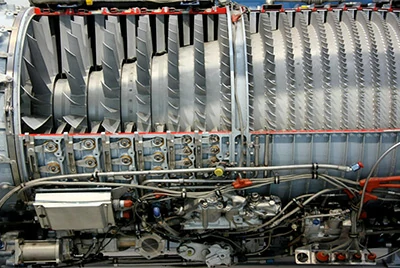
VT9 Applications in Aero-Engine Compressor Systems
VT9 is primarily used in aero-engine compressor components exposed to both high mechanical loads and temperatures around 500°C. Because different components require different starting material forms and manufacturing routes, material selection should consider not only the VT9 grade but also whether bar, forging stock, or forgings are appropriate for the final component.
Compressor Discs
Compressor discs operate under high temperature and high rotational speed, with significant centrifugal loading. Key considerations include elevated-temperature strength, cross-sectional macrostructure of the disc stock, and post-forging properties.
Typical input: Large-Diameter VT9 Bar / Disc Forging Stock / Disc Forging
Typical Manufacturing Route:
Large-Diameter Bar / Billet → Forging → Heat Treatment → Machining → Compressor Disc
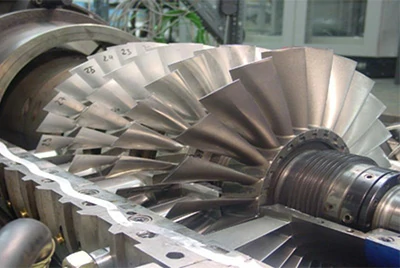
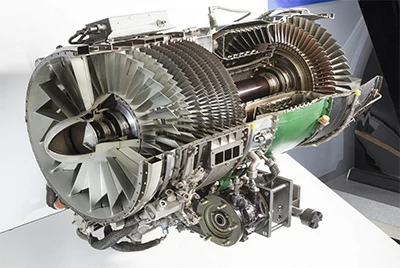
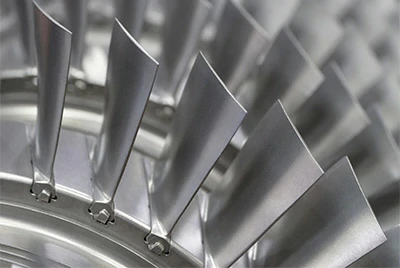
Compressor Blades
Compressor blades are subjected to high rotational speed, vibration, cyclic loading, and elevated temperatures. Key considerations include elevated-temperature strength, fatigue performance, forgeability, and microstructure after heat treatment.
Typical material route: VT9 Bar / Forging Stock
Typical Manufacturing Route:
Bar / Forging Stock → Blade Forging → Heat Treatment → Precision Machining → Surface Finishing
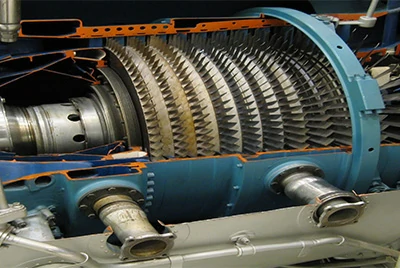
Rotor and Shaft Components
Engine rotors and shaft components typically experience rotational loads, axial loads, and thermal cycling. Material selection must balance strength, ductility, elevated-temperature load-bearing capability, and internal quality in large forgings.
Typical input: VT9 Bar / Shaft Forging Stock / Shaft Forging
Typical Manufacturing Route:
Bar / Billet → Shaft Forging → Heat Treatment → Machining → Rotor / Shaft Component
VT9 Standards and Specifications
VT9 grade chemistry, bars, and forgings are governed by different technical specifications. For procurement, the applicable GOST / OST or project-specific technical requirements should be confirmed based on the actual product form, dimensions, and project documentation.
| Product / Requirement | Typical Standard |
| VT9 alloy grade & chemical composition | GOST 19807-91 |
| Hot-rolled titanium bar | GOST 26492-85 |
| Φ400 mm bar / special large-section products | Applicable project specification / technical conditions |
| Forged titanium bar / forging stock | OST 1 90107-73 |
| Disc & shaft forgings | OST 1 90197-89 / project specification |
When requesting a quote, please provide the product form, dimensions, quantity, and the GOST / OST, heat-treatment, mechanical property, and inspection requirements specified in the drawing or purchasing documents. Final delivery conditions shall follow the customer's specified standard and project technical documents.
VT9 vs Ti-6242S: High-Temperature Titanium Alloy Comparison
VT9 and Ti-6242S are both used for high-temperature load-bearing aero-engine compressor components such as discs and blades at around 500°C. For projects comparing Ti-6242S with other high-temperature titanium alloys, VT9 can be evaluated as a candidate material.
| VT9 (BT9) | Ti-6242S | |
| Nominal Composition | Ti-6.5Al-3.5Mo-1.5Zr-0.3Si | Ti-6Al-2Sn-4Zr-2Mo-Si |
| Temperature Class | Approx. 500°C | Approx. 500°C |
| Typical Applications | Compressor discs, blades, shafts | Compressor discs, blades, impellers |
| Direct Equivalent | — | No |
Although the two alloys have similar application positioning, their chemical compositions and alloy designs differ, so they are not direct equivalents. Final material selection should be based on operating temperature, mechanical property requirements, and the applicable material specification.
Comparing VT9 and Ti-6242S? Send us your material specification for review.
Request a VT9 Titanium Quote
If you are sourcing VT9 / BT9 titanium bar, forging stock, or disc / shaft / hollow forgings, please provide the following information:
- Product Form: Bar / Disc Forging / Shaft Forging / Hollow Forging
- Dimensions
- Quantity
- GOST / OST or Project Technical Specification
- Heat Treatment
- Mechanical Property Requirements
- Inspection Requirements
- Drawing, if available
For aero-engine, high-temperature rotating component, or material comparison projects, you can also send your current material specification or component drawing. We can review it to confirm the appropriate VT9 product form, dimensions, and supply requirements.
Send Your Specification or Drawing for a VT9 Quote
Chalco can provide you the most comprehensive inventory of titanium products and can also supply you customized products. Precise quotation will be provided within 24 hours.
Get a quote

