

Titanium Fastener Hardness
Updated : Jul. 22, 2026There is no single hardness value for titanium alloy fasteners. The hardness ranges of commercially pure (CP) titanium and Ti-6Al-4V differ significantly, and even within the same grade, readings vary drastically between annealed and solution-treated & aged (STA) conditions.
This article discusses the base metal hardness of titanium bolts, nuts, screws, and rivets-not the surface hardness of TiN/AlTiN coatings (which can reach 81–90 HRC) or titanium cutting edges. These concepts are often confused but are irrelevant to fastener selection.
The following sections cover: typical hardness values by grade, logic for selecting HRC/HRB/HV scales, whether conversion tables apply to titanium, the real relationship between hardness and strength, how hardness relates to galling, and how ASTM and ISO standards address hardness for titanium fasteners.
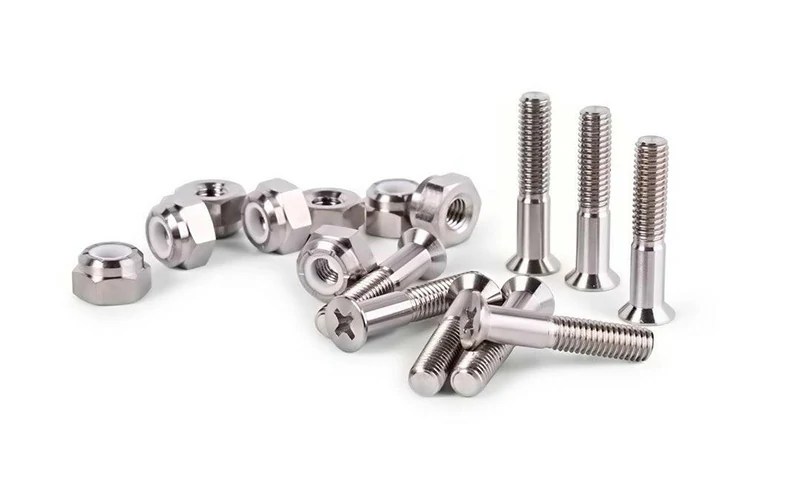
To view products directly, visit our titanium alloy fasteners page.
What can hardness tell you?
Many engineers treat hardness, strength, and wear resistance as interchangeable. Clarifying what hardness actually indicates is essential to avoid focusing solely on numerical comparisons during selection and inspection.
Hardness fundamentally measures a material's resistance to indentation. It reflects heat treatment condition and degree of cold working, making it suitable for batch consistency checks and anomaly screening-serving as a quick initial assessment tool when receiving a shipment of fasteners.
However, hardness does not equate to tensile strength, yield strength, or shear strength, nor can it replace thread or dimensional inspections. Passing a hardness test does not guarantee overall fastener performance compliance.
It should be noted upfront that in major fastener standards like ASTM F468/F467, titanium alloy hardness results are typically "for reference only"-tensile testing remains the acceptance criterion.
| Hardness can indicate | Hardness cannot confirm |
| Heat treatment condition | Ultimate tensile load capacity |
| Batch heat treatment consistency | Fatigue life |
| Cold working variation | Thread fit accuracy |
| Localized or surface variations | Suitability for specific service conditions |
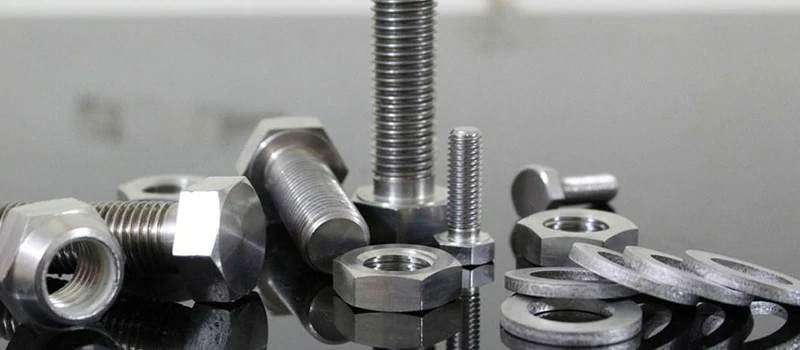
Typical hardness by grade and condition
This is the core information most engineers seek. The values below are for preliminary selection reference only-not final acceptance limits. Always rely on drawings, product specifications, and MTC (Mill Test Certificate) for verification.
CP Grade 1 (UNS R50250): ~70–80 HRB. Softest grade, offering the best corrosion resistance and formability.
CP Grade 2 (UNS R50400 / EN 3.7035): ~80 HRB (~140–200 HV). Balanced medium strength with superior corrosion resistance, commonly used in chemical and marine environments.
Grade 9 (Ti-3Al-2.5V / UNS R56320): Annealed condition ~24–30 HRC. Medium strength, frequently used in tubing and fasteners.
Grade 5 (Ti-6Al-4V / UNS R56400 / EN 3.7165): Annealed ~30–34 HRC (~300–340 HV); solution-treated & aged (STA) ~35–39 HRC (~350–380 HV). The most widely used titanium fastener grade.
Grade 23 (Ti-6Al-4V ELI / UNS R56401): Hardness range similar to Grade 5, but with lower oxygen content and better biocompatibility, primarily used in medical devices.
| Grade | UNS / EN | Heat Treatment Condition | Typical Hardness | Procurement Notes |
| CP Grade 1 | R50250 | Annealed | ~70–80 HRB | Softest; best corrosion resistance/formability |
| CP Grade 2 | R50400 / 3.7035 | Annealed | ~80 HRB (~140–200 HV) | State condition explicitly |
| Grade 9 | R56320 | Annealed | ~24–30 HRC | Medium strength; used in tubing & fasteners |
| Grade 5 | R56400 / 3.7165 | Annealed | ~30–34 HRC (~300–340 HV) | Do not mix with STA data |
| Grade 5 | R56400 | STA | ~35–39 HRC (~350–380 HV) | Heat treatment route affects values |
| Grade 23 | R56401 | Annealed | ~30–36 HRC | Low oxygen; medical/cryogenic use |
Three key points about this table:
First, typical values support early-stage selection discussions; acceptance ranges are defined by drawings and standards-these are not the same.
Second, hardness can differ significantly for the same grade under different heat treatment conditions-annealed and STA hardness values for Grade 5 must not be interchanged.
Third, hardness data from raw bar stock may not exactly match measured values on finished fasteners-a point explained later.
Chalco integrates titanium mill capabilities with CNC and cold-heading processing to supply bolts, nuts, screws, and rivets across multiple grades and specifications.
Is titanium "too soft"? understanding hardness vs. strength
This is one of the most frequently asked questions-and one of the most important misconceptions to clarify.
Let's acknowledge a fact: titanium fasteners are indeed softer than hardened alloy steels, which can exceed 50 HRC, whereas Grade 5 typically ranges only 35–40 HRC.
But critically, hardness measures resistance to indentation-it is not equivalent to tensile strength or load-bearing capacity. Grade 5 achieves tensile strengths of approximately 900–1100 MPa, comparable to steel fasteners rated at property classes 8.8–10.9.
As for "Does titanium break easily?"-fracture depends on toughness and tensile strength, not hardness. Grade 5 combines high strength with good ductility; lower hardness does not imply brittleness.
Another systemic difference is worth noting: steel fasteners follow standardized mechanical property classes (e.g., 8.8, 10.9, 12.9 per ISO 898-1), each linked to defined hardness ranges.
Titanium fasteners do not use this classification system-they are specified by grade under ASTM F468/F467, where hardness is "for reference only" and tensile testing governs acceptance. This explains why titanium bolts are never marked "10.9 class" like steel counterparts.
Titanium's true advantage lies in its strength-to-density ratio: with a density about 60% that of steel, it offers significant weight savings at equivalent strength levels.
Thus, selection logic isn't "harder is better." Choose Grade 5 for high-load applications and CP grades when corrosion resistance is prioritized. It's also honest to say that for extreme wear resistance, edge retention, or high contact stress, hardened steel remains more suitable. For full strength comparisons, refer to our titanium fastener strength page.
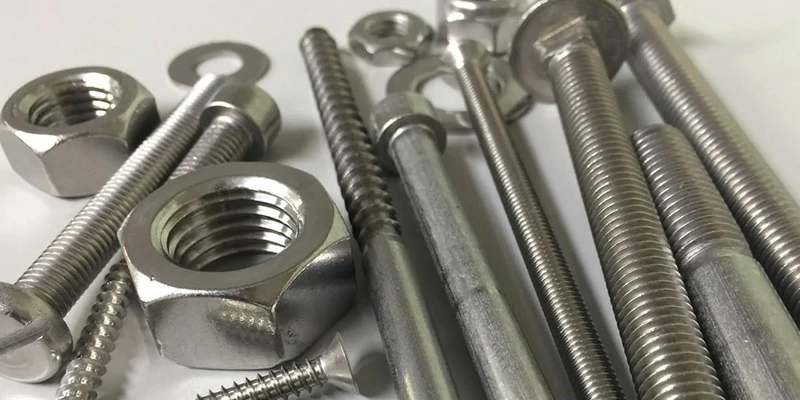
HRC, HRB, or HV? how to choose the right scale
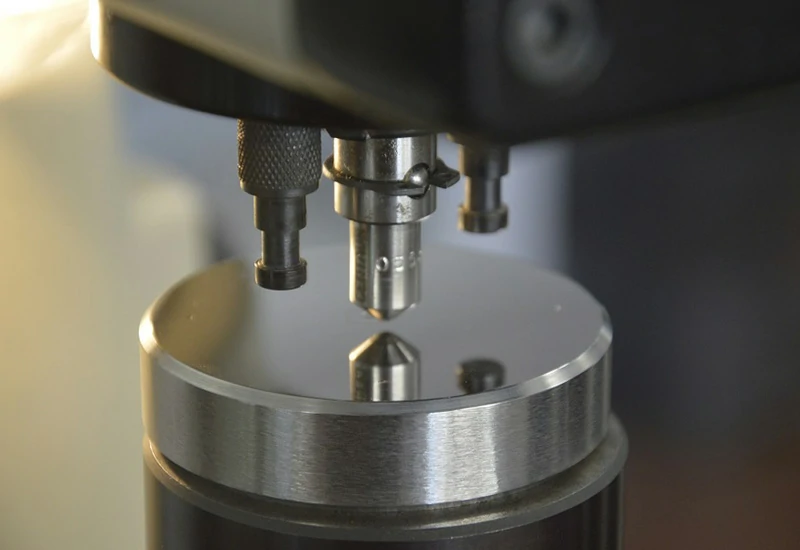
Small fasteners often lack sufficiently large flat surfaces for standard Rockwell testing, and scale selection directly impacts result reliability.
HRC applicability: Suitable for higher-hardness titanium grades, but requires adequate thickness and a flat surface. Threaded areas and small curved surfaces are generally unsuitable for HRC.
HRB applicability: Appropriate for softer CP grades or annealed titanium, provided thickness and surface requirements are met.
HV advantage: Vickers hardness (HV) allows smaller indentations and precise targeting of cross-sections or localized areas, making it more practical for small fasteners. Test reports must specify the load (e.g., HV5 or HV10).
When microhardness is needed: Use microindentation (micro-Vickers) for miniature screws, thin-walled parts, hardness gradient analysis across cross-sections, or localized testing near threads/surfaces.
ASTM E384 covers such tests, but note that smaller indentations demand higher precision and repeatability.
| Product Condition | Recommended Method | Primary Considerations |
| Large bolt head with flat surface | Rockwell (if conditions permit) | Thickness and surface condition |
| Small screws | Vickers | Indent location |
| Metallographic cross-section | Micro-Vickers | Sample preparation and test load |
| Curved surfaces | Method correction or cross-section testing | Geometric error |
It's incorrect to assume "HV is more accurate than HRC." The appropriate method depends on part size, surface condition, hardness range, and inspection purpose.
Can steel hardness conversion tables be used for titanium alloys?
This is an often-overlooked issue that can significantly affect acceptance decisions, especially when test reports use different hardness scales.
Conversions are empirical relationships, not mathematical calculations. Published research confirms: hardness lacks a universal physical dimension, so exact mathematical conversion between scales is impossible. Conversions rely on material-specific empirical data, meaning even seemingly precise formulas carry inherent error margins.
Conversion tables depend on elastic modulus. Research also shows: common hardness conversion tables are developed for steel (elastic modulus ~210 GPa) and are not fully applicable to materials with significantly different moduli. Titanium alloys have an elastic modulus of only ~104–116 GPa-substantially lower than steel-so applying steel-based conversion tables to titanium introduces larger errors.
Standard conversion tables typically list only "Steel" and "Soft Metal" columns, with no dedicated entry for titanium. Using steel-column values as acceptance criteria for titanium fasteners is inappropriate.
Field-portable measurements differ from lab results. Published studies also note: portable field hardness testers (e.g., Leeb hardness meters) exhibit systematic deviations from laboratory benchtop instruments, influenced by test location and surface condition.
This means field quick-test values may differ from lab-reported values on the MTC; acceptance should be based on direct testing using the specified method.
Note: Do not use steel hardness conversion charts as the final acceptance basis for titanium fasteners.
Formal test reports should prioritize retaining the original test results, such as 342 HV10. If the purchase documentation permits conversion, the source of the conversion chart, applicable material category, and heat treatment condition must be clearly stated.
ASTM E140 itself provides separate conversion charts by material category (steel, nickel alloys, copper, aluminum, etc.), which precisely illustrates that conversion relationships are material-specific-different materials require different charts.
| Reported Result | Can It Be Converted? | Acceptable for Final Acceptance? |
| Convert HV to HRC using steel conversion chart | For approximate reference only | No |
| Direct HV measurement under specified load | No conversion needed | Yes, if required by specification |
| Field portable instrument reading | May deviate from laboratory values | Laboratory benchtop instrument verification recommended |
Why does the same grade exhibit different hardness values?
This is a common point of confusion for quality and procurement personnel: why don't the values reported by suppliers, those on raw material certificates, and incoming inspection results match?
Systematically reviewing potential causes is often more useful than immediately concluding supplier quality instability."
Different heat treatment conditions: annealing, stress relieving, and solution treatment and aging (STA) are three entirely distinct conditions and cannot share the same hardness values. This is the most frequent cause.
Cold heading and thread rolling: cold forming and thread rolling can alter the local material condition compared to the original bar stock, potentially causing work hardening in certain areas.
Different test locations: readings can vary between the bolt head, shank, thread root, and cross-section. Published studies have documented hardness differences between the end and midsection of the same bolt-therefore, drawings should explicitly specify the test location.
Surface preparation differences: polished and ground surfaces may yield different readings. Studies show that polished surfaces typically produce slightly higher values than ground surfaces.
Instrument differences: systematic deviations exist between portable field instruments and laboratory benchtop equipment. Device calibration and standard hardness blocks also affect results.
Hardness and galling
Galling is a frequent and real issue during titanium fastener assembly, directly related to hardness.
Friction between threads during tightening generates heat, disrupting titanium's natural oxide film. The exposed metal undergoes micro-welding under pressure, causing threads to seize. Titanium's oxide film is relatively soft and easily damaged under high friction, especially in titanium-on-titanium (Ti-on-Ti) mating, which carries the highest risk.
Hardness plays a role here: maintaining at least a 50 HB difference between bolt and nut helps reduce galling tendency. Mating titanium components with identical hardness represents the most hazardous condition.
Preventive measures include applying dry-film lubricants or anti-seize compounds, controlling tightening torque, keeping threads clean, and selecting nut materials with different hardness than titanium. This is a process-controllable issue, not an inherent flaw in titanium material. A complete prevention protocol can be found on the titanium fastener galling prevention page.
Hardness in standards, and surface vs. core considerations
Procurement and quality personnel typically need clarity on two points: how standards address hardness, and what it means when surface and core hardness differ.
Product specifications and test method standards are distinct. ASTM F468/F467 are product specifications defining material composition and finished mechanical property requirements; ASTM E18, E92, E384 and ISO 6507-1, ISO 6508-1 are test method standards specifying how to measure hardness. Referencing a test method standard does not imply product certification.
Key provisions of ASTM F468/F467: for titanium (and aluminum) alloys, hardness test results are for information only," and tensile testing is the acceptance criterion; when both tensile and hardness tests are performed, tensile results govern. Current versions are ASTM F468-23(2026) and ASTM F467-24(2026), covering eight titanium grades: Grade 1, 2, 4, 5, 7, 19, 23, and 32.
Differences between surface and core hardness do not necessarily indicate a quality issue. In standard practice for steel fasteners, the surface-to-core hardness difference serves as an indicator of heat treatment quality (e.g., degree of surface decarburization/carburization) but does not directly reflect overall mechanical properties. Therefore, nonconformance cannot be determined solely based on surface/core hardness discrepancies.
The corresponding phenomenon in titanium alloys is alpha case (oxygen-enriched hardened surface layer): inadequate atmosphere protection during high-temperature processing or heat treatment causes titanium to form a hard, brittle, oxygen-rich alpha case on the surface, leading to abnormally high surface hardness that must be removed per process specifications. This differs conceptually from steel decarburization/carburization and should not be confused with it.
| Standard | Category | Controlled Content |
| ASTM F468-23(2026) / F467-24(2026) | Product Specification | Titanium hardness for information only; tensile test is acceptance criterion |
| ASTM E18 / E92 / E384 | Test Method | Rockwell / Vickers·Knoop / Microindentation |
| ASTM E140 | Hardness Conversion | Provides conversion charts by material category |
| ISO 6507-1 / 6508-1 | Test Method | Vickers / Rockwell |
Chalco can supply products as required to support compliance with the above standards (when specified).
Quick selection by application
| Application Scenario | Recommended Grade | Target Hardness | Reference Standard |
| General High-Strength Fasteners | Grade 5 | 30–40 HRC | ASTM F468/F467 |
| Chemical/Marine Corrosion Resistance | CP Grade 2 / Grade 7 | ~80 HRB | ASTM F468/F467 |
| Tubing / Medium Strength / Bicycle | Grade 9 | ~24–30 HRC | Per Drawing |
| Aerospace High Fatigue | Grade 5 + Shot Peening | 35–40 HRC | AMS / F468 |
| Medical Devices | Grade 23 | ~30–36 HRC | ASTM F136 / F468 |
Final selection should consider specific application, load requirements, and drawing specifications.
How to specify hardness in RFQs or drawings, and how to verify reports
This helps translate the knowledge above into practical procurement and quality management actions.
Hardness-related information to include in RFQs or drawings:
- Fastener type (bolt/screw/stud/nut)
- Titanium grade
- Material specification (e.g., ASTM F468)
- Material heat treatment condition (annealed/STA, etc.)
- Thread specification and dimensions
- Required hardness range and scale
- Test method (ASTM or ISO)
- Test load (must be specified for Vickers hardness, e.g., HV10)
- Test location
- Sampling plan
- Conversion allowed (yes/no)
- Required documentation (MTC / test report / heat treatment records)
Each item matters: specifying grade and condition defines the expected hardness range; defining test method, load, and location avoids the conversion bias and positional variation discussed earlier; clarifying documentation requirements enables supplier traceability.
Frequently asked questions
What is the hardness of titanium?
There is no single answer. CP grades are approximately 80 HRB, while Grade 5 ranges from 30–40 HRC, depending on grade and heat treatment condition.
What is titanium hardness in HRC?
Grade 5 in annealed condition is approximately 30–34 HRC; in solution treated and aged condition, it is approximately 35–39 HRC. Softer CP grades are typically expressed in HRB (~80 HRB) and are unsuitable for HRC scale.
Are titanium bolts as strong as steel bolts?
Grade 5 has a tensile strength of approximately 900–1100 MPa, comparable to property class 8.8–10.9 steel bolts, with about 40% less weight. Lower hardness does not equate to lower strength.
Is titanium prone to breaking?
Low hardness does not mean brittleness. Fracture depends on toughness and tensile strength; Grade 5 possesses both and is not prone to breaking under normal loads.
What is the typical hardness of Grade 5 titanium fasteners?
There is no single value independent of heat treatment condition: annealed condition is approximately 30–34 HRC; solution treated and aged condition is approximately 35–39 HRC. Final acceptance follows drawings and standards.
Can titanium HV hardness be converted to HRC?
Approximate conversion is possible, but it is not an exact mathematical conversion; steel conversion charts are not applicable to titanium due to differences in elastic modulus. Acceptance should prioritize direct test values obtained via specified methods.
Does ASTM F468/F467 impose mandatory hardness requirements for titanium fasteners?
For titanium alloys, hardness test results are for information only"; tensile testing is the acceptance criterion.
Titanium knives are marked 65 HRC-can titanium fasteners achieve this?
No. The high hardness values on knives refer to surface coatings such as TiN/AlTiN (reaching 81–90 HRC), not the titanium base metal. Titanium fastener base metal hardness is approximately 30–40 HRC (Grade 5)-these are entirely different concepts.
Contact Chalco for Specification Review
If you are selecting titanium fasteners for an assembly project, please submit your drawings, grade requirements, heat treatment condition, dimensional specifications, target hardness range, and applicable standards. We will provide matched grade recommendations and MTC.
Chalco can supply bolts, nuts, screws, and rivets in multiple grades per specification.


